
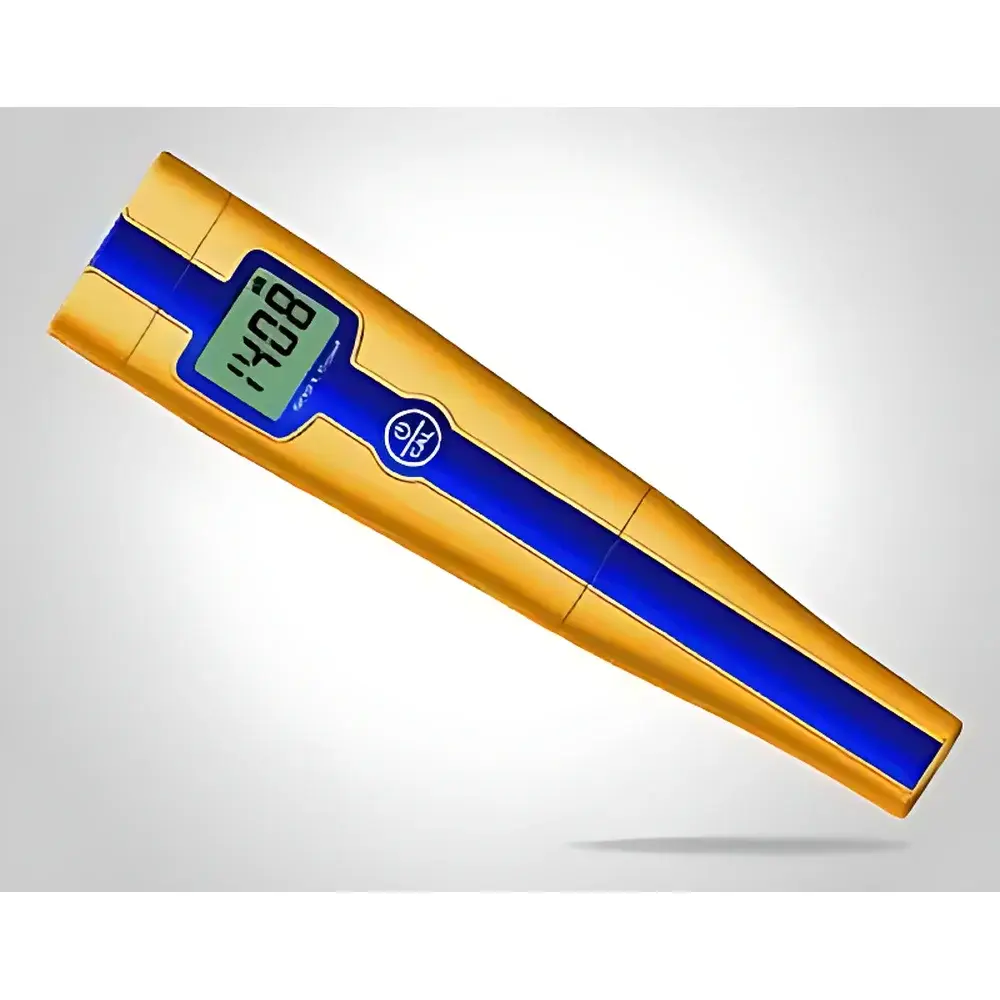
SANXIN 5021 Pocket-Sized Conductivity Tester
| Brand | SANXIN |
|---|---|
| Model | 5021 |
| Measurement Range | 0–10.00 mS/cm (auto-ranging across three segments: 0–99.9 μS/cm, 100–999 μS/cm, 1.00–10.00 mS/cm) |
| Resolution | 0.1/1 μS/cm |
| Accuracy | ±1% FS |
| Temperature Compensation | 5–50 °C (automatic, NTC 30 kΩ) |
| Calibration | Single-point auto-calibration with 1413 μS/cm standard solution |
| Power Supply | Two AAA batteries (1.5 V × 2) |
| Dimensions | 39 × 25 × 176 mm |
| Weight | 87 g |
| Ingress Protection | IP57 |
| Origin | Shanghai, China |
| Manufacturer | SANXIN Peirui Instrument Co., Ltd. |
Overview
The SANXIN 5021 Pocket-Sized Conductivity Tester is a compact, handheld electrochemical instrument engineered for rapid, field-deployable measurement of aqueous solution conductivity. Based on two-electrode AC conductivity sensing architecture, it operates at a fixed frequency to minimize polarization effects and electrode fouling—ensuring stable readings in routine water quality checks, process monitoring, and educational laboratory environments. Its design adheres to fundamental principles of conductometric analysis: conductivity (κ) is derived from the measured conductance (G) normalized by the cell constant (Kcell), where κ = G × Kcell. The device employs a factory-calibrated, fixed-geometry graphite electrode pair with a nominal Kcell of 1.0 cm−1, optimized for general-purpose use without user-adjustable cell constant input. Unlike benchtop meters, the 5021 prioritizes portability and operational simplicity over multi-parameter expansion or advanced data logging—making it suitable for spot-checking drinking water, aquariums, hydroponic nutrient solutions, boiler feedwater, and pre-filtration stages in small-scale purification systems.
Key Features
- Auto-ranging measurement across three overlapping ranges: 0–99.9 μS/cm, 100–999 μS/cm, and 1.00–10.00 mS/cm—eliminating manual range selection errors
- Automatic temperature compensation (ATC) using an integrated NTC thermistor (30 kΩ @ 25 °C), compliant with ISO 7888 and ASTM D1125 reference methodologies for standardized reporting at 25 °C
- Single-point calibration routine using certified 1413 μS/cm KCl standard (traceable to NIST SRM 3601), supporting routine verification per GLP documentation requirements
- IP57-rated enclosure—dust-protected and submersible up to 1 m for 30 minutes—enabling reliable use in humid industrial settings or outdoor sampling locations
- Low-power electronics architecture delivering >100 hours of continuous operation on two standard AAA alkaline cells, with automatic power-off after 10 minutes of inactivity
- Ergonomic pen-form factor (39 × 25 × 176 mm; 87 g) designed for one-handed operation and pocket storage, with tactile button feedback and LCD contrast optimized for ambient lighting conditions
Sample Compatibility & Compliance
The 5021 is validated for use with low-to-moderate ionic strength aqueous samples including potable water, surface water, wastewater effluents (pre-treatment), nutrient solutions, and mild industrial process streams. It is not intended for high-salinity brines (>20 mS/cm), organic solvents, viscous liquids, or suspensions containing particulates >50 µm. Electrode geometry limits effective use in foaming or aerated media. The instrument complies with IEC 61010-1:2010 for electrical safety in laboratory equipment and meets RoHS Directive 2011/65/EU for hazardous substance restrictions. While not certified for ATEX or IECEx zones, its non-sparking circuitry and sealed housing support safe deployment in non-hazardous Class I, Division 2 environments per NEC guidelines.
Software & Data Management
The SANXIN 5021 operates as a standalone, embedded-system device with no Bluetooth, USB, or PC connectivity. All measurements are displayed in real time on a 3½-digit LCD with dual-unit indication (μS/cm or mS/cm). No internal memory or timestamping is implemented; users must manually record results. However, its calibration protocol and ATC algorithm conform to traceability frameworks required under ISO/IEC 17025:2017 Clause 7.7 (sampling and measurement traceability) when paired with documented standard solution lot numbers and environmental condition logs. For laboratories operating under FDA 21 CFR Part 11 or EU Annex 11, the 5021 may serve as a secondary verification tool—provided calibration events, operator ID, and environmental notes are maintained in controlled paper-based or LIMS-integrated records.
Applications
- Routine QC checks of municipal tap water and bottled water compliance with WHO Guideline Limits (≤2500 μS/cm)
- Monitoring conductivity drift in reverse osmosis (RO) permeate lines to detect membrane integrity loss
- Verifying nutrient concentration stability in controlled-environment agriculture (CEA) and aquaponics systems
- Field assessment of stormwater runoff conductivity as a proxy for chloride or heavy metal contamination
- Teaching core electrochemical concepts—including Ohm’s law in electrolytes, Kohlrausch’s law of independent migration, and temperature dependence of ion mobility—in undergraduate chemistry labs
- Pre-screening of cleaning validation rinse water in pharmaceutical manufacturing (non-GMP critical use only)
FAQ
What is the recommended calibration frequency for routine use?
For daily field use, calibrate before the first measurement and after any significant temperature shift (>5 °C). In stable lab environments with infrequent use, weekly calibration suffices—always verify against fresh 1413 μS/cm solution.
Can the 5021 measure TDS directly?
No. It reports conductivity only. TDS estimation (e.g., ppm) requires user-applied conversion factors (typically 0.5–0.7 × conductivity in μS/cm), which vary by sample matrix and are not embedded in firmware.
Is the electrode replaceable or serviceable?
The sensor is integrated and non-user-replaceable. If performance degrades due to coating or damage, the entire unit must be replaced per manufacturer specifications.
Does the device store calibration history or date stamps?
No. It retains no persistent memory. All calibration actions are ephemeral and unlogged.
How does IP57 rating impact maintenance protocols?
After exposure to splashes or brief immersion, rinse the probe tip with deionized water and dry with lint-free tissue. Avoid ultrasonic cleaning or alcohol immersion, which may degrade the epoxy sensor seal.





