
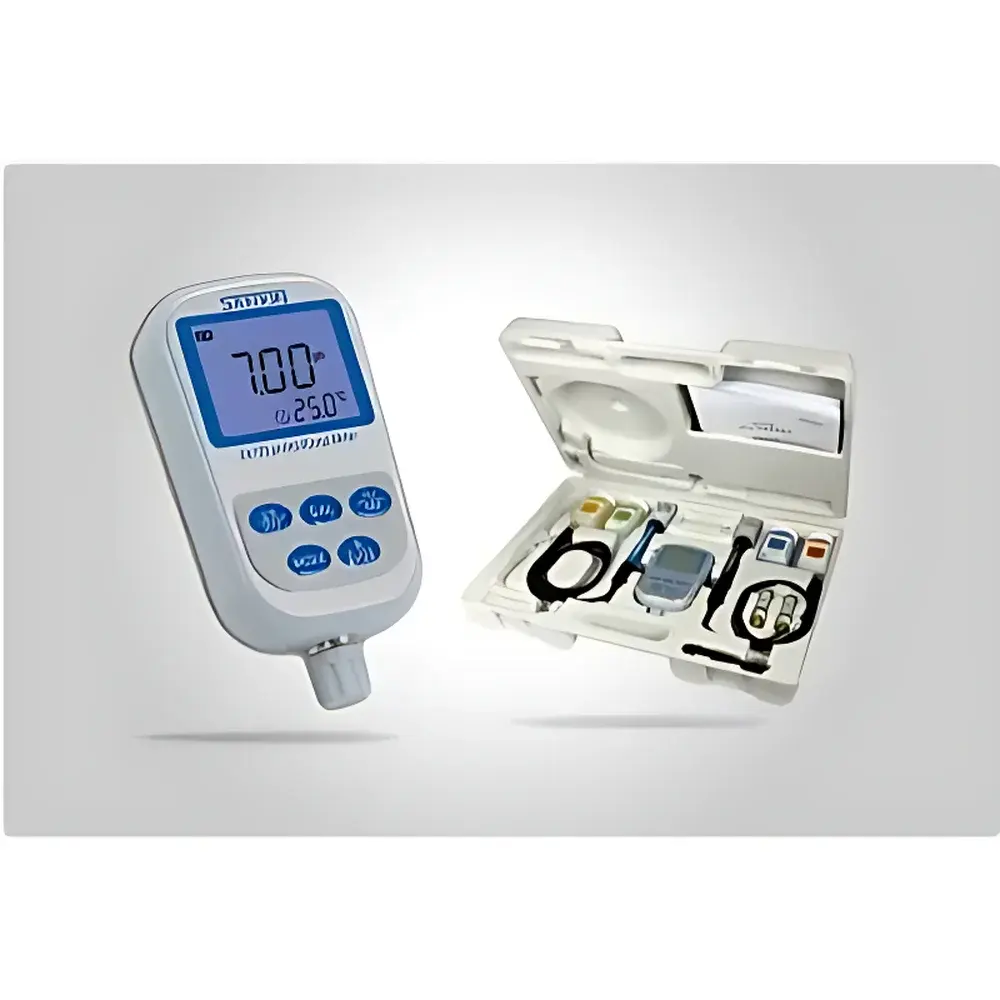
SANXIN SX723 Portable pH/mV/Conductivity Meter
| Brand | SANXIN |
|---|---|
| Origin | Shanghai, China |
| Manufacturer Type | Direct Manufacturer |
| Product Category | Domestic (China-made) |
| Model | SX723 |
| Instrument Type | Portable/Handheld Water Quality Analyzer |
| Measured Parameters | pH, ORP (mV), Conductivity, TDS, Salinity, Resistivity, Temperature |
| Measurement Ranges | pH (-2.00–19.99), ±0.01 pH accuracy |
| Temp. compensation | 0–100 °C (pH), 0–50 °C (conductivity) |
| Data Storage | 300 sets |
| Power | 2 × AA batteries (1.5 V) |
| Dimensions & Weight | Meter: 65 × 120 × 31 mm / 180 g |
| Carrying Case | 360 × 270 × 76 mm / 1.5 kg |
| Ingress Protection | IP57 |
| Electrode Interface | 8-pin waterproof connector with automatic electrode recognition |
Overview
The SANXIN SX723 Portable pH/mV/Conductivity Meter is an integrated, field-deployable electrochemical analyzer engineered for high-reliability measurement of multiple water quality parameters in real-time. It operates on fundamental potentiometric and conductometric principles: pH and ORP are determined via Nernstian potential response across ion-selective and redox-sensitive electrodes; conductivity is measured using a four-electrode (or two-electrode, depending on cell configuration) AC excitation method to minimize polarization error and electrode fouling effects. Temperature compensation is applied algorithmically using built-in thermistor data, conforming to standard linear or non-linear (e.g., CaCO₃-based) compensation models per ISO 7888 and ASTM D1125. Designed for rugged outdoor use, the SX723 meets IP57 ingress protection requirements—ensuring operational integrity under rain exposure and temporary immersion (up to 1 m for 30 min)—making it suitable for environmental monitoring, municipal water distribution audits, industrial effluent screening, and emergency response fieldwork.
Key Features
- 8-pin waterproof electrode interface enabling plug-and-play compatibility with up to four electrode types (pH, ORP, conductivity, dissolved oxygen—though DO not included in base configuration); instrument auto-detects connected sensor and loads corresponding calibration and range settings.
- Single-point conductivity calibration validated across five overlapping ranges (0.00–19.99 µS/cm to 20.0–199.9 mS/cm), eliminating need for multi-point standards in routine field applications while maintaining traceable accuracy per ISO 17025-compliant calibration practices.
- Integrated ATC (Automatic Temperature Compensation) with dual-range support: 0–100 °C for pH measurements (enabling high-temperature process water analysis) and 0–50 °C for conductivity (aligned with standard reference temperature conventions).
- Intelligent power management including auto-off after 10 minutes of inactivity and low-battery indicator—critical for extended battery life during multi-site surveys without external charging infrastructure.
- Onboard diagnostic system reporting electrode impedance, calibration status, and sensor drift alerts—supporting GLP-aligned field documentation and preventive maintenance scheduling.
Sample Compatibility & Compliance
The SX723 is optimized for aqueous samples ranging from ultrapure water (resistivity mode) to high-salinity seawater (salinity up to 100 ppt) and industrial wastewater (conductivity up to 199.9 mS/cm). Its electrode architecture accommodates variable sample viscosity and particulate load within limits typical of grab-sample field analysis. All measurements comply with internationally recognized methodologies: pH per ISO 10523 and ASTM D1293; conductivity per ISO 7888 and ASTM D1125; TDS and salinity derived from conductivity using standardized conversion factors (NaCl-equivalent). The instrument’s firmware and calibration routines support audit-ready operation in environments governed by EPA Method 120.1, USP , and EU Drinking Water Directive (98/83/EC) field verification protocols.
Software & Data Management
Data acquisition and storage occur entirely onboard: 300 measurement records—including parameter values, timestamp, temperature, electrode ID, and calibration history—are retained in non-volatile memory. Export is facilitated via manual transcription or optional IR/Bluetooth adapter (not bundled). Each stored entry includes metadata required for traceability: date/time stamp, operator ID field (user-entered), and calibration verification flag. While the SX723 does not feature native USB connectivity or cloud synchronization, its structured data format aligns with laboratory information management systems (LIMS) ingestion templates used in municipal water utilities and contract environmental labs conducting ISO/IEC 17025-accredited testing.
Applications
- Field validation of drinking water treatment plant effluent compliance (pH, conductivity, residual chlorine surrogate via ORP).
- Rapid assessment of surface water bodies (rivers, lakes, estuaries) for salinity intrusion, acid mine drainage (low-pH/high-ORP signatures), or nutrient loading indicators (TDS trends).
- Process control monitoring in food & beverage production, pharmaceutical clean-in-place (CIP) rinse validation, and boiler feedwater conditioning.
- Educational use in university environmental science labs for hands-on training in electrochemical sensor theory, calibration hierarchy, and field sampling QA/QC procedures.
- Emergency response deployment during chemical spills or flood events where immediate water safety triage is required.
FAQ
Does the SX723 support GLP-compliant data logging?
Yes—each stored reading includes time/date stamp, calibration status, and sensor identification. While it lacks electronic signature or 21 CFR Part 11 audit trail features, its record structure satisfies basic GLP documentation requirements for field notebooks and internal QA reports.
Can I use third-party electrodes with the 8-pin interface?
No—the interface is proprietary and designed exclusively for SANXIN-certified electrodes (e.g., 201T-S, 301Pt-S, 2301-S). Interchangeability is limited to factory-matched sensor families to ensure accurate auto-recognition and range mapping.
What is the recommended calibration frequency for field use?
Daily calibration is advised before first use and after major environmental shifts (e.g., >5 °C ambient change or transition between freshwater/seawater matrices). Single-point conductivity calibration at 1413 µS/cm is sufficient for most applications per manufacturer validation data.
Is the carrying case included in the standard configuration?
Yes—the rugged molded carrying case (360 × 270 × 76 mm) is supplied with all standard kits, along with buffer solutions (pH 4.00, 6.86, 9.18) and 1408 µS/cm conductivity standard.
How does temperature compensation differ between pH and conductivity modes?
pH compensation uses a full-range Nernst slope correction (0–100 °C), while conductivity applies a fixed 2% per °C coefficient within 0–50 °C, consistent with IEC 60746-3 reference conditions for aqueous electrolyte measurements.
Related Products







