
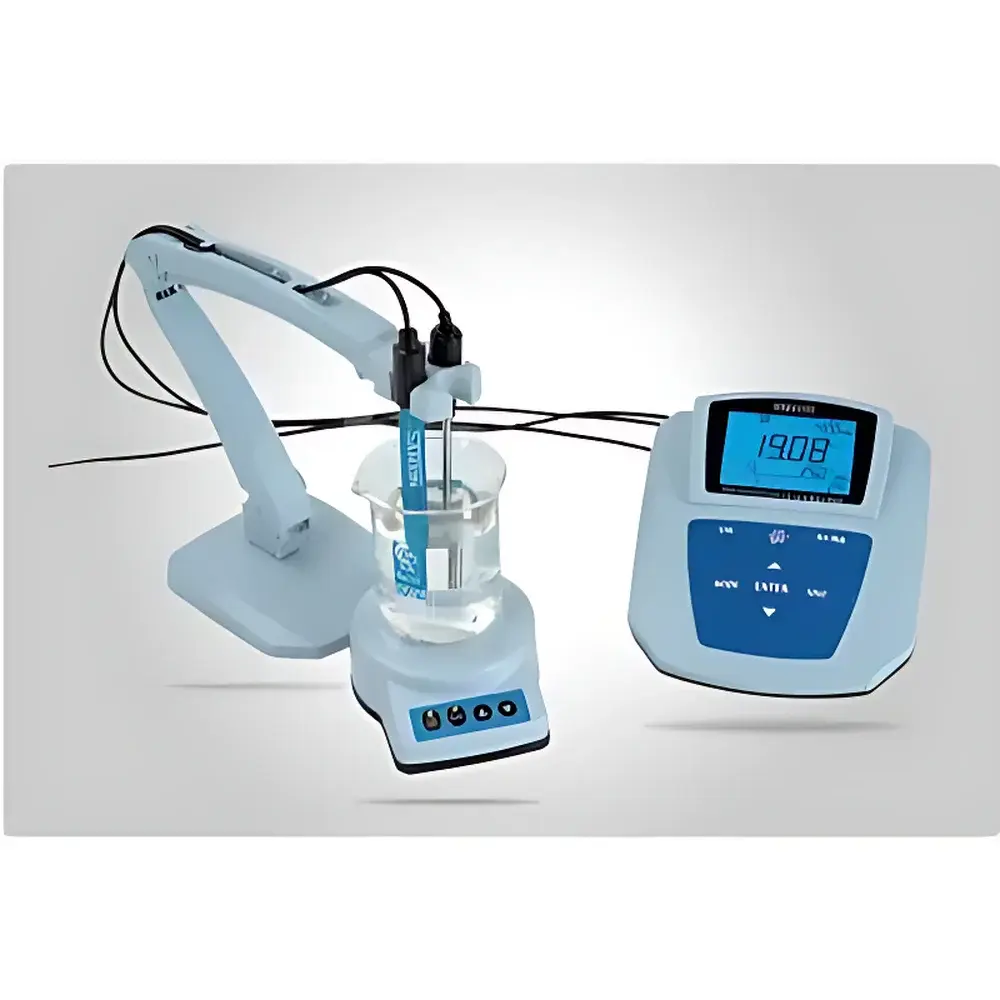
MP523-03 Calcium Ion Concentration Meter
| Origin | Shanghai, China |
|---|---|
| Manufacturer Type | Authorized Distributor |
| Origin Category | Domestic (China) |
| Model | MP523-03 |
| Price | USD 920 (FOB Shanghai) |
| Instrument Type | Multi-Ion Meter |
| pH Range | −2.000 to 19.999 |
| pH Accuracy | ±0.002 pH |
| pH Temp. Compensation | 0–100 °C |
| pCa Range (Meter) | 0.00–9.00 pCa |
| pCa Range (with Electrode) | 1.00–7.00 pCa |
| pCa Accuracy | ±0.01 pCa |
| pCa Temp. Compensation | 0–50 °C |
| mV Range | ±1999.9 mV |
| mV Resolution | 0.1 mV |
| mV Accuracy | ±0.1% FS |
| Temperature Range | −10 to 110 °C |
| Temp. Accuracy | ±0.5 °C (5–60 °C), ±1.0 °C (elsewhere) |
| Data Storage | 600 sets |
| Interface | RS232 |
| Power Supply | DC 9 V / 300 mA |
| Dimensions | 160 × 190 × 70 mm |
| Weight | 880 g |
Overview
The MP523-03 Calcium Ion Concentration Meter is a benchtop, multi-parameter ion analyzer engineered for precise, trace-level quantification of free calcium ions (Ca²⁺) in aqueous environmental and industrial samples. It operates on the principle of potentiometric measurement using a solid-state calcium-selective composite electrode (CA501), generating a Nernstian response proportional to the logarithm of Ca²⁺ activity in solution. The instrument simultaneously supports pH, mV, and temperature measurements—enabling rigorous ionic strength control and automatic temperature compensation critical for accurate ion activity calculations. Designed for compliance with Good Laboratory Practice (GLP) requirements, it delivers high reproducibility in routine water quality monitoring, wastewater treatment process control, boiler feedwater analysis, and groundwater contamination assessment.
Key Features
- Four interchangeable concentration units—pCa, mol/L, mg/L, and ppm—for seamless calibration and real-time result display without manual conversion.
- Dual-point automatic calibration with user-defined standard solutions; includes concentrated pCa 1.00 stock solution (100 mL) for flexible dilution across analytical ranges.
- Integrated intelligent magnetic stirrer (Model 901) with fixed-speed operation to ensure consistent hydrodynamic conditions and minimize boundary layer effects during measurement.
- Comprehensive GLP functionality: timestamped data logging (600 entries), RS232 serial output with MP518 software support, clock-driven measurement scheduling, and built-in self-diagnostic routines.
- Robust enclosure rated IP54 for dust resistance and splash protection; all electrode and cable ports feature silicone caps to prevent moisture ingress and maintain electrical integrity.
- Auto-temperature compensation (ATC) for both pH and pCa channels, with independent sensor inputs (MP500 thermistor probe) and validated accuracy across physiologically and industrially relevant thermal ranges.
Sample Compatibility & Compliance
The MP523-03 is optimized for low- to medium-conductivity aqueous matrices including drinking water, surface water, effluent streams, cooling tower water, and desalination brine pre-treatment samples. It requires use of ionic strength adjuster (ISA) to maintain constant background electrolyte activity—ensuring Nernstian slope stability and minimizing junction potential errors. All measurements adhere to ASTM D511-22 (Standard Test Methods for Calcium in Water) and ISO 10523:2022 (Water Quality — Determination of pH), while its data management architecture supports audit-trail-ready workflows compliant with EPA Method 300.0 and EU Directive 2000/60/EC (Water Framework Directive). The device meets CE marking requirements for electromagnetic compatibility (EN 61326-1) and safety (EN 61010-1).
Software & Data Management
Data acquisition and reporting are enabled via the MP518 PC communication software (supplied on CD-ROM), supporting bidirectional RS232 transfer of calibrated readings, timestamps, temperature values, and electrode status flags. The software permits batch export to CSV or Excel formats for LIMS integration and generates GLP-compliant reports containing operator ID, calibration history, measurement uncertainty estimates, and instrument configuration snapshots. All stored entries include metadata such as date/time stamp, measurement mode, unit selection, and ATC activation status—facilitating full traceability under FDA 21 CFR Part 11–aligned validation protocols when paired with appropriate electronic signature controls.
Applications
- Regulatory compliance testing for calcium hardness in municipal drinking water per WHO Guidelines and US EPA Secondary Maximum Contaminant Levels (SMCLs).
- Monitoring Ca²⁺ depletion in reverse osmosis permeate and ion exchange regeneration cycles.
- Corrosion control in closed-loop HVAC systems through continuous evaluation of scaling tendency (LSI/Ryznar index inputs).
- Quality assurance of pharmaceutical excipients and buffer formulations where calcium interference must be quantified at sub-mg/L levels.
- Educational laboratory instruction in analytical chemistry, focusing on ion-selective electrode theory, calibration strategies, and activity vs. concentration distinctions.
FAQ
What types of samples are compatible with the CA501 calcium composite electrode?
Aqueous samples with total dissolved solids (TDS) below 5,000 mg/L and pH between 4.5 and 11.0. High-fluoride or high-sulfate matrices require ISA addition and electrode conditioning prior to measurement.
Does the MP523-03 support calibration verification with certified reference materials?
Yes—when used with NIST-traceable calcium standard solutions (e.g., CRM 3001a), the instrument enables post-calibration verification within ±0.02 pCa tolerance, satisfying ISO/IEC 17025 internal quality control requirements.
Can the RS232 interface connect directly to a LIMS without additional hardware?
Yes—the native ASCII protocol is LIMS-compatible; no USB-to-serial adapters or proprietary drivers are required for integration with standard laboratory informatics platforms.
Is the temperature compensation algorithm adjustable for non-aqueous solvents?
No—the ATC function is preconfigured for aqueous systems only and follows the standard Nernst equation temperature coefficient; alternative solvents necessitate manual correction using published activity coefficients.
How often should the CA501 electrode be reconditioned?
Every 4–6 weeks under routine use; more frequently if measuring high-Ca²⁺ samples (>100 mg/L) or after exposure to proteinaceous or colloidal suspensions. Reconditioning involves soaking in CA502 internal filling solution for ≥2 hours.







