
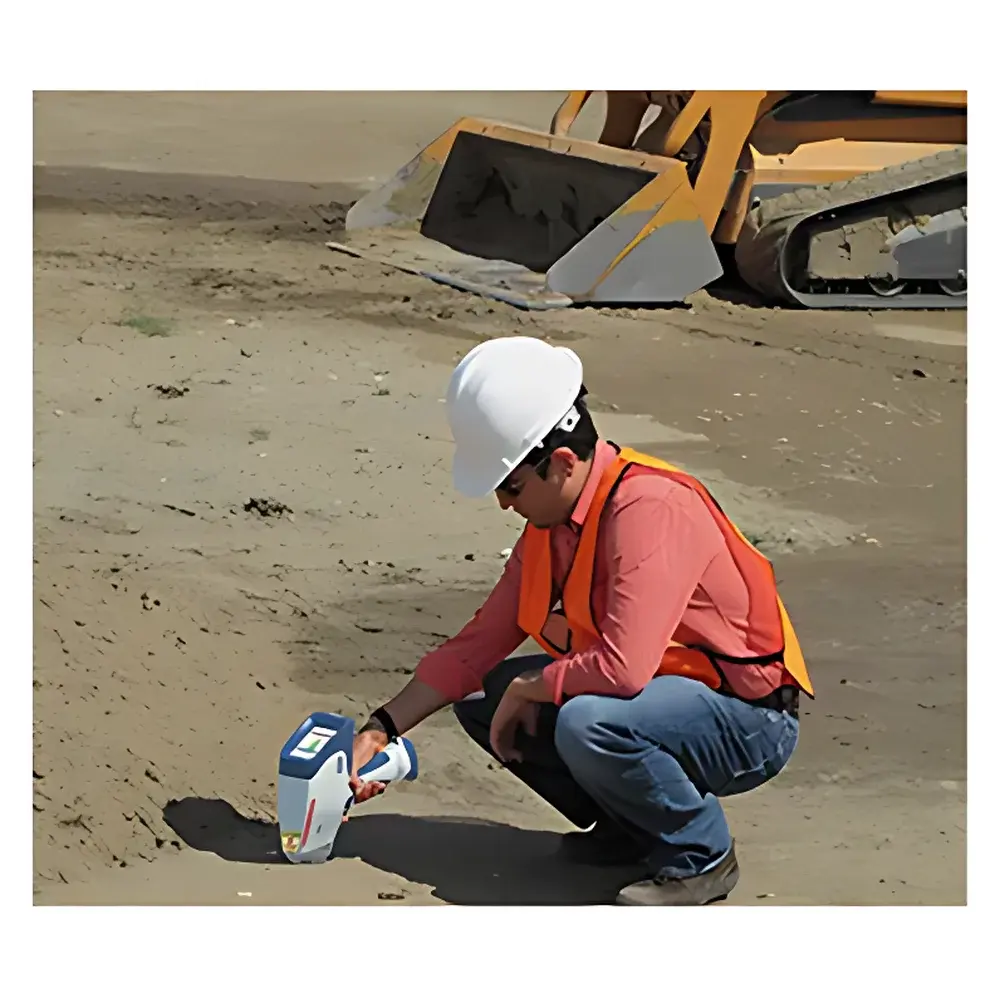
Bruker S1 TITAN Handheld X-ray Fluorescence (XRF) Soil Analyzer
| Brand | Bruker |
|---|---|
| Origin | Germany |
| Model | S1 TITAN for Soil Analysis |
| Instrument Type | Multi-element Portable XRF Analyzer |
| Regulatory Compliance | CE, RoHS, IEC 61000-4-2/3/4/6, FDA 21 CFR Part 1040.20 (X-ray safety) |
| Detection Principle | Energy-Dispersive X-ray Fluorescence (EDXRF) |
| Elemental Range | S (16) to U (92), ≥40 elements quantifiable in soil matrices |
| Typical Measurement Time | 5–60 s per analysis |
| Sample Form | Solid, powdered, or pressed pellets |
| Operating Environment | –10 °C to 50 °C, IP54 rated enclosure |
| Detector | High-resolution silicon drift detector (SDD), <145 eV Mn Kα resolution |
| Excitation Source | Rh anode microfocus X-ray tube, 4 W max power, variable kV (up to 50 kV) and µA control |
Overview
The Bruker S1 TITAN Handheld X-ray Fluorescence (XRF) Soil Analyzer is an industrial-grade, field-deployable elemental analyzer engineered for rapid, non-destructive quantification of metals and metalloids in heterogeneous environmental solid matrices. Based on energy-dispersive X-ray fluorescence (EDXRF) physics, the instrument excites atoms in the sample using a high-stability rhodium-target microfocus X-ray tube and resolves emitted characteristic X-rays via a high-resolution silicon drift detector (SDD). Its optimized geometry, vacuum-compatible measurement chamber (optional), and real-time spectral deconvolution algorithms enable reliable detection and quantification of regulated heavy metals—including Pb, As, Cd, Hg, Cr, Ni, Cu, and Zn—at concentrations relevant to regulatory thresholds (e.g., EPA Method 6200, ISO 18227, EN 17249). Designed for compliance with international radiation safety standards (IEC 61000-4 series, FDA 21 CFR Part 1040.20), the S1 TITAN operates without chemical reagents or sample digestion, significantly reducing turnaround time and analytical cost while preserving sample integrity.
Key Features
- Robust, IP54-rated magnesium alloy housing with integrated ergonomic grip and shock-absorbing bumper—engineered for daily use in rugged field conditions including mining sites, brownfields, and agricultural zones.
- High-sensitivity SDD detector with ≤145 eV Mn Kα resolution ensures accurate peak separation for overlapping transitions (e.g., As Kα/Pb Lα, Cd Kα/Sn Kα), critical for low-concentration heavy metal analysis in complex soil matrices.
- Intelligent beam optimization: automatic kV/µA adjustment based on sample composition and target element—maximizing signal-to-noise ratio while minimizing matrix effects and tube wear.
- Onboard calibration libraries pre-validated for common soil types (clay, loam, sand, organic-rich, acidic, alkaline) and certified reference materials (CRMs) including NIST SRM 2710a, 2711a, and GBW07401–GBW07409 series.
- Integrated GPS, digital camera, and barcode scanner enable georeferenced data capture, visual documentation of sampling points, and traceable chain-of-custody logging—essential for regulatory reporting and GIS integration.
- Battery life ≥12 hours (Li-ion hot-swappable dual-battery system), supporting continuous operation across multi-site surveys without external power.
Sample Compatibility & Compliance
The S1 TITAN is validated for direct analysis of untreated or minimally prepared environmental solids: air-dried and homogenized soils, sediments, sludges, mine tailings, construction debris, dust wipes, and filter media. It complies with method requirements for EPA Region 10 Field Screening Guidance, ASTM D7522-21 (Standard Practice for Field Screening of Soils Using Portable XRF), and ISO 18227:2016 (Soil quality — Determination of elemental composition by portable XRF). All calibrations adhere to GLP principles, with full audit trails for instrument performance verification (drift correction, background monitoring, detector livetime tracking). Data export formats (CSV, XML, PDF) support integration into LIMS platforms and satisfy 21 CFR Part 11 requirements when deployed with Bruker’s optional secure software package.
Software & Data Management
The instrument runs Bruker’s proprietary S1 PXRF software v4.x, featuring embedded multivariate regression (PLS-R) and fundamental parameters (FP) quantification engines. Users can create custom calibrations using local CRMs or lab-derived reference data, with built-in uncertainty estimation (k = 2) for each reported concentration. All spectra, metadata (GPS coordinates, operator ID, timestamp, humidity/temperature), and QA/QC logs are stored locally and synchronizable via Wi-Fi or USB to Bruker’s cloud-based S1 Cloud Portal. The portal supports role-based access control, automated report generation (per ISO/IEC 17025 templates), and statistical trend mapping across time-series datasets—enabling longitudinal site assessment and regulatory submission readiness.
Applications
- Rapid screening of contaminated land prior to remediation planning or property transfer (Phase I/II ESA).
- Real-time monitoring of emissions impact zones adjacent to smelters, electroplating facilities, and waste incinerators.
- Validation of soil washing and stabilization treatment efficacy by comparing pre- and post-treatment metal distributions.
- Regulatory compliance checks against national soil quality standards (e.g., China GB 15618-2018, EU CLP Regulation, US EPA Regional Screening Levels).
- Academic research on bioavailability modeling, metal speciation correlation studies (when paired with sequential extraction data), and pedogenic process investigation.
- Emergency response during industrial spills or natural disasters involving hazardous material release.
FAQ
Does the S1 TITAN require sample digestion or acid leaching before analysis?
No—analysis is performed directly on solid, air-dried, and homogenized samples. Digestion is unnecessary for screening and semi-quantitative assessment; however, for regulatory-grade total metal reporting under certain jurisdictions (e.g., EPA 3050B), lab-based ICP-MS/AES confirmation may be required.
How does the instrument handle moisture or organic content variability in field soils?
The S1 TITAN employs matrix-matched calibrations and real-time Compton normalization to compensate for density and light-element effects. For high-organic or high-moisture samples (>25% w/w), drying or pelletization is recommended to stabilize measurement geometry.
Is spectral data export compliant with laboratory accreditation requirements?
Yes—raw spectra, processed results, instrument logs, and user annotations are exportable in ASCII and XML formats traceable to ISO/IEC 17025 and ILAC-G8:2009 guidelines. Optional 21 CFR Part 11-compliant software enables electronic signatures and audit trail retention.
Can the S1 TITAN differentiate between Cr(III) and Cr(VI)?
No—XRF measures total chromium concentration only. Speciation requires complementary techniques such as ion chromatography coupled with ICP-MS or colorimetric assays per EPA Method 7196A.
What maintenance is required for long-term field reliability?
Annual detector calibration verification and X-ray tube output validation are recommended. No routine consumables are required; the SDD has no liquid nitrogen or Peltier cooling fluid. Bruker-certified field service technicians perform preventive maintenance per ISO 9001 procedures.







