
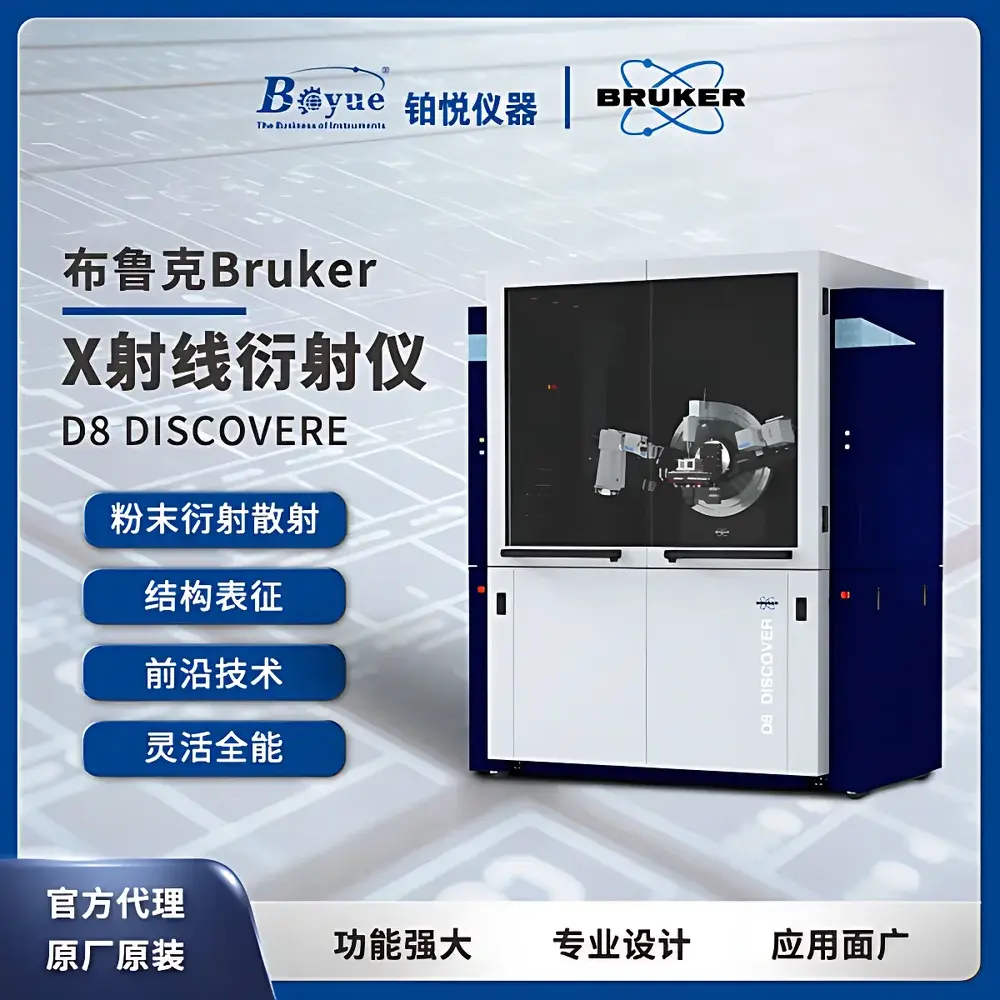
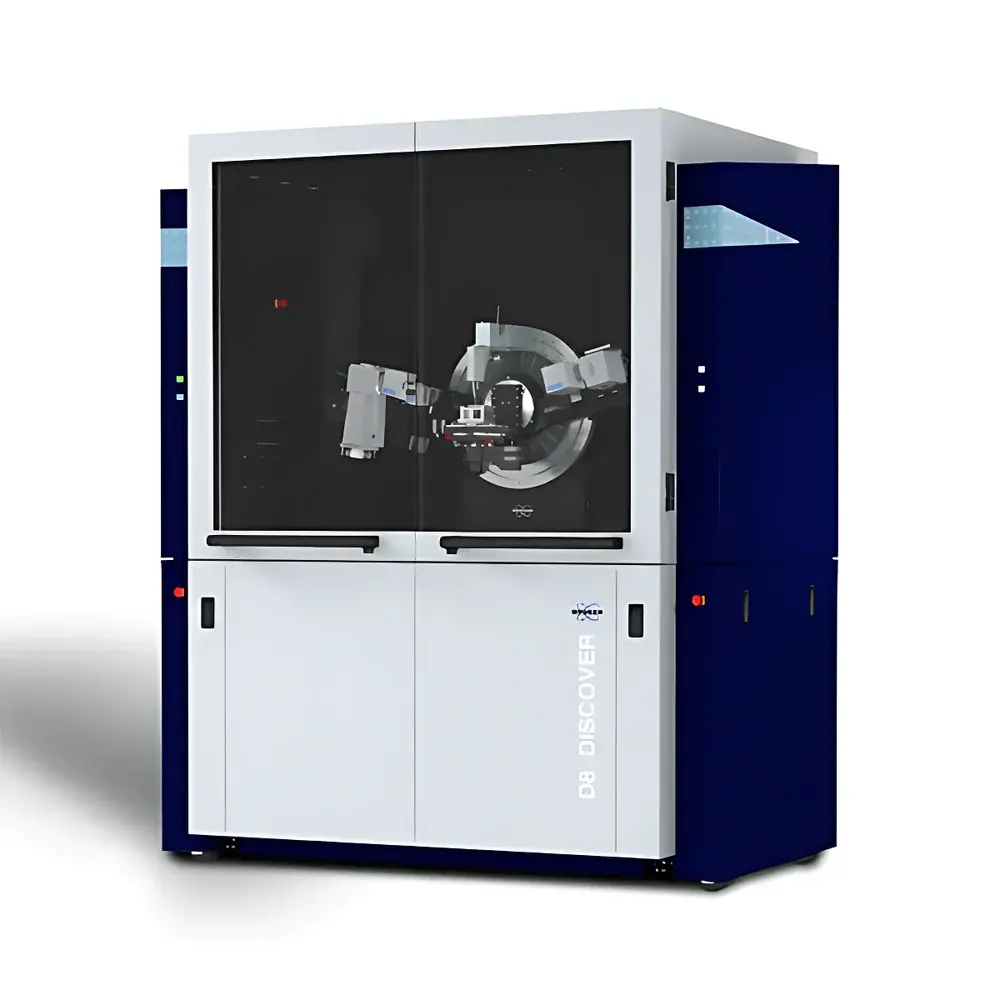
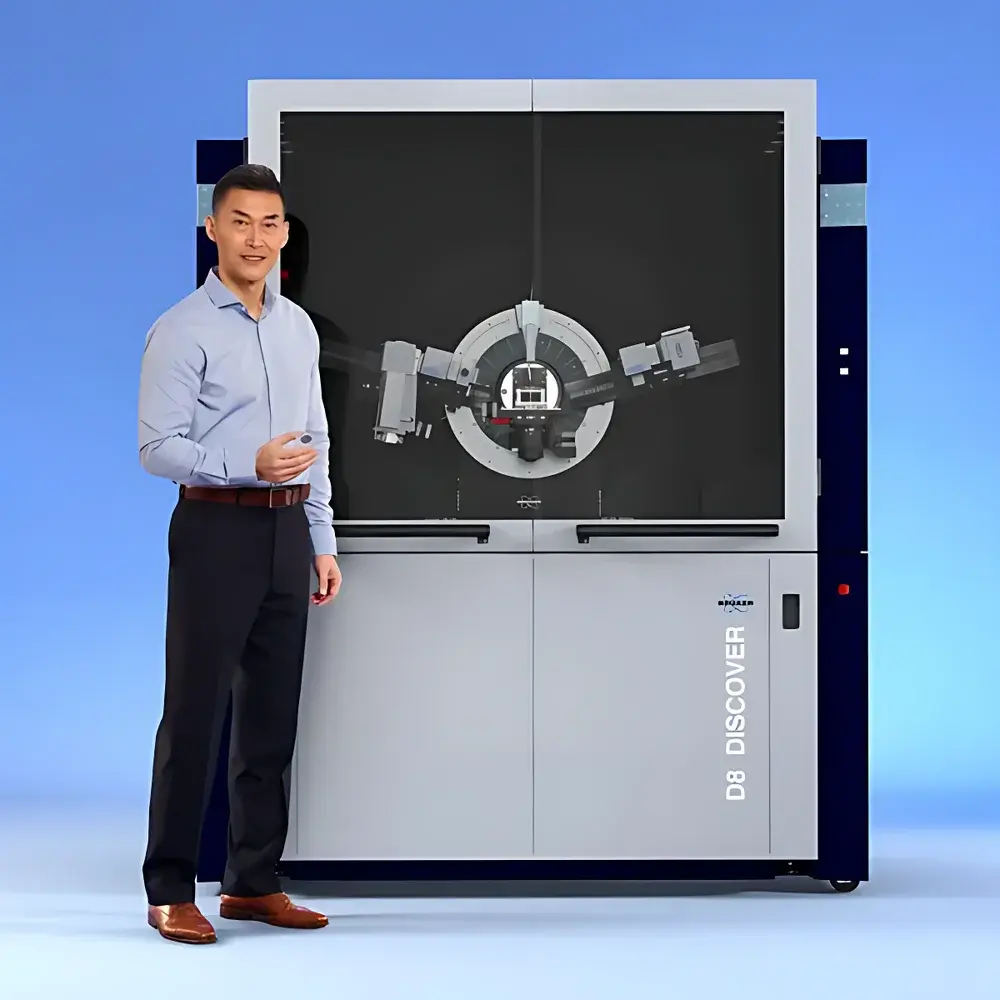
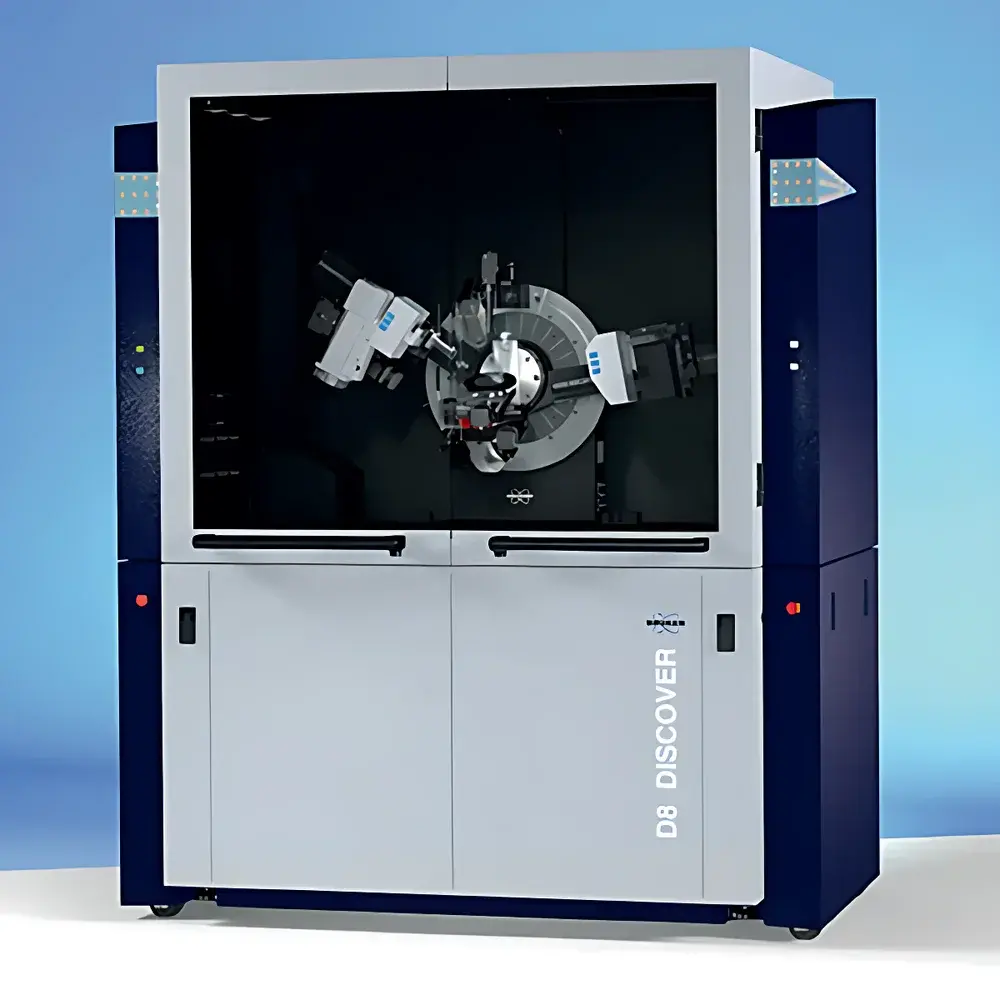
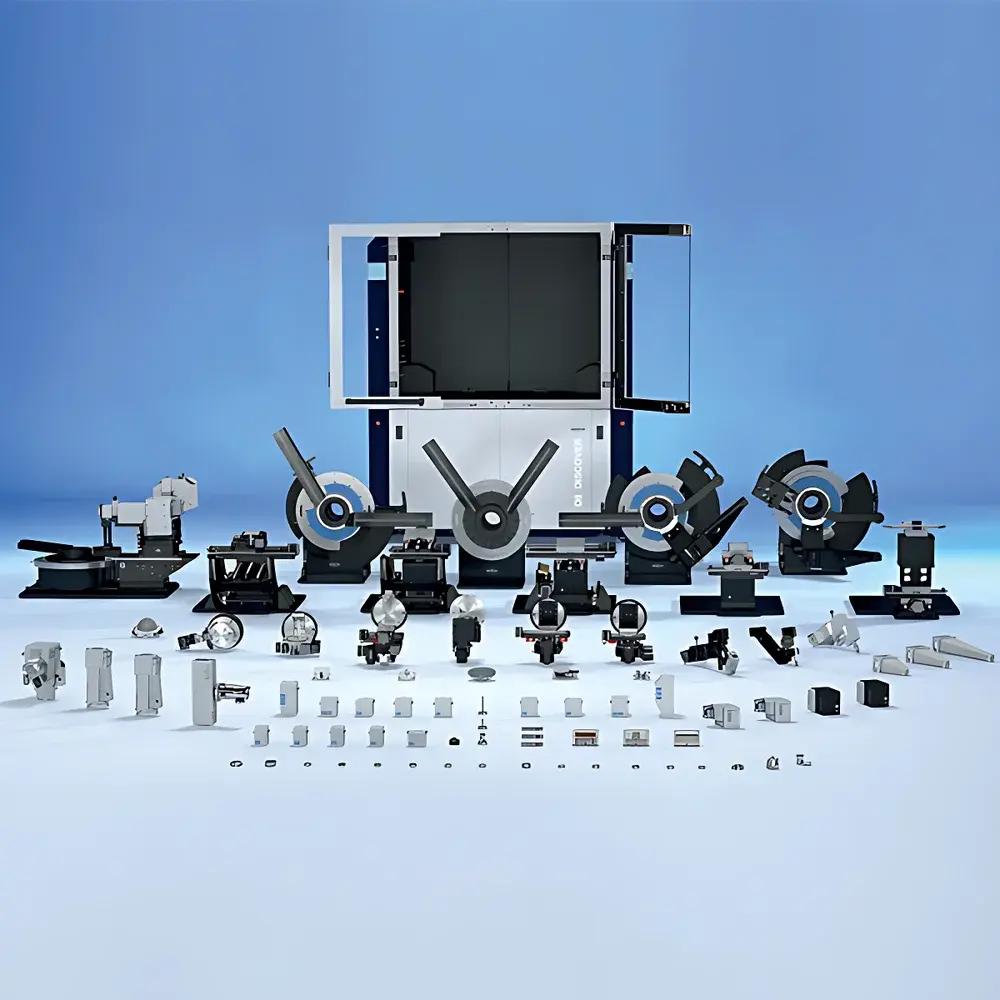
Bruker D8 DISCOVER Advanced High-Resolution X-ray Diffractometer
| Brand | Bruker |
|---|---|
| Origin | Germany |
| Model | D8 DISCOVER |
| Instrument Type | High-Resolution X-ray Diffractometer |
| Configuration | Floor-Standing |
| X-ray Power | 5.4 kW |
| Angular Accuracy | ±0.01° |
| Angular Resolution | 0.01° |
Overview
The Bruker D8 DISCOVER is a high-performance, floor-standing X-ray diffractometer engineered for precision structural characterization of crystalline, polycrystalline, and amorphous materials under ambient and non-ambient conditions. Based on Bragg’s law and constructive interference of monochromatic X-rays scattered from atomic planes, the system delivers quantitative phase identification, lattice parameter refinement, microstructural analysis (crystallite size, microstrain), thin-film epitaxy assessment, residual stress mapping, texture quantification, and reciprocal-space measurements. Its modular architecture integrates state-of-the-art X-ray optics, high-brilliance sources, large-area 2D detectors, and motorized sample stages—enabling seamless transition between powder diffraction (Bragg–Brentano), grazing-incidence geometry (GID), X-ray reflectivity (XRR), high-resolution XRD (HRXRD), GISAXS, and micro-diffraction (μXRD) without manual realignment.
Key Features
- High-Brilliance X-ray Sources: Equipped with IµS microfocus source (monocapillary optics) and HB-TXS high-brightness Turbo X-ray Source (up to 5.4 kW), delivering photon flux >10⁹ photons/mm²/s at sample position—ideal for microbeam applications and low-background measurements.
- TRIO Optics System: Motorized, fully automated switching among three beam geometries: (1) Bragg–Brentano focusing for powder analysis; (2) high-intensity parallel-beam Kα₁,₂ for GID/XRR; (3) high-resolution parallel-beam Kα₁ for epitaxial film analysis—all within a single measurement sequence.
- EIGER2 R 250K/500K 2D Detector: Hybrid pixel detector with 75 × 75 mm² active area, 500,000 pixels, single-photon counting, and energy discrimination. Supports 0D (point), 1D (line), and 2D (area) acquisition modes—including snapshot, step-scan, continuous scan, and RapidRSM for reciprocal space mapping.
- UMC Sample Stage: Universal Motorized Cradle accommodating samples up to 300 mm in diameter and 5 kg in mass. Enables high-throughput screening (HTS) with triple-well plate support, automated wafer scanning, and precise positioning for in situ/operando experiments.
- SNAP-LOCK Optics Interface: Tool-free, alignment-free optical module exchange—reducing reconfiguration time from hours to seconds while maintaining angular reproducibility better than ±0.005°.
- D8 Goniometer: Precision-engineered θ/θ geometry with thermal stability <0.001°/°C and angular accuracy certified to ±0.01° (full-scale), traceable to NIST standards.
Sample Compatibility & Compliance
The D8 DISCOVER supports diverse sample forms: powders, bulk solids, fibers, foils, wafers (up to 300 mm), thin films (1 nm–10 µm), multilayers, and nanocomposites. It operates under standard laboratory conditions as well as controlled environments (temperature: −196 °C to +1600 °C; humidity, gas atmosphere, mechanical loading). All hardware and software comply with ISO 17025 requirements for testing laboratories and support GLP/GMP workflows via audit-trail-enabled DIFFRAC.SUITE. Data acquisition and processing adhere to ASTM E975 (residual stress), ASTM E1478 (texture), ISO 13900 (XRR), and USP (pharmaceutical polymorph screening). The system is compatible with FDA 21 CFR Part 11-compliant electronic signatures when deployed with validated configurations.
Software & Data Management
DIFFRAC.SUITE provides an integrated, modular software platform for instrument control, experiment design, real-time monitoring, and advanced data analysis. Key modules include:
- DIFFRAC.COMMANDER: Centralized instrument orchestration with method-based automation, live diffraction pattern visualization, and remote operation via secure TLS-encrypted connection.
- DIFFRAC.WIZARD: Guided workflow builder for both routine (e.g., phase ID) and advanced (e.g., RSM, GID, XRR) measurements—configurable for ISO/ASTM-compliant reporting templates.
- DIFFRAC.EVA: Core analysis engine for 1D/2D data: peak search, background subtraction, phase identification against ICDD PDF-4+ database, semi-quantitative analysis, and 2D image integration.
- DIFFRAC.TOPAS: Full-pattern Rietveld refinement engine supporting crystal structure solution, quantitative phase analysis (QPA), microstructure modeling (size-strain anisotropy), and PDF analysis.
- DIFFRAC.LEPTOS: Dedicated module for thin-film metrology: XRR modeling (layer thickness, density, interfacial roughness), HRXRD simulation (mosaicity, strain, composition), and sin²ψ residual stress calculation.
- DIFFRAC.TEXTURE: Comprehensive texture analysis using spherical harmonics and discrete orientation distribution function (ODF) reconstruction—generating pole figures, inverse pole figures, and volume-weighted orientation fractions.
All modules store metadata (instrument parameters, calibration history, user actions) in encrypted SQLite databases with version-controlled project files and export to standardized formats (CIF, XYE, TIFF, HDF5).
Applications
The D8 DISCOVER serves cross-disciplinary research and industrial QA/QC needs:
- Pharmaceutical Development: Polymorph screening, API crystallinity assessment, excipient compatibility studies, and stability testing under variable T/RH using non-ambient stages.
- Semiconductor & Microelectronics: Epitaxial layer thickness, strain relaxation, defect density, and interface quality evaluation on Si, GaN, and perovskite substrates.
- Energy Materials: In situ/operando XRD during battery cycling (Li-ion, solid-state), catalyst phase evolution under reactive gas flow, and thermal barrier coating degradation analysis.
- Metals & Aerospace: Residual stress mapping in turbine blades, texture analysis of rolled alloys, retained austenite quantification in steels per ASTM E975.
- Geosciences & Ceramics: μXRD of fluid inclusions, clay mineral identification, and high-pressure phase transitions using diamond-anvil cells.
- Soft Matter & Nanomaterials: SAXS/WAXS co-measurement on block copolymers, colloidal nanoparticles, and biomacromolecules using EIGER2 R 500K in hybrid mode.
FAQ
What sample types can be analyzed on the D8 DISCOVER?
Powders, bulk metals, thin films (including epitaxial multilayers), wafers up to 300 mm, porous scaffolds, biological tissues, and encapsulated samples in environmental cells.
Is the system suitable for regulatory submissions (e.g., FDA, EMA)?
Yes—when configured with Part 11-compliant DIFFRAC.SUITE, full audit trails, electronic signatures, and IQ/OQ/PQ documentation packages are available.
Can the D8 DISCOVER perform simultaneous SAXS and WAXS measurements?
Yes—using the EIGER2 R 500K detector with appropriate collimation and beamstop configuration, enabling dual-region scattering detection in a single exposure.
How is angular calibration maintained over time?
The D8 goniometer features active thermal compensation and periodic self-calibration routines using certified Si standard reference materials traceable to NIST SRM 640e.
Does the system support automated high-throughput screening?
Yes—the UMC stage integrates with third-party robotics and supports programmable HTS workflows for multi-well plates, combinatorial libraries, and wafer-level mapping.
Related Products






