
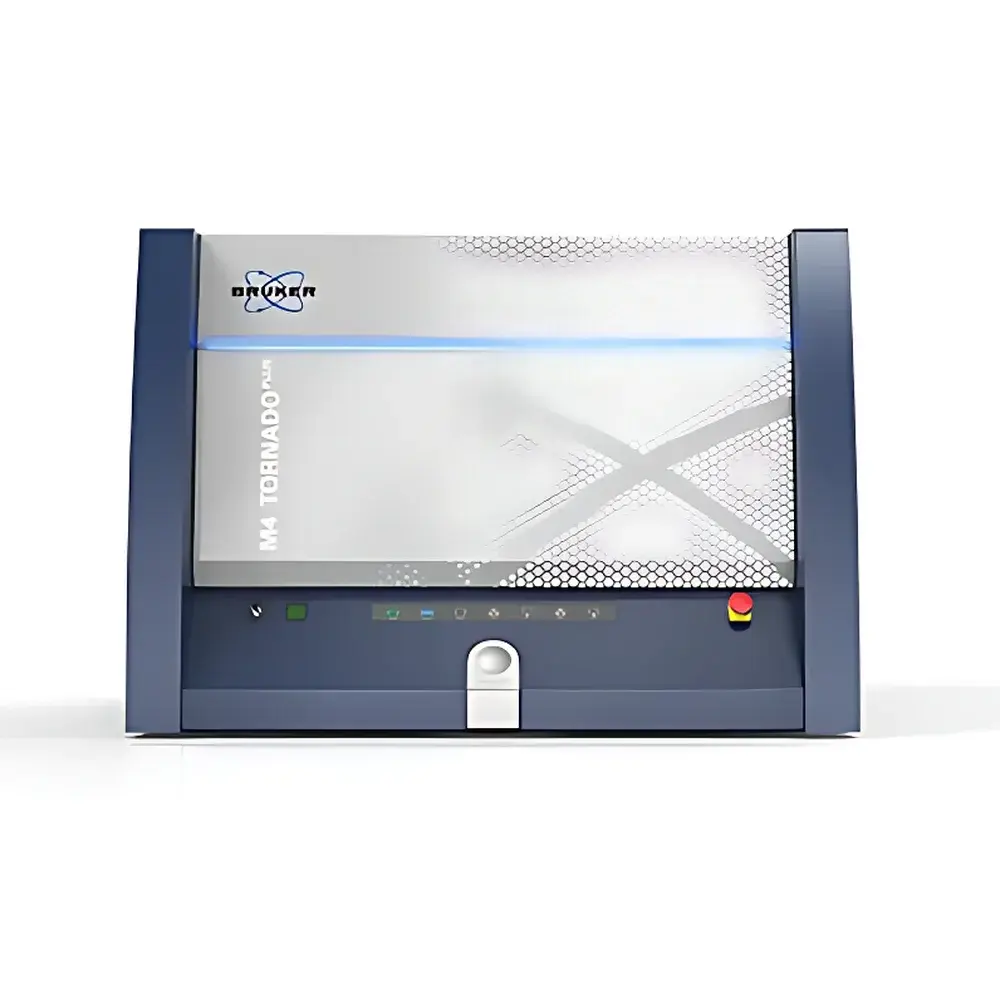
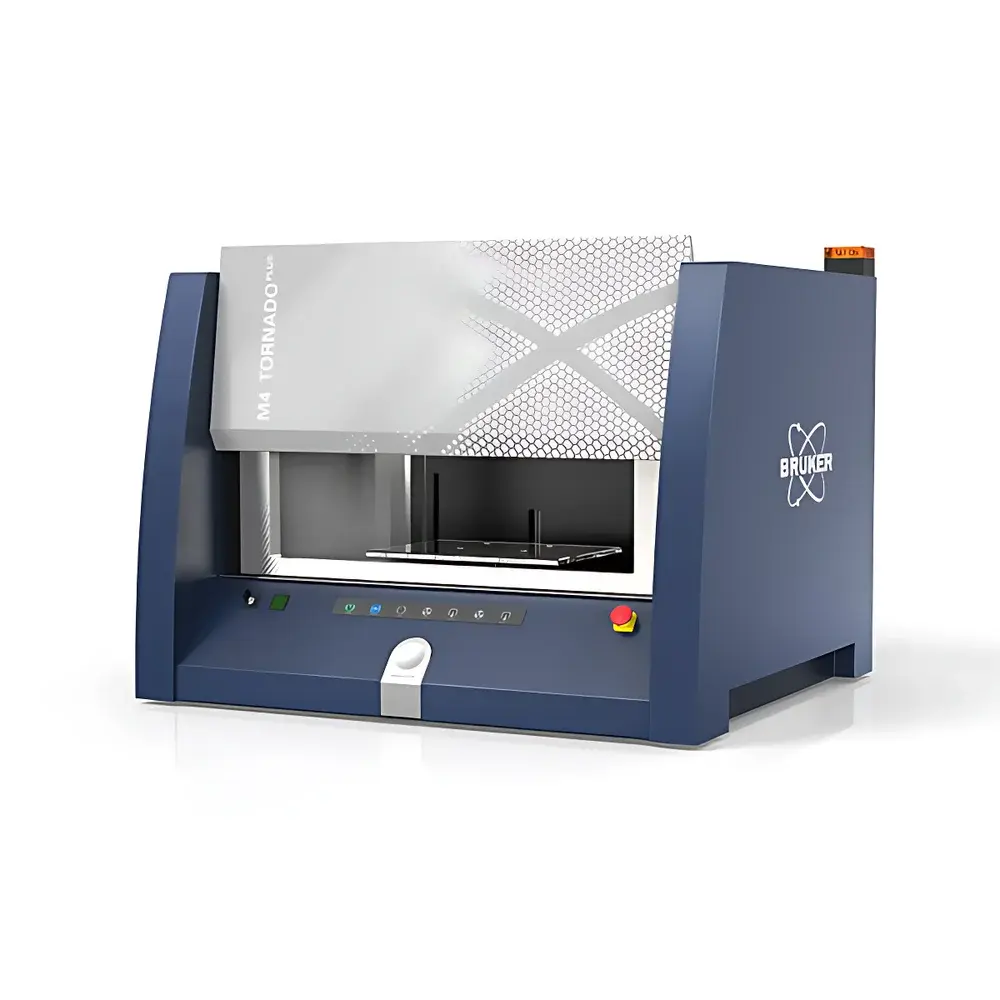
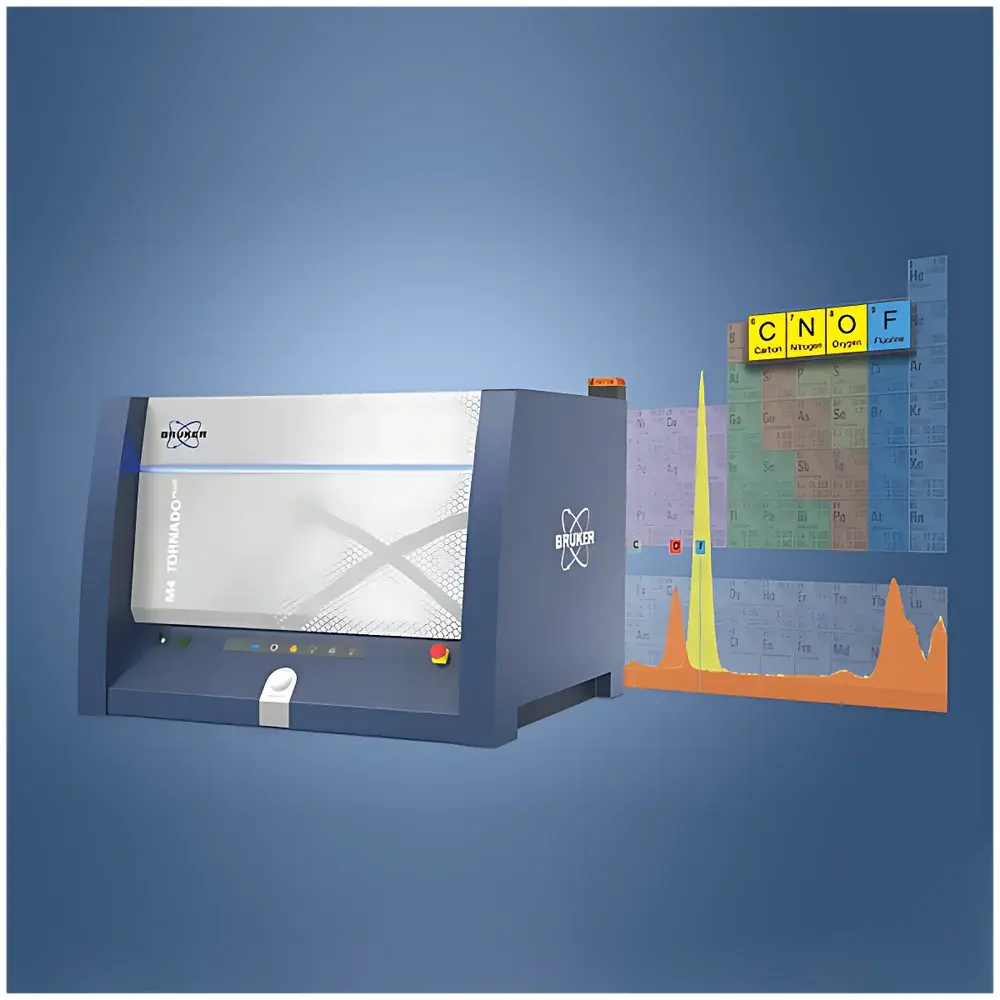
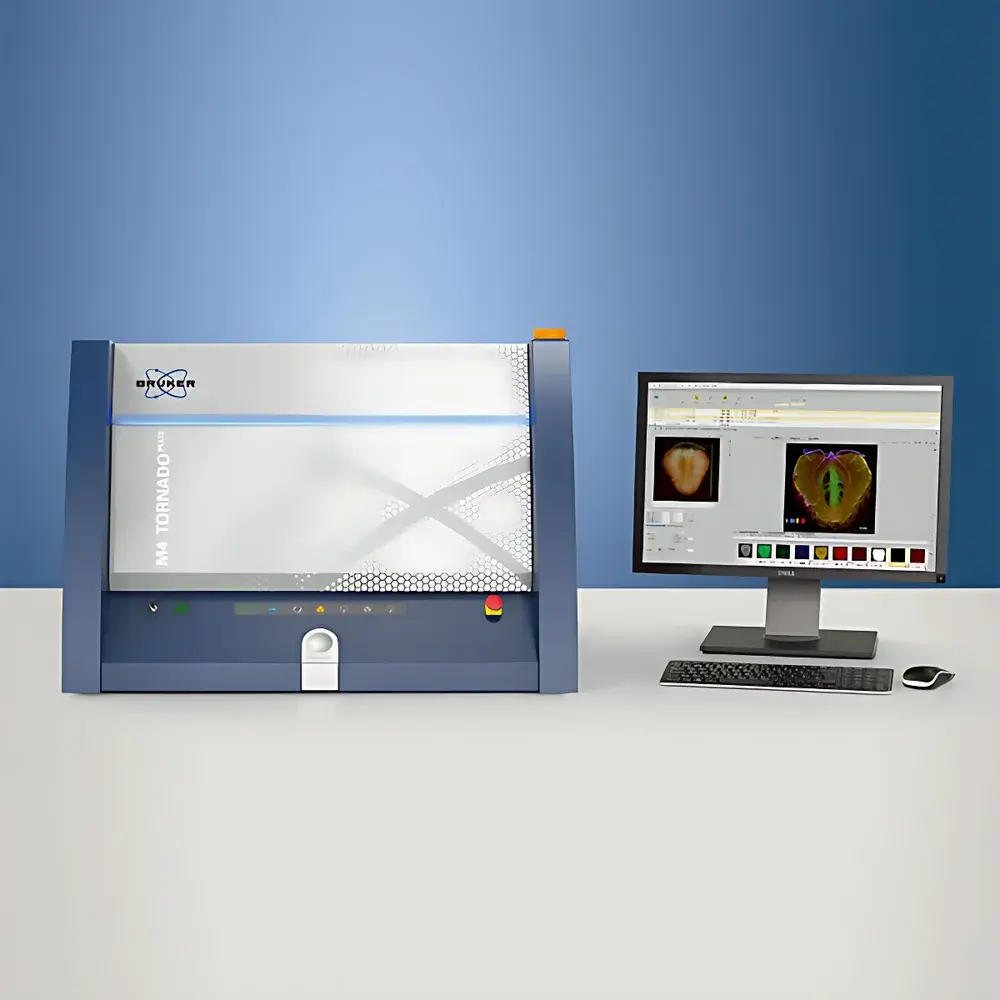
Bruker M4 TORNADO PLUS Micro-XRF Spectrometer
| Brand | Bruker |
|---|---|
| Origin | Germany |
| Model | M4 TORNADO PLUS |
| Configuration | Benchtop/Floor-standing |
| Application Type | General-purpose |
| Elemental Range | C (Z=6) to Am (Z=95) |
| Detection Limit | 1 ppm |
| Quantification Range | 1 ppm – 99.99 wt% |
| Energy Resolution | <140 eV (Mn Kα) |
| Repeatability | ≤0.1% RSD |
| Detector | Silicon Drift Detector (SDD) |
| Compliance | CE, RoHS, IEC 61000-4 series |
| Safety | IEC 62471 (LED/X-ray emission), EN 61326-1 |
Overview
The Bruker M4 TORNADO PLUS is a high-performance benchtop/floor-standing micro-focus energy dispersive X-ray fluorescence (μ-EDXRF) spectrometer engineered for non-destructive elemental mapping and quantitative analysis at micrometer-scale spatial resolution. Utilizing a highly focused polycapillary optic-coupled microfocus X-ray source (50 μm spot size), the system excites characteristic X-ray fluorescence from sample surfaces with exceptional lateral precision. Combined with a large-area silicon drift detector (SDD) offering high count-rate capability and <140 eV energy resolution at Mn Kα, the M4 TORNADO PLUS delivers superior peak separation for overlapping transitions—critical for accurate quantification of adjacent elements (e.g., S/Cl, Cr/Mn, Ni/Cu, Sr/Y). Its vacuum or helium purge options enable reliable detection of light elements down to carbon (Z=6), supporting rigorous compositional characterization across materials science, electronics, geoscience, and cultural heritage applications.
Key Features
- Micrometer-scale mapping resolution (down to 50 μm) enabled by polycapillary focusing optics and motorized XYZ stage with sub-micron repeatability
- High-throughput SDD detector with >200,000 cps maximum input count rate and real-time dead-time correction
- Automated multi-point and raster scanning modes with user-defined ROI selection and dynamic dwell time optimization
- Integrated high-resolution optical camera (5 MP) with live overlay of elemental maps onto true-color sample images
- Robust mechanical design compliant with ISO 14644-1 Class 5 cleanroom compatibility; fully shielded X-ray enclosure meeting IEC 61326-1 EMC and IEC 62471 photobiological safety requirements
- Modular vacuum/helium purge system for enhanced light-element sensitivity (C–F) without compromising measurement speed
Sample Compatibility & Compliance
The M4 TORNADO PLUS accommodates samples up to 300 × 300 × 150 mm (W×D×H) and supports flat, curved, irregular, and fragile specimens—including wafers, cross-sectioned metals, concrete cores, painted artifacts, and PCB assemblies—without requiring conductive coating. Sample height auto-detection ensures consistent focal distance across topographic variations. The system complies with international regulatory frameworks essential for quality-controlled environments: full alignment with ASTM E1621 (standard guide for EDXRF analysis), ISO 8258 (Shewhart control charts for process monitoring), and USP / for elemental impurities in pharmaceuticals. Audit trail functionality, electronic signatures, and 21 CFR Part 11–compliant software modules are available for GLP/GMP laboratories.
Software & Data Management
Operation is managed via Bruker’s ESPRIT™ 3.0 software platform—a Windows-based application supporting method development, automated calibration (fundamental parameters + empirical standards), spectral deconvolution (based on the Sherman equation), and advanced multivariate image processing. All raw spectra, map metadata, instrument parameters, and user actions are stored in a secure, timestamped database with configurable retention policies. Data export formats include TIFF (for GIS integration), CSV (for statistical packages), and standardized .spc/.map files compatible with third-party tools such as HyperMap™ and MATLAB. Built-in reporting templates support ISO/IEC 17025-compliant certificate generation with uncertainty estimation per EURACHEM/CITAC guidelines.
Applications
- Thin-film metrology: thickness and uniformity assessment of metallic, dielectric, and multilayer coatings (e.g., TiN on Si, ITO on glass)
- Corrosion science: spatially resolved Cl, S, and Fe distribution mapping in reinforced concrete to quantify chloride ingress depth and corrosion front progression
- Electronics failure analysis: identification and quantification of intermetallic compounds, solder joint voiding contaminants (Pb, Bi, Ag), and trace halogen residues at bond pads
- Metallurgy: compositional gradient profiling across diffusion couples, weld zones, and heat-affected regions in Ni-based superalloys and Al–Li aerospace alloys
- Geological and environmental forensics: U–Th–Pb zonation in zircons, As/Sb mobility in soil profiles, and heavy metal sequestration mechanisms in remediated sediments
FAQ
What is the minimum detectable element and under what conditions?
Carbon (Z=6) is detectable under helium purge or vacuum conditions with ≥300 s acquisition per pixel and optimized tube voltage (15–25 kV); typical MDLs range from 1–5 ppm for mid-Z elements (Fe–Zn) and 10–50 ppm for light elements (Na–Al) in homogeneous matrices.
Can the system perform quantitative analysis without matrix-matched standards?
Yes—ESPRIT™ implements fundamental parameter (FP) algorithms validated against NIST SRMs (e.g., 610–617, 2781–2787) and supports hybrid FP+empirical calibration for improved accuracy in heterogeneous or unknown matrices.
Is remote operation and data review supported?
The system supports secure remote desktop access (via TLS-encrypted VNC) and web-based report viewing through Bruker’s optional LabLink™ portal, enabling off-site collaboration while maintaining full audit trail integrity.
How is beam stability maintained during long-duration mapping sessions?
An integrated X-ray tube current and voltage feedback loop, coupled with real-time thermal drift compensation of the polycapillary optic position, ensures <±0.5 μm positional stability over 8-hour acquisitions.
Does the instrument meet regulatory requirements for pharmaceutical QA/QC?
With optional 21 CFR Part 11 module, electronic signature validation, and IQ/OQ/PQ documentation packages, the M4 TORNADO PLUS is qualified for use in USP / elemental impurity testing and ICH Q3D compliance workflows.





