
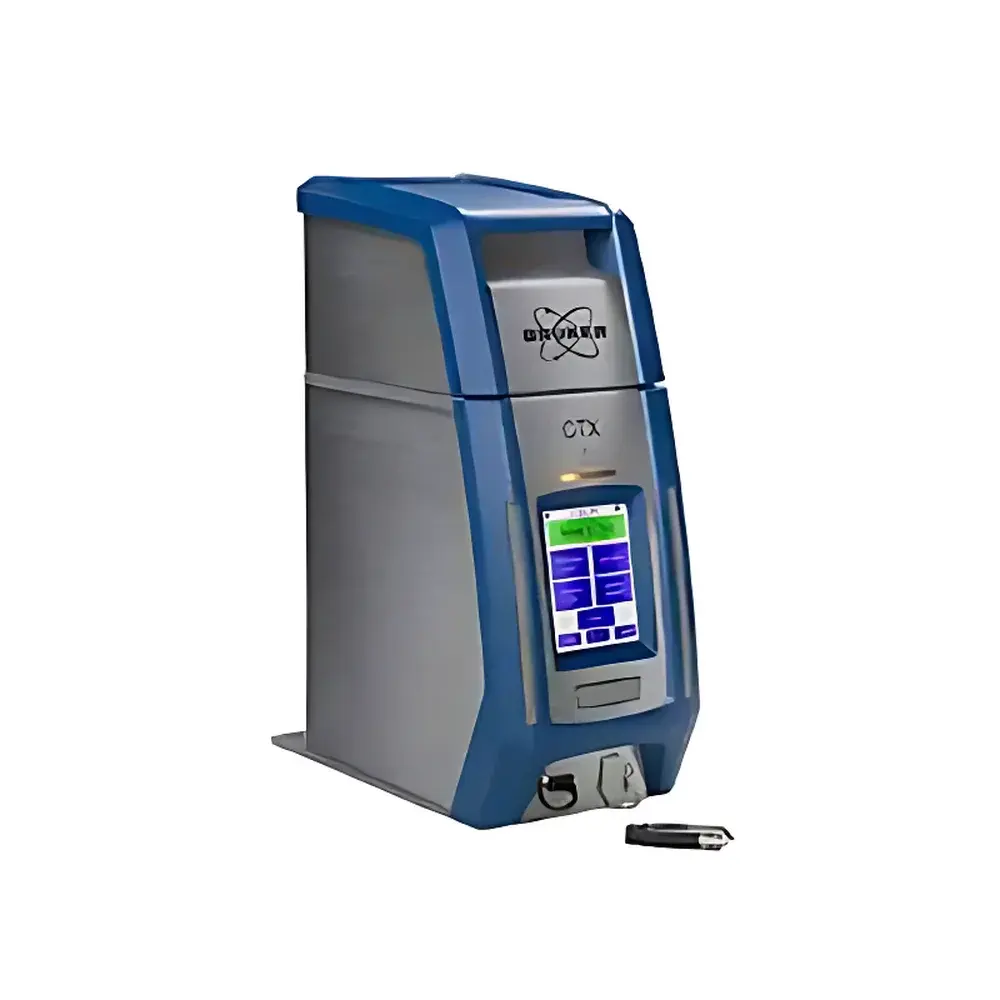
Bruker CTX Portable Benchtop Energy Dispersive X-Ray Fluorescence Spectrometer
| Brand | Bruker |
|---|---|
| Origin | Germany |
| Manufacturer Type | Authorized Distributor |
| Origin Category | Imported |
| Model | CTX Portable Benchtop XRF Analyzer |
| Application Mode | Benchtop/Portable |
| Industry Type | General-Purpose |
| Elemental Range | Mg to U |
| Quantification Range | 1 ppm – 99.99% |
| Energy Resolution | <140 eV (Mn Kα) |
| Repeatability (RSD) | ≤0.1% |
| Detector | Silicon Drift Detector (SDD) |
Overview
The Bruker CTX is a benchtop energy dispersive X-ray fluorescence (EDXRF) spectrometer engineered for rapid, non-destructive elemental analysis of heterogeneous solid, powder, and liquid samples — with particular optimization for automotive catalytic converter recycling applications. Operating on the fundamental principle of X-ray fluorescence emission, the CTX irradiates a sample with high-energy X-rays from a micro-focus X-ray tube; characteristic secondary (fluorescent) X-rays emitted by constituent elements are collected and resolved by a high-performance silicon drift detector (SDD). The resulting spectrum enables quantitative determination of elemental composition across the Mg–U range, including critical platinum group metals (PGMs): Pt, Pd, and Rh — the primary active catalysts in three-way catalytic converters (TWCs). Unlike handheld XRF systems, the CTX integrates a fully enclosed, self-shielded sample chamber that complies with international radiation safety standards (e.g., IEC 61010-1, EN 62471), eliminating regulatory restrictions associated with open-beam portable instruments while maintaining field-deployable flexibility.
Key Features
- Self-contained benchtop architecture with integrated X-ray tube, SDD detector, and vacuum/purge-capable sample chamber — no external pumps or cooling units required.
- Optimized for PGM quantification in spent catalytic converters: factory-calibrated methods for Pt, Pd, Rh, Ce, La, Zr, and Al, traceable to NIST SRM reference materials.
- High-count-rate SDD detector delivering <140 eV resolution at Mn Kα, enabling robust peak separation for overlapping L-lines of adjacent PGMs (e.g., Pd Lβ vs. Rh Lα).
- Dual-layer hardware protection: hermetically sealed sample tray prevents contamination from spills; TITAN Detector Shield provides mechanical and particulate protection for the SDD window without compromising detection efficiency.
- Robust industrial-grade enclosure rated IP54 for dust and splash resistance — suitable for workshop, scrap yard, and warehouse environments.
- Pre-loaded application-specific calibrations for >15 industry domains, including fuel sulfur monitoring (per ISO 8754 and ASTM D7039), soil geochemistry (EPA Method 6200), and alloy identification (ASTM E1086).
Sample Compatibility & Compliance
The CTX accepts samples in multiple physical forms: intact monoliths (cut or uncut), crushed ceramic substrates, powdered washcoat residues, and liquid leachates — all placed directly into standardized sample cups (32 mm diameter) or sealed polyethylene bags. Its fixed geometry and consistent beam-sample-detector alignment ensure high reproducibility (RSD ≤0.1% for repeated measurements of homogeneous PGM standards). Regulatory compliance includes adherence to EU RoHS Directive (2011/65/EU), WEEE requirements, and US EPA Method 6200 for field screening of hazardous metals. For regulated laboratories, optional software modules support 21 CFR Part 11-compliant electronic signatures, audit trails, and user-access controls aligned with GLP/GMP documentation workflows.
Software & Data Management
Powered by Bruker’s proprietary S1 PXRF software suite, the CTX delivers intuitive method setup, real-time spectral visualization, and automated matrix correction via fundamental parameters (FP) algorithms. All calibrations are stored as encrypted, version-controlled method files with embedded uncertainty estimates. Data export supports CSV, XML, and PDF report formats compatible with LIMS integration. Remote diagnostics and firmware updates are performed over secure HTTPS, ensuring continuous compliance with evolving instrument performance standards. Optional cloud-based data vaulting enables centralized fleet management for multi-site recycling operations.
Applications
- Automotive catalyst recycling: rapid grade sorting and PGM assay of spent TWCs prior to hydrometallurgical processing.
- Refinery and marine fuel testing: sulfur quantification in diesel and residual fuels per IMO 2020 sulfur cap regulations.
- Geochemical prospecting: field-deployable analysis of soil, sediment, and drill core samples for base and precious metal exploration.
- Quality assurance in metallurgy: verification of alloy composition (e.g., stainless steels, superalloys) and coating thickness uniformity.
- Environmental compliance: screening of contaminated soils and construction debris for As, Cd, Cr, Hg, Pb, and Se per EPA and EU regulatory thresholds.
FAQ
Is the CTX certified for use in radiation-controlled facilities?
Yes — its fully enclosed, interlocked sample chamber meets IEC 61010-1 and national radiation safety codes, allowing deployment in labs, ports, and recycling plants where open-beam devices are prohibited.
Can the CTX analyze irregularly shaped catalytic monoliths without grinding?
Yes — the large-diameter sample chamber (Ø 100 mm × H 60 mm) accommodates whole or sectioned monoliths up to 90 mm in length; automatic collimation ensures representative excitation of surface and subsurface layers.
Does the system require daily calibration verification?
No — factory-installed stability monitors track tube output and detector gain drift in real time; annual verification using Bruker-certified check standards satisfies ISO/IEC 17025 metrological requirements.
How is spectral interference between Pt M-lines and Rh L-lines managed?
Through combined hardware resolution (<140 eV) and software-based deconvolution using Bruker’s proprietary Peak Deconvolution Engine (PDE), which applies constrained iterative fitting based on physical transition probabilities.
Is method transfer possible between CTX units?
Yes — all calibrations are portable via encrypted USB key or network sync; cross-instrument reproducibility is maintained within ±2% RSD for PGMs when using identical sample preparation protocols.
Related Products





