
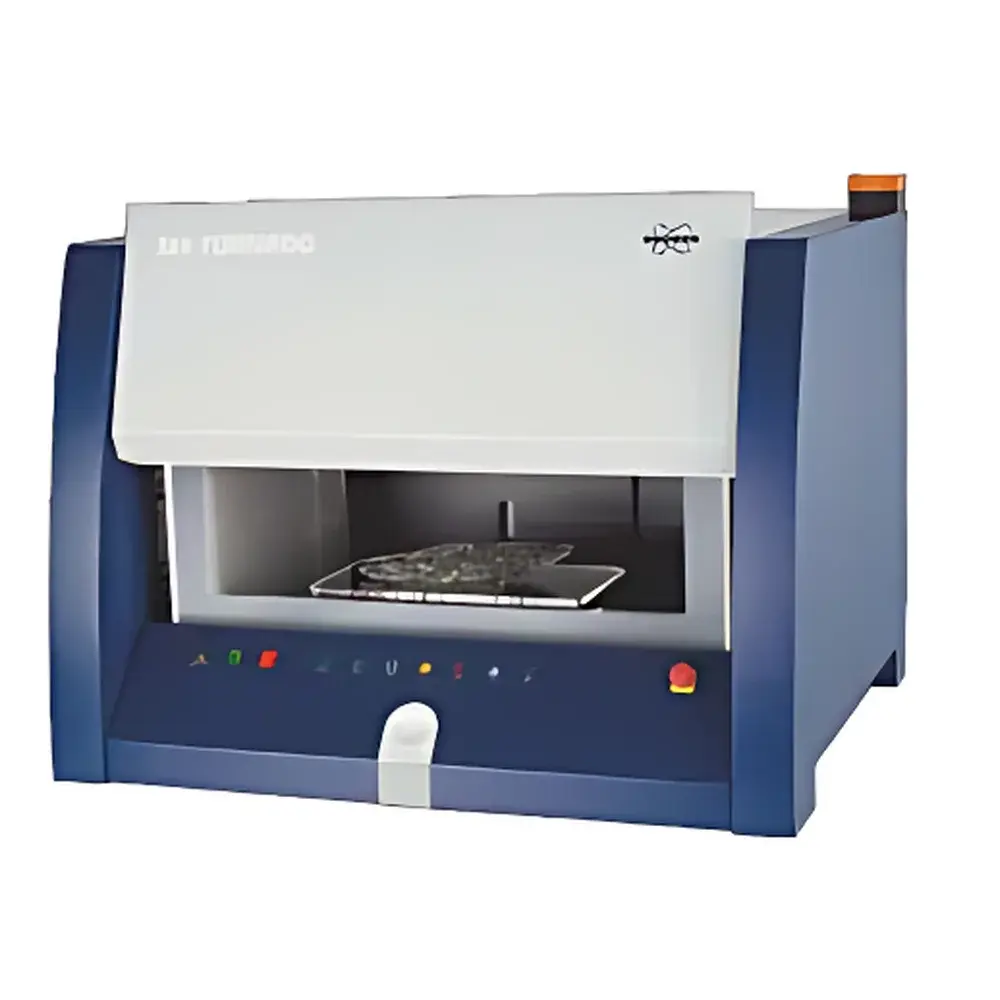
Bruker M4 TORNADO High-Performance Micro-XRF Spectrometer
| Brand | Bruker |
|---|---|
| Origin | Germany |
| Manufacturer Type | Authorized Distributor |
| Origin Category | Imported |
| Model | M4 TORNADO |
| Pricing | Upon Request |
Overview
The Bruker M4 TORNADO is a high-resolution, benchtop micro-focus X-ray fluorescence (μ-XRF) spectrometer engineered for non-destructive, spatially resolved elemental analysis of heterogeneous, irregular, or micro-sized samples—including encapsulated or coated specimens. Operating on the principle of energy-dispersive X-ray fluorescence (ED-XRF), the system excites sample atoms with a focused polychromatic X-ray beam, inducing characteristic secondary X-ray emission that is resolved by an ultra-fast silicon drift detector (XFlash®). Its core architecture integrates optics, motion control, and spectral processing to deliver quantitative elemental mapping at micrometer-scale spatial resolution—without requiring conductive coating, vacuum-compatible sample preparation, or destructive sectioning.
Key Features
- Multi-capillary polycapillary optic: Focuses the primary X-ray beam to a spot size down to 25 µm (FWHM), enabling high spatial resolution elemental imaging with minimal beam divergence and enhanced signal-to-background ratio.
- High-speed XYZ motorized stage with turbo acceleration: Supports rapid raster scanning (up to 100 mm/s) while maintaining positional repeatability better than ±1 µm; synchronized with real-time optical imaging for precise region-of-interest (ROI) targeting.
- Variable-magnification optical camera system: Integrated coaxial microscope with 0.7×–4.5× zoom provides live, high-contrast sample visualization—enabling “fly-through” mapping where spectral acquisition occurs concurrently with stage motion.
- Dual X-ray source configuration (optional): Equipped with two independent microfocus X-ray tubes (Cr and Rh anodes), each selectable via software to optimize excitation efficiency across light (Na–Ca) and heavy (Pb–U) element ranges.
- 6-position automatic filter wheel: Enables dynamic background suppression and peak enhancement by selecting optimal absorption filters (e.g., Al, Cu, Mo, Ti) during acquisition or between measurement points.
- High-throughput XFlash® silicon drift detector (SDD): Delivers count rates >1,000,000 cps with energy resolution <125 eV at Mn Kα, supporting fast mapping without spectral pile-up artifacts; optional multi-detector configurations further reduce total acquisition time.
Sample Compatibility & Compliance
The M4 TORNADO accommodates samples up to 300 × 300 × 150 mm (W × D × H) in its vacuum-capable chamber (operable at ≤10 Pa), ensuring optimal detection sensitivity for low-Z elements (down to Na). Its flexible loading design supports flat sections, curved surfaces, embedded cross-sections, and fragile artifacts—without fixation or metallization. The system complies with IEC 61000-6-3 (EMC) and IEC 61000-6-4, and meets radiation safety requirements per DIN EN 62471. Data acquisition and reporting workflows support audit-ready documentation aligned with GLP and ISO/IEC 17025 frameworks. Optional integration with Bruker’s QUANTAX software enables full compliance with ASTM E1508 (standard guide for quantitative EDXRF analysis) and ISO 17918 (micro-XRF for thin-film thickness determination).
Software & Data Management
Controlled via Bruker’s ESPRIT™ 2.0 platform, the M4 TORNADO provides intuitive workflow-driven operation—from automated calibration and ROI definition to real-time spectral preview and batch mapping. Quantitative analysis employs fundamental parameter (FP) algorithms with matrix correction, supporting both standardless bulk quantification and multilayer film modeling (e.g., Ni/Cu/Fe stacks, oxide passivation layers). Hyperspectral data cubes (X, Y, energy) are stored in standardized HDF5 format, compatible with third-party tools (Python, MATLAB, ImageJ). All user actions, parameter changes, and calibration events are logged with timestamped, tamper-evident audit trails satisfying FDA 21 CFR Part 11 requirements when configured with electronic signature modules.
Applications
- Geosciences: Elemental distribution imaging of drill cores, tephra layers, biogenic carbonates, and dendrochemical profiles—supporting paleoclimate reconstruction and diagenetic process analysis.
- Forensic science: Detection and spatial localization of gunshot residue (GSR) particles (Sb, Ba, Pb) on skin, fabric, or cartridge casings; trace metal profiling in counterfeit document inks.
- Cultural heritage: Non-invasive pigment identification in paintings, manuscripts, and glazed ceramics; stratigraphic analysis of varnish and overpaint layers.
- Life sciences: Mapping Ca/P gradients in bone implants, Zn/Cu co-localization in neurodegenerative tissue sections, and elemental diffusion profiles in hydrogel-based drug delivery matrices.
- Materials engineering: Thickness and composition verification of sputtered ternary alloy films (e.g., NiFeCo), foreign particle identification in Li-ion cathode slurries, and chloride-induced corrosion product characterization on reinforced concrete interfaces.
- Environmental monitoring: Speciation-independent quantification of As, Cd, Cr, Hg, and Pb in soil digests, sludge particulates, and airborne PM10 filters.
- Electronics QC: RoHS-compliant screening of Pb, Cd, Hg, Cr(VI), and Br in PCB solder joints, conformal coatings, and connector platings.
FAQ
What is the minimum detectable limit (MDL) for trace elements in solid samples?
MDLs vary by element, matrix, and acquisition time; typical values range from 1–10 µg/cm² for transition metals in polymer substrates under 300 s dwell per pixel.
Can the M4 TORNADO analyze liquids or powders?
Yes—liquids require containment in low-background XRF sample cups (e.g., polypropylene or Mylar windows); powders must be homogenized and pelletized or presented as loose layers with consistent thickness.
Is vacuum operation mandatory for light-element analysis?
Vacuum or He purge is recommended for reliable detection of Na, Mg, Al, and Si due to air absorption; ambient-air mode remains suitable for elements above P.
Does the system support automated multi-sample analysis?
Yes—the optional auto-loader module accepts up to 12 standard Petri dishes or custom trays, enabling unattended overnight mapping sequences with position recall and error recovery.
How is spectral interference corrected during multi-element quantification?
ESPRIT™ applies iterative deconvolution using physical detector response models and empirical peak shape fitting, supplemented by internal standard normalization where reference standards are available.



