
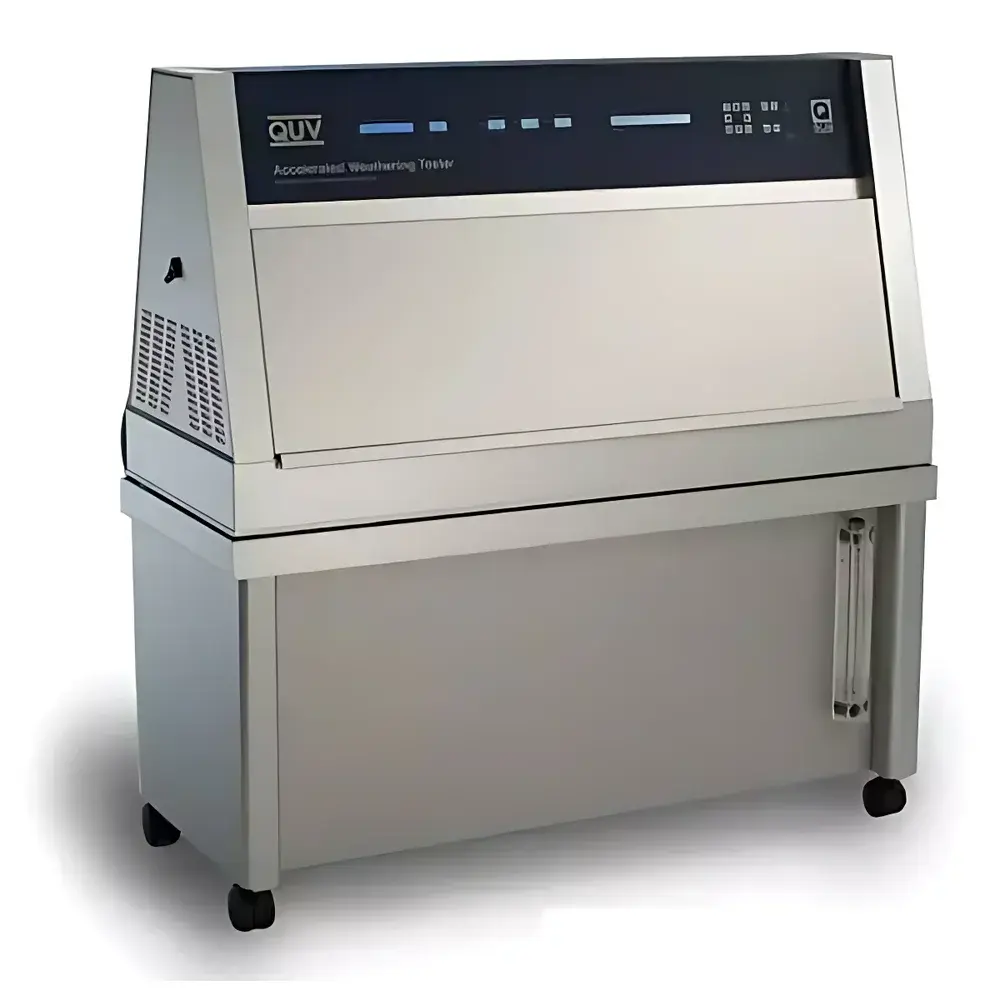
Q-LAB QUV Advanced UV Accelerated Weathering Tester
| Brand | Q-LAB |
|---|---|
| Origin | USA |
| Model | QUV |
| UV Wavelength Range | 280–400 nm |
| Compliance | ASTM G154, ISO 11507, ASTM D4329, JIS D0205, SAE J2020, AATCC TM186, ISO 4892-3 |
| Light Source Options | UVA-340 (sunlight-simulating), UVB-313 (enhanced degradation), UVC (for specialized disinfection or polymer studies), Cool White Fluorescent (QUV/cw) |
| Irradiance Control | SOLAR EYE® feedback-controlled system (standard on QUV/se, QUV/spray, QUV/cw) |
| Condensation Mechanism | Refrigerated cold-wall condensation |
| Optional Features | Water Spray (QUV/spray), Visible Light Exposure (QUV/cw), Programmable Cycles (UV/condensation/spray/dark), Digital Touchscreen Interface, GLP/GMP Audit Trail Support (via Q-Lab’s QUV Software Suite) |
Overview
The Q-LAB QUV Advanced UV Accelerated Weathering Tester is an industry-standard benchtop environmental test chamber engineered for reproducible simulation of solar ultraviolet (UV) radiation and moisture-driven degradation mechanisms affecting polymeric materials, coatings, inks, textiles, and composites. Unlike broad-spectrum xenon arc testers, the QUV leverages fluorescent UV lamp technology to isolate and intensify the most photochemically aggressive portion of terrestrial sunlight—the short-wavelength UV region (280–400 nm)—which accounts for >80% of photodegradation in outdoor-exposed materials per ASTM G154 Annex A1. Its core architecture implements a controlled cyclic exposure protocol combining UV irradiation with either condensation (via refrigerated cold-wall surfaces) or water spray, enabling accelerated emulation of natural weathering phenomena including photooxidation, hydrolysis, surface chalking, gloss loss, color shift, embrittlement, and interfacial delamination. The system operates without requiring external cooling water or high-voltage infrastructure, making it suitable for routine QC labs, R&D facilities, and contract testing laboratories adhering to ISO/IEC 17025 requirements.
Key Features
- Fluorescent UV lamp options calibrated to replicate critical spectral bands: UVA-340 (closely matching solar cutoff at 295 nm up to 360 nm), UVB-313 (accelerated stress testing), and Cool White Fluorescent (for indoor light stability per ASTM D4329 and ISO 11507 Clause 7)
- SOLAR EYE® irradiance control system—closed-loop optical sensor continuously monitors and auto-adjusts lamp power to maintain user-specified irradiance setpoints (e.g., 0.68 W/m² @ 340 nm), compensating for lamp aging, voltage fluctuations, and thermal drift
- Refrigerated cold-wall condensation system generating realistic dew-point conditions without distilled water reservoirs or manual refilling; achieves stable relative humidity >95% RH during dark/condensation phases
- Optional integrated water spray module (QUV/spray) delivering programmable thermal shock and mechanical erosion cycles using deionized water (resistivity ≥1 MΩ·cm) per ASTM D4329 Section 7.3
- Digital touchscreen controller with preloaded test standards (ASTM G154 Cycle 1–5, ISO 4892-3 Method A/B, JIS D0205), password-protected user profiles, real-time graphing, and USB data export
- Modular design supporting field-upgradable firmware, lamp tray replacement, and calibration traceability to NIST-traceable reference radiometers (calibration certificate included with SOLAR EYE-equipped models)
Sample Compatibility & Compliance
The QUV accommodates flat-panel specimens up to 150 mm × 75 mm × 20 mm (standard rack capacity: 48 samples per cycle), with optional fixtures for 3D parts, coated metal coupons, and flexible substrates. All configurations comply with regulatory and industry-standard test protocols including ASTM G154 (Standard Practice for Operating Fluorescent Ultraviolet (UV) Lamp Apparatus for Exposure of Non-Metallic Materials), ISO 11507 (Paints and Varnishes — Exposure of Coatings to Artificial Weathering — Exposure to Fluorescent UV Lamps and Water), and SAE J2020 (Automotive Exterior Materials — Accelerated Exposure Using Fluorescent UV and Condensation). For pharmaceutical packaging and medical device materials, the system supports validation under FDA 21 CFR Part 11 when paired with Q-Lab’s compliant QUV Software Suite (version 5.2+), which provides electronic signatures, audit trails, and change control logs required for GLP and GMP environments.
Software & Data Management
Q-Lab’s proprietary QUV Software Suite (Windows-based, license-free with hardware purchase) enables full remote monitoring, method library management, automated report generation (PDF/CSV), and integration with LIMS platforms via ODBC. The software enforces SOP-driven workflows—including irradiance ramping profiles, multi-step cycle sequencing (e.g., UV → condensation → spray → dark), and pass/fail criteria based on spectrophotometric ΔE* or gloss retention thresholds. All measurement data—including real-time irradiance values, chamber temperature/humidity logs, lamp-on hours, and calibration history—are timestamped and cryptographically hashed to satisfy ALCOA+ principles (Attributable, Legible, Contemporaneous, Original, Accurate, Complete, Consistent, Enduring, Available). Raw sensor outputs are stored in IEEE 754 double-precision format to preserve numerical integrity across long-term archival.
Applications
- Automotive OEMs validating exterior trim, headlamp lenses, and sealants per GMW14124, Ford CETP 00.00-L-467, and VW TL 226
- Coatings manufacturers qualifying architectural paints per ASTM D4587 and ISO 20340 for offshore wind turbine components
- Textile producers assessing colorfastness of reactive dyes and pigment prints under AATCC TM186 and ISO 105-B02
- Photovoltaic module encapsulant developers screening EVA and POE adhesion durability per IEC 61215-2 MQT10
- Medical device packaging engineers verifying Tyvek® and foil-laminate barrier integrity per ISO 11607-1 Annex B
- Roofing membrane formulators meeting ASTM D4799 and ANSI/RMA IPR-1 requirements for UV resistance and hail impact synergy
FAQ
What is the difference between UVA-340 and UVB-313 lamps?
UVA-340 lamps emit spectral energy closely matching terrestrial sunlight from 295 nm to 360 nm and are recommended for realistic outdoor weathering simulations. UVB-313 lamps extend output down to 270 nm, inducing more rapid degradation but with less solar relevance—typically used for quality control screening or failure-mode analysis.
Can the QUV meet ISO 17025 calibration requirements?
Yes. When equipped with SOLAR EYE irradiance control and operated with annual third-party calibration (using NIST-traceable UV radiometers), the QUV satisfies ISO/IEC 17025 Clause 6.4.6 for measurement traceability and uncertainty budgeting.
Is condensation generated by steam or refrigeration?
Condensation is formed exclusively via refrigerated cold-wall technology—no steam generators or humidifiers are used. This eliminates mineral deposits, ensures consistent dew-point control, and complies with ASTM G154 Section 6.2.2.
How often must UV lamps be replaced?
Lamp service life is defined by irradiance decay—not calendar time. With SOLAR EYE control, lamps are typically replaced after 1,500–2,000 hours of operation (per ASTM G154 Annex A3), as verified by onboard sensor trending and scheduled radiometer verification.
Does the QUV support multi-user access with role-based permissions?
Yes. The QUV Software Suite supports administrator, technician, and reviewer roles with configurable permissions for method editing, test initiation, data export, and audit log review—fully aligned with 21 CFR Part 11 Subpart B §11.10 and §11.30 requirements.



