
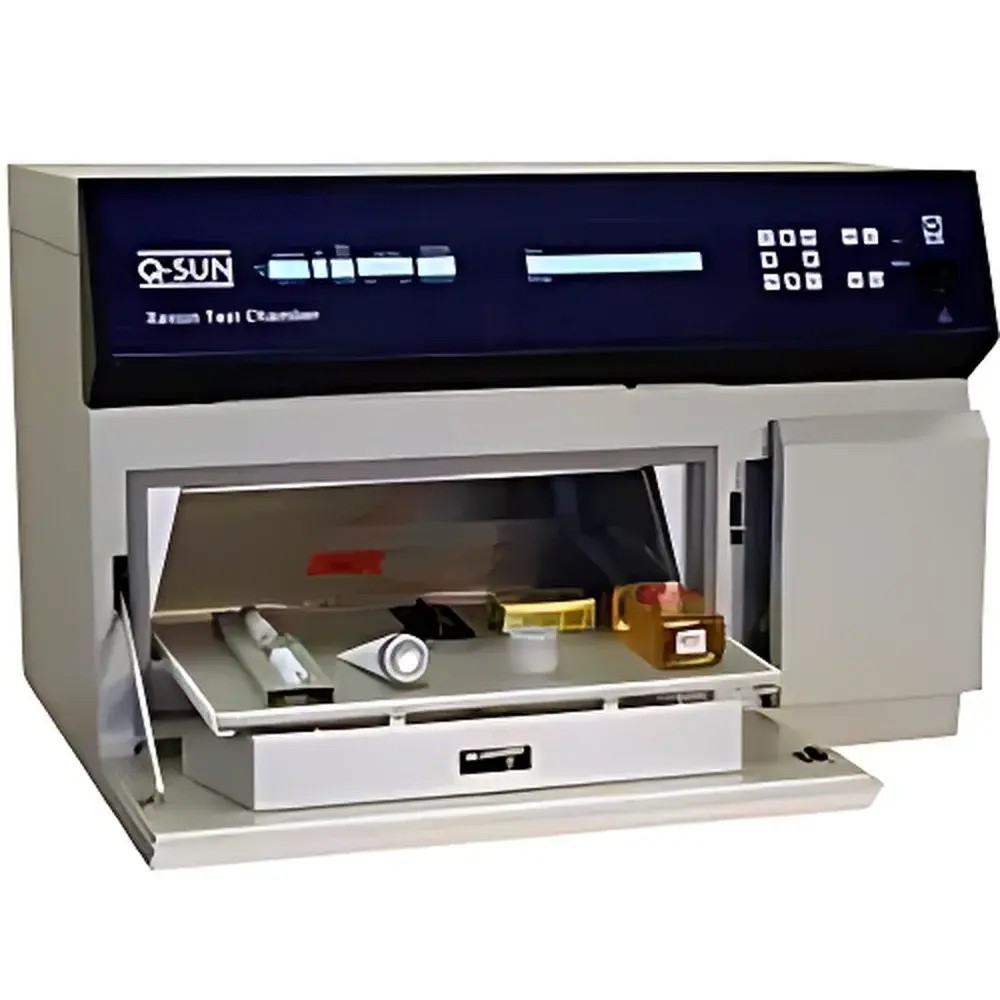
Q-LAB Xe-1 Xenon Arc Weathering Test Chamber
| Brand | Q-LAB |
|---|---|
| Origin | USA |
| Model | Xe-1 |
| Xenon Lamp Power | 1800 W |
| Lamp Cooling | Air-cooled |
| Lamp Lifetime | ~1500 hours |
| Filter Options | Daylight-F / Daylight-Q / Daylight-B/B / Window-Q / Window-B/SL / Window-SF-5 / Window-IR / Extended UV-Q/B |
| Sample Mounting | Horizontal flat tray |
| Chamber Type | Benchtop |
| Compliance | ASTM G155, ISO 4892-2, SAE J2527, AATCC TM16, ISO 105-B02, GB/T 16422.2 |
Overview
The Q-LAB Xe-1 Xenon Arc Weathering Test Chamber is a benchtop-scale instrument engineered for accelerated light stability, colorfastness, and photostability evaluation of materials under controlled solar-spectrum irradiation. Utilizing a single air-cooled 1800 W xenon arc lamp, the Xe-1 replicates the full solar spectrum—including ultraviolet (UV), visible, and near-infrared (NIR) radiation—with spectral fidelity critical for correlating laboratory exposure to real-world outdoor or indoor service conditions. Unlike narrow-band UV sources, xenon arc technology delivers continuous spectral output closely matching terrestrial sunlight at solar noon (AM1.5), enabling physically representative photochemical degradation mechanisms such as polymer chain scission, pigment fading, and surface oxidation. The chamber operates on the principle of controlled irradiance exposure, where radiant energy is precisely delivered to horizontally mounted specimens while environmental parameters—temperature and relative humidity—are maintained within defined operational envelopes. Though nominal temperature and humidity ranges are not specified in base configuration, the system supports optional refrigerated cooling and water spray modules to emulate diurnal thermal cycling and wet/dry cycles per ASTM G155 and ISO 4892-2 protocols.
Key Features
- Air-cooled 1800 W xenon arc lamp with ~1500-hour service life—eliminates water chiller infrastructure and reduces long-term OPEX versus water-cooled alternatives
- Benchtop footprint optimized for space-constrained laboratories; horizontal sample tray enables rapid specimen loading/unloading without reorientation
- Interchangeable optical filter system supporting three spectral classes: daylight (for outdoor exposure simulation), window glass (for indoor/filtered-spectrum applications), and extended UV (for accelerated automotive or aerospace qualification)
- Filter durability validated for indefinite spectral stability—no measurable spectral shift after years of operation under standard test conditions
- Modular design accommodates optional water spray and refrigerated cooling units to meet cyclic weathering requirements per SAE J2527 and AATCC TM16
- Single-point lamp replacement: lamp access from top panel; disconnect one electrical connector, loosen two screws, remove cover—no tools or calibration reset required
Sample Compatibility & Compliance
The Xe-1 accepts flat, rigid, or flexible specimens up to standard dimensions compatible with its horizontal tray (exact dimensions per LU-8054a specification). It supports testing of polymers, coatings, textiles, automotive interiors, printing inks, and architectural finishes. Regulatory and industry-standard compliance includes ASTM G155 (practice for operating xenon arc lamps), ISO 4892-2 (plastics—methods of exposure to laboratory light sources), SAE J2527 (automotive interior materials), AATCC TM16 (colorfastness to light), ISO 105-B02 (textile colorfastness), and GB/T 16422.2 (Chinese national standard equivalent to ISO 4892-2). While the base unit does not include data logging or electronic audit trail functionality, when integrated into a GLP/GMP-compliant lab environment, manual test records and filter change logs satisfy traceability requirements per FDA 21 CFR Part 11 Annex 11 principles.
Software & Data Management
The Xe-1 operates via front-panel mechanical controls and analog irradiance monitoring; it does not feature embedded microprocessor control or digital user interface. Irradiance is maintained using a broadband radiometer calibrated against NIST-traceable standards. For laboratories requiring automated data capture, third-party data loggers may be connected to monitor chamber temperature, humidity (when equipped), and lamp voltage/current. All filter types are labeled with permanent spectral designation codes (e.g., “Daylight-Q”, “Window-IR”) to ensure method reproducibility across instruments and facilities. Maintenance records—including lamp installation date, filter replacement history, and calibration verification dates—are recommended to support ISO/IEC 17025 accreditation audits.
Applications
- Outdoor durability screening of architectural coatings, roofing membranes, and exterior plastics
- Colorfastness validation of textiles, automotive fabrics, and printed packaging per AATCC TM16 and ISO 105-B02
- Photostability assessment of pharmaceutical packaging and medical device materials per ICH Q1B guidance
- Accelerated aging of interior automotive components (dashboards, trim, seat fabrics) per SAE J2527 using Window-B/SL or Window-SF-5 filters
- Correlation studies between laboratory xenon exposure and natural outdoor exposure (e.g., Florida or Arizona field sites) using Daylight-F or Daylight-Q filters
- R&D-stage material screening where high-throughput, low-cost benchtop exposure is prioritized over full-featured chamber automation
FAQ
What spectral filters are available for the Xe-1, and how do they differ?
The Xe-1 supports three filter families: Daylight (F/Q/B/B) for direct sunlight simulation; Window Glass (Q/B/SL/SF-5/IR) for indoor or behind-glass exposure; and Extended UV (Q/B) for enhanced short-wavelength irradiance used in automotive OEM specifications.
Is the Xe-1 compliant with ASTM G155 and ISO 4892-2?
Yes—the Xe-1 meets the core hardware and spectral requirements of both standards when configured with appropriate filters and optional spray/refrigeration modules.
Does the Xe-1 require external cooling water or compressed air?
No—its air-cooled lamp eliminates dependency on chilled water circuits or pneumatic systems, simplifying facility integration.
Can irradiance be measured and controlled in real time?
The system includes a broadband radiometer for periodic irradiance verification; however, it does not provide closed-loop irradiance feedback control. Users perform manual setpoint adjustment per test method requirements.
What is the typical maintenance schedule for the Xe-1?
Lamp replacement every ~1500 hours; filter inspection annually or per test cycle count; radiometer calibration recommended every 12 months or after 500 hours of operation.



