
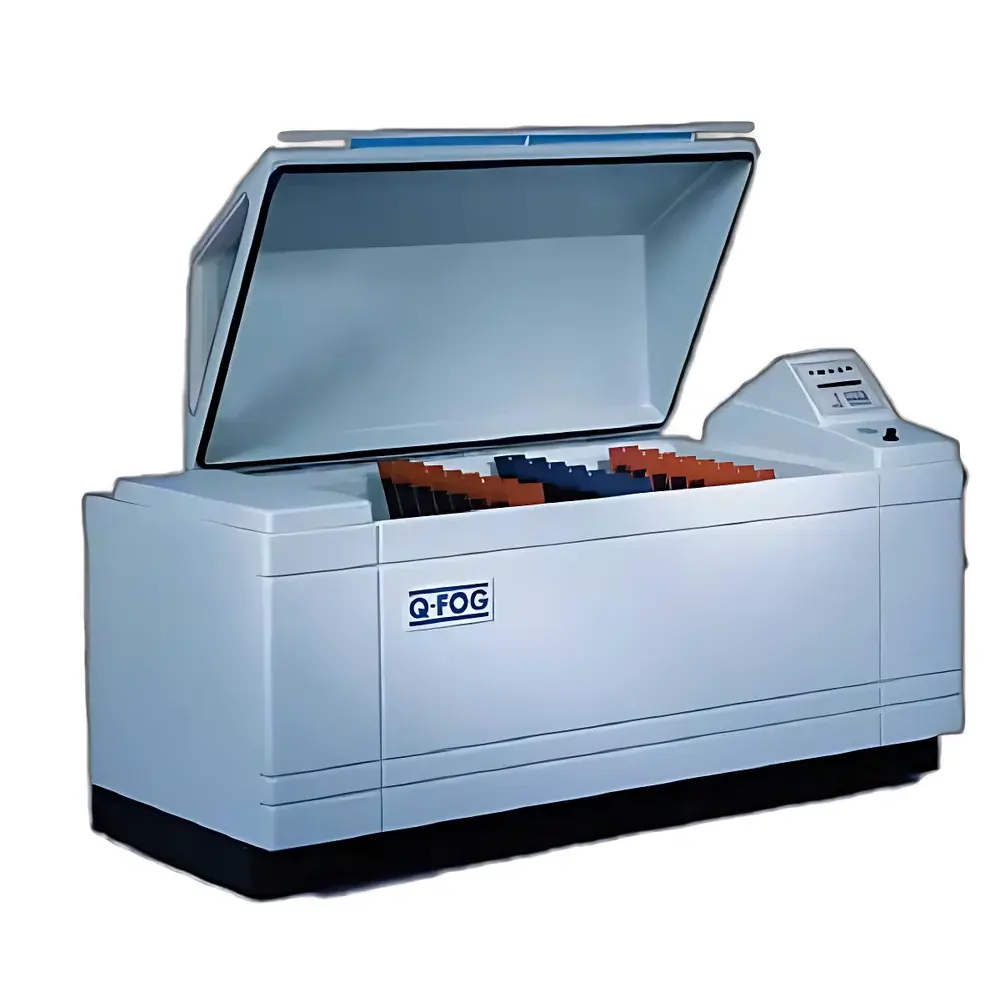
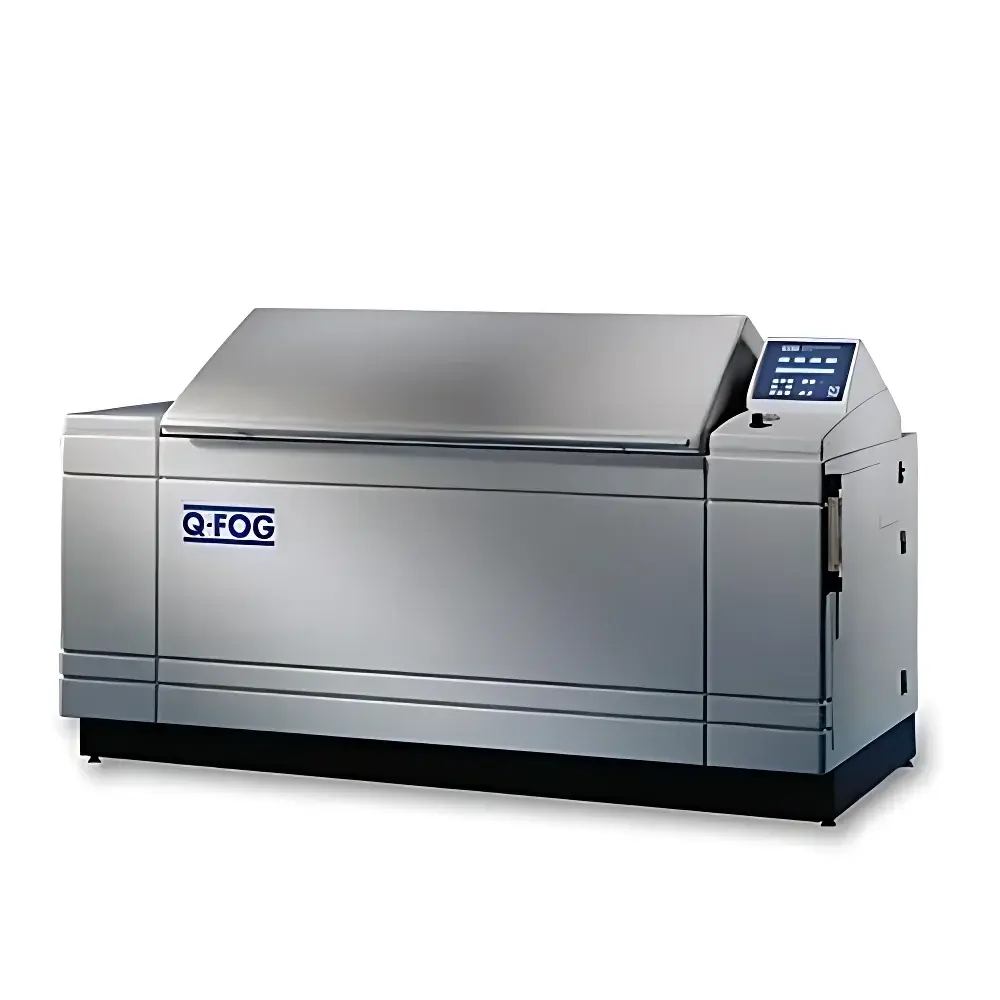
Q-Lab Q-FOG SSP-600 Salt Spray Test Chamber
| Brand | Q-Lab |
|---|---|
| Origin | USA |
| Model | Q-FOG SSP-600 |
| Salt Spray Deposition Rate | 0.5–3.0 mL/(h·80 cm²) |
| Temperature Range | Ambient to 70°C |
| Compliance | ASTM B117, ASTM G85 (Prohesion), ISO 9227, BS 3900 F4/F9, DIN 50021 |
Overview
The Q-Lab Q-FOG SSP-600 Salt Spray Test Chamber is an engineered environmental test system designed for accelerated corrosion evaluation of metallic substrates, coated surfaces, and electroplated components under controlled, repeatable laboratory conditions. Unlike conventional static salt fog chambers operating solely at 35°C per ASTM B117, the SSP-600 implements programmable cyclic corrosion testing (CCT) — a methodology grounded in the physical principles of electrochemical degradation accelerated by alternating exposure to corrosive electrolyte mist, elevated temperature, low-humidity drying, and ambient rest phases. This multi-stage cycling replicates key atmospheric stressors observed in real-world service environments, including coastal, industrial, and automotive applications, thereby improving correlation between lab results and field performance. The chamber’s architecture integrates precision air pressure regulation, variable-speed peristaltic dosing, and rapid thermal response via internal resistive heaters and high-capacity forced-air cooling/drying fans — enabling transitions between test phases in minutes rather than hours.
Key Features
- Programmable cyclic corrosion testing with up to four distinct exposure phases: salt spray, dry-off, ambient rest, and optional 100% RH conditioning (note: full humidity control requires CCT-series configuration)
- Independent control of salt solution delivery rate (via peristaltic pump) and spray dispersion distance (via regulated compressed air), ensuring precise and reproducible deposition across the test area
- Temperature range from ambient to 70°C, with rapid thermal transition capability enabled by low-thermal-mass heating elements and high-CFM drying airflow
- Integrated 120 L internal solution reservoir with built-in saline filtration and low-level fluid alarm, supporting uninterrupted operation for ≥7 days under typical test cycles
- Microprocessor-based controller with intuitive menu-driven interface, preloaded standard test methods (ASTM B117, ASTM G85 Annex A5 Prohesion, ISO 9227, BS 3900 F4/F9, DIN 50021), and comprehensive self-diagnostic routines
- Front-access low-profile design with hinged lid and optimized interior geometry for efficient sample loading — accommodates up to 160 test panels (75 mm × 150 mm) per cycle
- Requires purified water (deionized or distilled) for all operational modes to prevent nozzle clogging and ensure long-term system reliability
Sample Compatibility & Compliance
The Q-FOG SSP-600 is validated for use with flat-panel specimens, small mechanical parts, electronic assemblies, and coated fasteners. Its chamber dimensions and rack configuration support standardized specimen mounting per ISO 9227 and ASTM standards. All test protocols executed on this platform are traceable to internationally recognized corrosion testing frameworks, including but not limited to: ASTM B117 (continuous neutral salt spray), ASTM G85 Annex A5 (Prohesion cycling), ISO 9227 (neutral/acidified/acetic acid salt spray), BS 3900 Part F4 (cyclic salt spray/fog), and DIN 50021. The system meets general requirements for GLP-compliant laboratories when operated with documented procedures, calibration records, and audit-ready data logs. While not inherently 21 CFR Part 11 compliant out-of-the-box, the controller supports timestamped event logging and user-accessible audit trails suitable for integration into validated quality management systems.
Software & Data Management
The embedded controller provides non-volatile storage for up to 100 user-defined test programs, each containing multiple sequential steps with independent setpoints for temperature, duration, and phase type. Real-time status display includes current phase, elapsed time, chamber temperature, and active alarms. All operational events — including start/stop commands, parameter changes, fault triggers, and maintenance alerts — are automatically logged with date/time stamps. Export functionality via USB port enables transfer of test logs and configuration files for external analysis or regulatory submission. Optional Q-Lab’s CR-4 software (sold separately) extends capabilities with remote monitoring, automated report generation, and trend analysis across multiple test runs — supporting long-term corrosion performance benchmarking and comparative material qualification studies.
Applications
This instrument serves as a core tool in R&D, QC, and supplier qualification workflows across aerospace, defense, automotive OEMs, and industrial coating manufacturers. Typical use cases include evaluating primer adhesion durability on aluminum alloys, assessing galvanic corrosion resistance of zinc-nickel plated steel, validating passivation effectiveness on stainless components, and qualifying conformal coatings for printed circuit boards exposed to marine environments. It is widely employed for comparative ranking of coating systems (e.g., epoxy vs. polyurethane topcoats), qualification of pretreatment chemistries prior to painting, and accelerated lifetime modeling of fastener assemblies in chloride-rich service conditions. Its ability to replicate complex field-relevant sequences — such as wet-dry-salt-wet cycles mimicking diurnal tidal exposure — makes it especially valuable for developing corrosion-resistant materials for offshore infrastructure and electric vehicle battery enclosures.
FAQ
What standards does the Q-FOG SSP-600 support out of the box?
It natively executes ASTM B117, ASTM G85 Annex A5 (Prohesion), ISO 9227, BS 3900 F4/F9, and DIN 50021 test protocols without hardware modification.
Is deionized water mandatory for operation?
Yes — only purified water (≥1 MΩ·cm resistivity) may be used to fill the reservoir and generate salt solution; tap or softened water will cause premature nozzle fouling and sensor drift.
Can the SSP-600 perform humidity-controlled cycles?
No — humidity control (100% RH soak) is exclusive to the CCT-series models; the SSP-600 supports only salt spray, dry-off, and ambient rest phases.
How often does the internal filter require replacement?
Under normal usage with filtered brine solution, the inline saltwater filter should be inspected every 30 days and replaced every 90 days or after 500 hours of cumulative spray time.
What is the maximum recommended test duration without manual intervention?
With a full 120 L reservoir and typical Prohesion cycling (e.g., 2h salt + 2h dry), uninterrupted operation exceeds 168 hours (7 days); actual runtime depends on spray frequency and solution concentration.



