
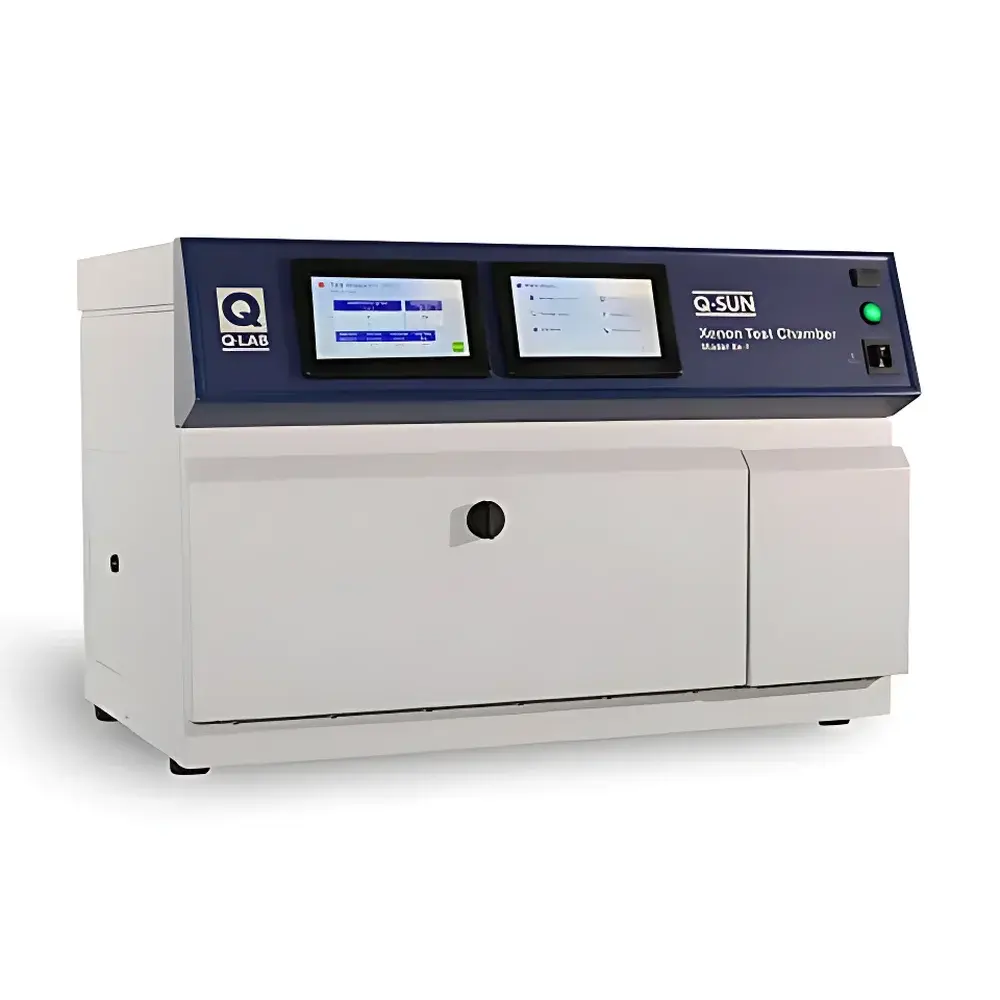
Q-LAB Q-SUN Xe-1-BC Xenon Arc Weathering Test Chamber
| Brand | Q-LAB |
|---|---|
| Origin | USA |
| Manufacturer Type | Authorized Distributor |
| Product Category | Imported Instrument |
| Model | Q-SUN Xe-1-BC |
| Xenon Lamp Power | 1800 W |
| Irradiance Control | Solar Eye® Closed-Loop Radiometer System (Selectable Monitoring at 340 nm, 420 nm, or TUV) |
| Humidity Range | 10–95% RH (Controlled & Monitored) |
| Temperature Range | Ambient to 103°C (with optional refrigeration unit: down to 19°C) |
| Sample Capacity | Benchtop Configuration, Single-Lamp Design |
| Compliance Standards | ASTM G155, ISO 4892-2, AATCC TM16, SAE J2527, ISO 105-B02, ASTM D4459, ASTM D2565 |
Overview
The Q-LAB Q-SUN Xe-1-BC is a benchtop xenon arc weathering test chamber engineered for precision accelerated aging of materials under controlled solar-spectrum irradiation. It utilizes a single 1800 W xenon lamp with spectral output closely matching natural daylight (CIE No. 85), enabling realistic simulation of UV, visible, and near-infrared radiation exposure. The system operates on the principle of xenon arc irradiation—where high-intensity broadband light passes through optical filters (e.g., Daylight-Q/B, Window Glass-Q/B) to replicate specific environmental conditions such as full-spectrum sunlight or filtered terrestrial solar radiation. Designed for laboratories with limited floor space or constrained capital budgets, the Xe-1-BC delivers full-featured weathering performance in a compact footprint. Its architecture supports programmable irradiance setpoints, real-time closed-loop feedback control, and synchronized environmental parameter management—making it suitable for R&D validation, QC release testing, and comparative durability benchmarking across polymers, coatings, textiles, automotive interiors, and pharmaceutical packaging.
Key Features
- Solar Eye® Irradiance Control System: Patented closed-loop radiometry continuously monitors and adjusts lamp output to maintain user-defined irradiance levels at selectable wavelengths—340 nm (for UV-driven degradation), 420 nm (for visible-light effects), or TUV (total ultraviolet). This ensures measurement repeatability and inter-laboratory comparability.
- Integrated Environmental Control: Simultaneous monitoring and regulation of relative humidity (10–95% RH), black panel temperature (BPT), and chamber air temperature. Sensors comply with ASTM G155 calibration traceability requirements.
- Optional Refrigeration Unit: Enables low-temperature operation (down to 19°C), critical for evaluating thermally sensitive products—including cosmetics, pharmaceuticals, and medical device packaging—without inducing non-physiological thermal stress.
- Programmable Water Spray Function (Optional): Delivers calibrated water pulses during irradiation cycles to simulate dew, rain, or thermal shock. Spray timing, duration, and frequency are fully configurable via the controller interface, supporting standards such as ASTM D4355 and ISO 4892-2 Cycle 1.
- Benchtop Form Factor & Ventilation Flexibility: Compact design allows direct indoor exhaust without external ductwork. Installation requires only standard 208–240 VAC power and ambient cooling airflow—no chilled water or compressed air supply needed.
Sample Compatibility & Compliance
The Q-SUN Xe-1-BC accommodates flat-panel specimens up to 152 mm × 152 mm (6″ × 6″) mounted on the specimen tray, with adjustable sample angle (0°–10°) to optimize irradiance uniformity. It supports standard specimen holders per ASTM G155 and ISO 4892-2 geometries. All operational parameters—including irradiance, humidity, temperature, and spray timing—are logged with timestamped audit trails compliant with GLP and FDA 21 CFR Part 11 when paired with Q-LAB’s optional Q-Lab Software Suite. The chamber meets essential regulatory alignment for material qualification in regulated industries: ASTM D4303 (pigment lightfastness), AATCC TM16 (textile colorfastness), SAE J2527 (automotive interior materials), and ISO 105-B02 (color fastness to artificial light). Calibration documentation follows NIST-traceable protocols per ISO/IEC 17025 guidelines.
Software & Data Management
The embedded touchscreen controller provides intuitive cycle programming, real-time parameter visualization, and alarm logging. For advanced data governance, Q-LAB’s optional Q-Lab Software Suite enables remote monitoring, automated report generation (PDF/CSV), electronic signature workflows, and secure database archiving. All irradiance and environmental sensor data are time-stamped and stored with immutable audit trails—supporting compliance with ISO 17025 accreditation requirements and internal quality management systems (QMS). Data export formats conform to LIMS integration standards, including ASTM E2500 Annex A3 metadata tagging for traceability.
Applications
- Evaluation of photostability in pharmaceutical solid dosage forms and primary packaging per ICH Q1B guidance.
- Colorfastness and gloss retention testing of architectural coatings and exterior automotive finishes.
- UV-induced embrittlement assessment of polyolefin films used in agricultural mulch and food packaging.
- Accelerated aging of OLED display encapsulation layers under controlled humidity and irradiance.
- Validation of UV absorber efficacy in cosmetic formulations per COLIPA (now Cosmetics Europe) protocols.
FAQ
Does the Q-SUN Xe-1-BC meet ASTM G155 and ISO 4892-2 requirements?
Yes—the system is factory-configured to execute all exposure cycles defined in ASTM G155 (Method A) and ISO 4892-2, including irradiance control at 340 nm ± 0.5 W/m²/nm, black panel temperature regulation, and optional water spray synchronization.
Can irradiance be monitored and controlled at multiple wavelengths simultaneously?
No—the Solar Eye® system monitors and controls irradiance at one selected wavelength per test cycle (340 nm, 420 nm, or TUV). Multi-wavelength concurrent control is not supported on the Xe-1-BC platform.
Is refrigeration required for all tests?
No—refrigeration is an optional accessory. It is recommended only when test protocols specify exposure temperatures below ambient or require suppression of thermal aging artifacts, such as in ICH Q1B photostability studies.
What maintenance intervals are recommended for the xenon lamp and filters?
Lamp replacement is advised every 1,500 hours of operation; optical filters should be replaced every 3,000 hours or per visual inspection for discoloration or haze—consistent with Q-LAB’s Maintenance Manual Rev. 6.2.
How is calibration verified for regulatory submissions?
Q-LAB provides NIST-traceable calibration certificates for irradiance sensors and temperature/humidity transducers. Users may perform in-house verification using Q-LAB’s certified reference radiometers and secondary standards per ISO/IEC 17025 Clause 6.5.



