
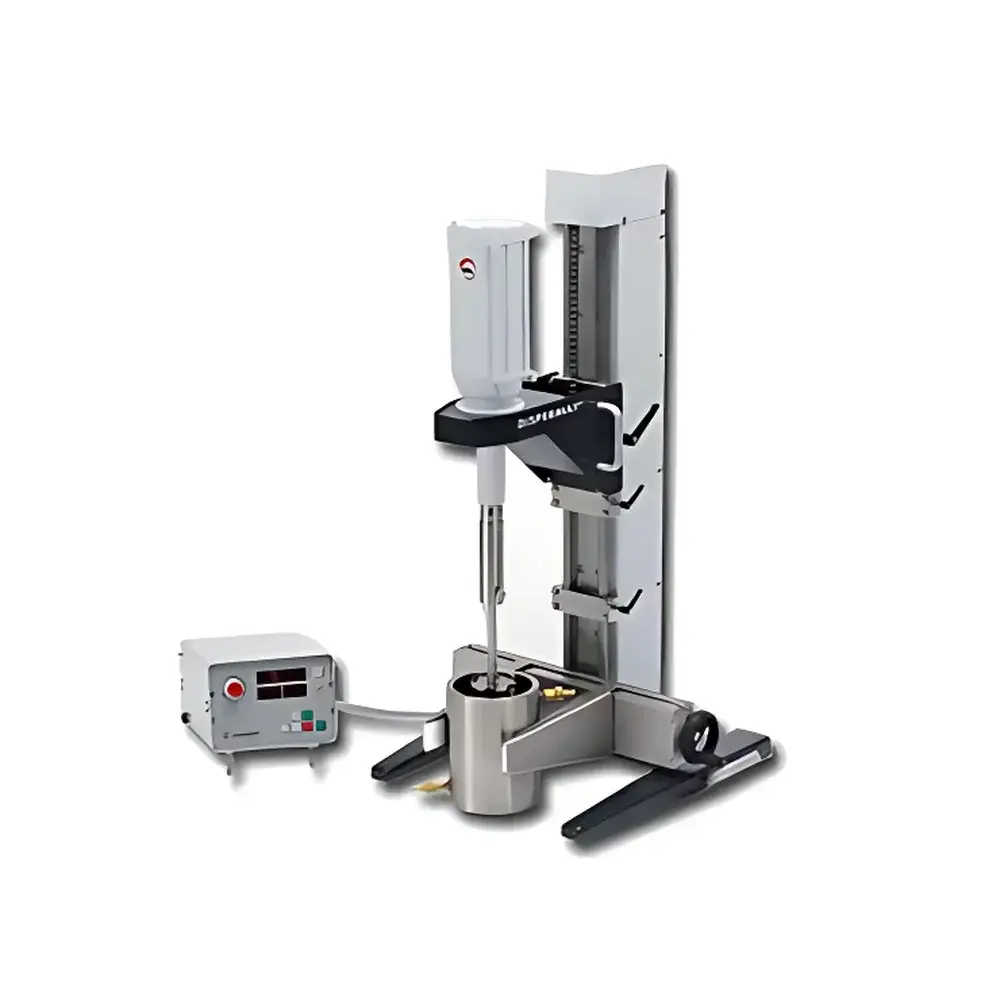
VMA DISPERMAT LC/CV High-Speed Laboratory Bead Mill & Disperser
| Brand | VMA |
|---|---|
| Origin | Germany |
| Equipment Type | Bead Mill (Wet Grinding & Dispersion) |
| Model | LC/CV Series |
| Sample Suitability | Soft to Medium-Hard Materials |
| Feed Particle Size | <15 mm |
| Final Output Particle Size | <40 µm (down to 0.01 mm in optimized conditions) |
| Batch Volume Range | 500 mL – 3 L |
| Compliance | CE, ISO 9001, Designed for GLP/GMP-Compliant Labs |
Overview
The VMA DISPERMAT LC/CV is a high-precision, modular high-speed laboratory bead mill and disperser engineered for reproducible wet grinding, dispersion, and homogenization of suspensions, pastes, and viscous formulations. Based on the Couette flow principle, it utilizes high-shear rotor-stator geometry combined with controlled media circulation to achieve consistent particle size reduction down to sub-40 µm — with process optimization enabling stable output below 10 µm in suitable matrix systems. Designed and manufactured in Germany, the LC/CV platform integrates interchangeable grinding modules (APS, TML, CDS, SR, ASC) to support diverse operational requirements — from vacuum-assisted deaeration and pressurized milling to nanoscale dispersion using ceramic or zirconia beads. Its robust cast-aluminum frame, precision-machined vertical column, and thermally stable motor housing ensure long-term dimensional stability and minimal vibration during operation at speeds up to 20,000 rpm.
Key Features
- Modular system architecture supporting five interchangeable process modules: APS (sealable batch bead mill), TML (basket-type bead mill), CDS (vacuum dispersion system), SR (rotor-stator emulsification), and ASC (scraping system for high-viscosity materials)
- Digital speed control with real-time torque monitoring (CV models), integrated timer, and optional temperature sensing for process traceability
- CE-certified safety design including automatic motor cutoff upon lid removal, mechanical interlock on cup clamping, and overload protection
- Stainless steel or epoxy-coated lift columns with fine-pitch lead screws for smooth, repeatable height adjustment and precise immersion depth control
- Motor cooling via forced-air convection; low-noise operation (<65 dB(A) at 1 m) even at maximum rotational speed
- Compatibility with DIN-standard dispersing discs, grinding baskets, and media retention screens (mesh sizes from 50 µm to 500 µm)
Sample Compatibility & Compliance
The DISPERMAT LC/CV accommodates a broad spectrum of sample rheologies — from low-viscosity aqueous dispersions to non-flowing pastes (up to 10⁶ mPa·s with ASC module). Feed material must be pre-sieved to ≤15 mm to prevent feed blockage. Final particle size distribution is validated per ISO 13320 (laser diffraction) or ASTM D4467 (sedimentation analysis), depending on application context. All contact parts comply with FDA 21 CFR 177.2600 for food-contact polymers and USP Class VI biocompatibility standards where applicable. The system supports audit-ready documentation workflows aligned with GLP and GMP Annex 11 requirements, including electronic signature-capable software logging of speed, time, torque, and temperature events.
Software & Data Management
While the base LC/CV operates via intuitive front-panel controls, optional PC interface enables full data capture and export in CSV format. The VMA LabControl software (v3.2+) provides real-time graphical display of torque vs. time curves, automatic calculation of energy input (kWh/kg), and comparative analysis across multiple batches. All parameter changes are timestamped and user-logged, satisfying FDA 21 CFR Part 11 requirements for electronic records when paired with role-based access control and audit trail activation. Raw sensor data can be exported for integration into LIMS or ELN platforms via standard OPC UA or Modbus TCP protocols.
Applications
- Pre-formulation development of pigment dispersions, battery cathode slurries, and pharmaceutical nanosuspensions
- R&D-scale production of conductive inks, ceramic slurries, and functional coatings requiring narrow PSD (D90 < 50 µm)
- Quality control testing of raw material grindability and dispersion stability under accelerated shear conditions
- Method development for scale-up to pilot-scale agitated bead mills (e.g., VMA NETZSCH LabStar series)
- Validation studies for cleaning-in-place (CIP) procedures using CDS vacuum mode to assess residual carryover
FAQ
What is the difference between APS and TML grinding modules?
The APS (Active Process System) is a sealed jacketed vessel configuration where the entire grinding chamber rotates around a fixed disperser shaft, enabling true batch-wise media containment and pressure/vacuum operation. The TML (Turbo Mill Basket) uses a rotating basket immersed in stationary material; its internal impeller drives media circulation while an external pump wheel enhances axial flow — ideal for rapid recirculation and heat-sensitive applications.
Can the LC/CV be used for dry grinding?
No. The LC/CV is strictly a wet-grinding system requiring liquid medium and grinding media (e.g., zirconia, glass, or ceramic beads) to function safely and effectively. Dry operation risks catastrophic media jamming and motor overload.
Is calibration required before use?
Torque and speed sensors are factory-calibrated and require no routine recalibration. However, users should verify disperser disc concentricity and immersion depth against reference standards (e.g., ISO 8421) prior to critical experiments.
Which models support temperature monitoring?
Only CV3 and CV4 models include integrated Pt100 temperature probes compatible with optional external cooling jackets (e.g., Huber CC-K units) for exothermic processes.
What maintenance intervals are recommended?
Lubrication of lift column threads every 200 operating hours; inspection of disperser disc wear and shaft runout every 500 hours; annual verification of torque sensor linearity by authorized VMA service center.



