
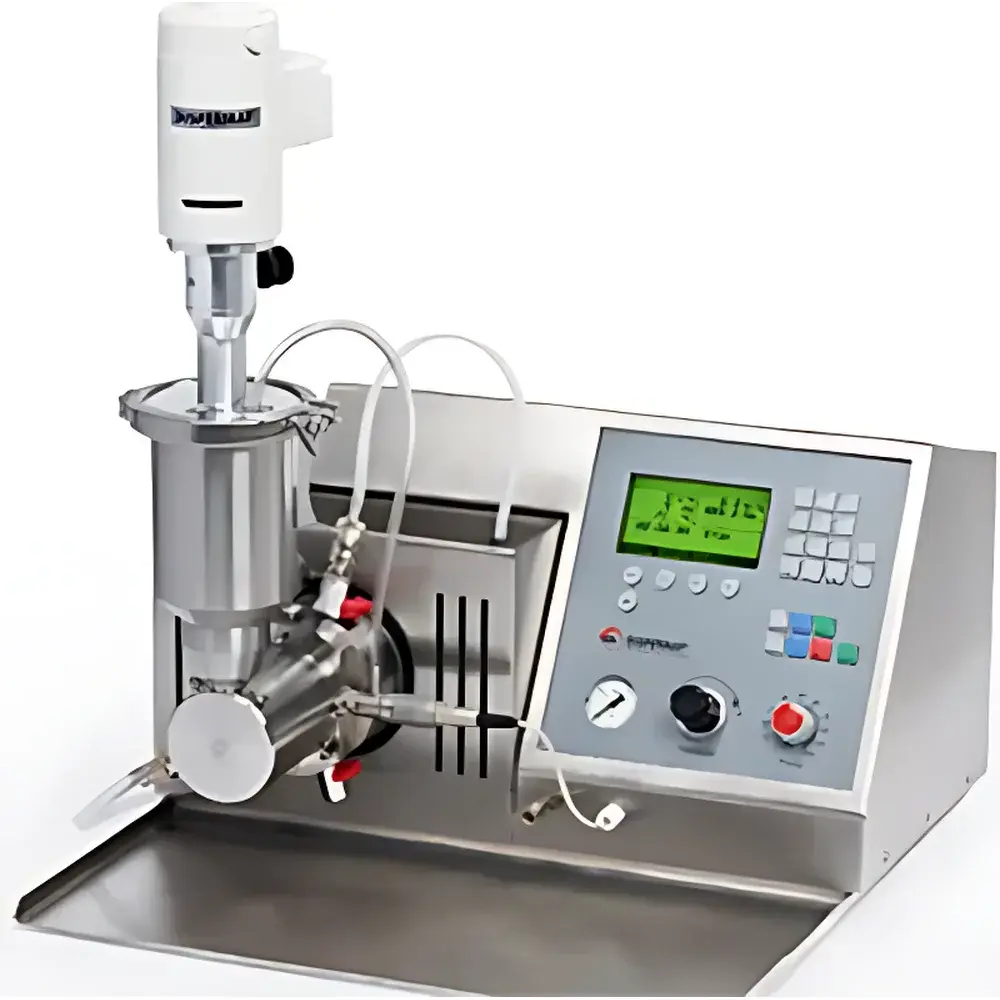
VMA DISPERMAT SL50 Digital High-Speed Disperser
| Brand | VMA |
|---|---|
| Origin | Germany |
| Model | SL50 |
| Construction | 316 Stainless Steel (wetted parts & frame) |
| ATEX Certified | II 2G Ex db IIB T4 Gb / II 2D Ex tb IIIB T135°C Db |
| Drive System | High-torque, brushless DC motor with closed-loop speed control |
| Speed Range | 0–6,000 rpm (digital display, ±0.5% full scale accuracy) |
| Max. Tip Speed | 22 m/s |
| Max. Viscosity Handling | Up to 50,000 mPa·s (with circulation mode) |
| Grinding Media Compatibility | 0.1 mm zirconia or stainless steel beads |
| Integrated Circulation Pump | Diaphragm-type, flow rate adjustable up to 12 L/min |
| Control Interface | C-Ex® and M-Ex® explosion-proof touchscreen HMI with programmable multi-step dispersion protocols |
| Compliance | ISO 8502-4, ASTM D1210, EN 60079-0, EN 60079-1, GLP-ready audit trail logging |
Overview
The VMA DISPERMAT SL50 Digital High-Speed Disperser is a precision-engineered laboratory-scale dispersion system designed for reproducible deagglomeration, wetting, and homogenization of complex formulations under controlled mechanical energy input. Operating on the principle of high-shear rotor-stator hydrodynamics, the SL50 delivers consistent energy density across batch and recirculation modes—enabling reliable particle size reduction and stable suspension formation in pigment dispersions, battery slurries, pharmaceutical suspensions, and advanced nanocomposites. Its modular architecture integrates a high-efficiency dispersing shaft, sealed circulation pump, and explosion-proof control electronics, making it suitable for R&D labs and pilot-scale process development where regulatory traceability, material compatibility, and operational safety are non-negotiable.
Key Features
- Explosion-proof certified (ATEX II 2G/2D) design for safe operation with flammable solvents, volatile monomers, or dust-laden environments—fully compliant with EN 60079 series standards.
- Brushless DC drive with closed-loop speed regulation ensures ±0.5% repeatability over the full 0–6,000 rpm range; digital tachometric feedback enables precise correlation between tip speed and shear rate.
- Full 316 stainless steel construction of all product-contact surfaces—including dispersing disc, pump head, valves, and housing—ensures corrosion resistance, cleanability, and compliance with FDA-recommended materials for pharmaceutical and food-grade applications.
- Integrated diaphragm circulation pump supports both batch and continuous recirculation modes; flow rate is independently adjustable (0–12 L/min), allowing optimization of residence time and shear history for shear-sensitive or highly viscous systems.
- Dual-control platform options: C-Ex® for basic parameter setting and real-time monitoring; M-Ex® for advanced protocol programming—including up to 10-step sequences with ramping, hold, and automatic shutdown logic, all stored with timestamped execution logs.
- Optimized rotor-stator geometry accommodates 0.1 mm grinding media (zirconia or stainless steel), enabling nano-scale dispersion without contamination risk—validated per ISO 8502-4 for residual metal ion release testing.
Sample Compatibility & Compliance
The SL50 handles Newtonian and non-Newtonian fluids across a broad rheological spectrum—from low-viscosity inks (30,000 mPa·s)—without requiring tooling change. Its recirculation capability extends applicability to high-solid-content pastes and thixotropic gels that cannot be processed effectively in static batch mode. All wetted components meet USP Class VI biocompatibility requirements and pass extractables testing per ASTM D1210 for pigment dispersion validation. The system supports GLP-compliant operation through optional firmware enabling 21 CFR Part 11–compliant electronic signatures, user access levels, and immutable audit trails for all parameter changes and run executions.
Software & Data Management
The M-Ex® control interface provides native CSV export of time-stamped process data—including speed, torque, temperature (via optional PT100 probe), pressure (with inline sensor), and cumulative energy input (kWh/kg). Data files are structured for direct import into LIMS or statistical process control platforms (e.g., JMP, Minitab). Firmware supports firmware version locking, configuration backup/restore, and remote diagnostics via Ethernet (TCP/IP). Audit trail records include operator ID, timestamp, parameter values pre- and post-modification, and reason-for-change annotation—fully aligned with Annex 11 and ALCOA+ data integrity principles.
Applications
- Development and QC of aqueous and solvent-based pigment dispersions for coatings, inks, and cosmetics.
- Rheological conditioning of Li-ion battery electrode slurries prior to coating—ensuring uniform particle distribution and minimizing agglomerate-induced defects.
- Stabilization of nanoparticle suspensions (e.g., TiO₂, SiO₂, quantum dots) for optical, catalytic, or biomedical use.
- Preparation of homogeneous ceramic and metal oxide slurries for tape casting or additive manufacturing feedstocks.
- Dispersive formulation of functional additives (e.g., carbon nanotubes, graphene flakes) into polymer matrices under inert atmosphere (with optional glovebox integration).
FAQ
What certifications does the SL50 hold for hazardous area operation?
The SL50 carries ATEX certification for both gas (II 2G Ex db IIB T4 Gb) and dust (II 2D Ex tb IIIB T135°C Db) environments, fully tested to EN 60079-0 and EN 60079-1 standards.
Can the SL50 be integrated into automated lab workflows?
Yes—via Modbus TCP or RS485, the SL50 supports external PLC coordination for synchronized start/stop, speed setpoint modulation, and status reporting within larger process automation frameworks.
Is cleaning validation supported out-of-the-box?
All fluid paths are accessible, crevice-free, and designed for CIP compatibility; optional validation kits include swab test templates and residue quantification SOPs aligned with ISO 14644-1 cleanliness class verification.
What maintenance intervals are recommended for long-term reliability?
The brushless motor requires no scheduled commutator servicing; annual calibration of speed/torque sensors and inspection of diaphragm pump seals are advised per VMA’s documented maintenance schedule (Document No. SL50-MNT-REV3).



