
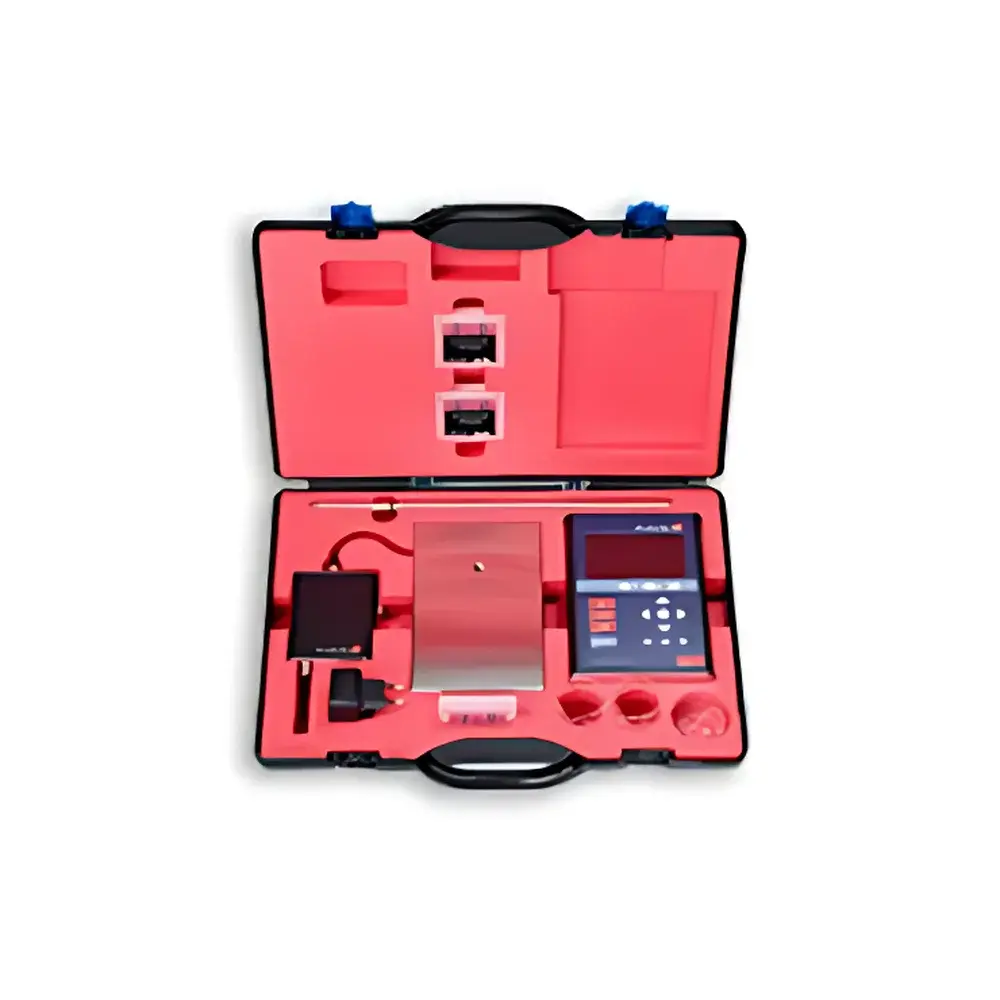
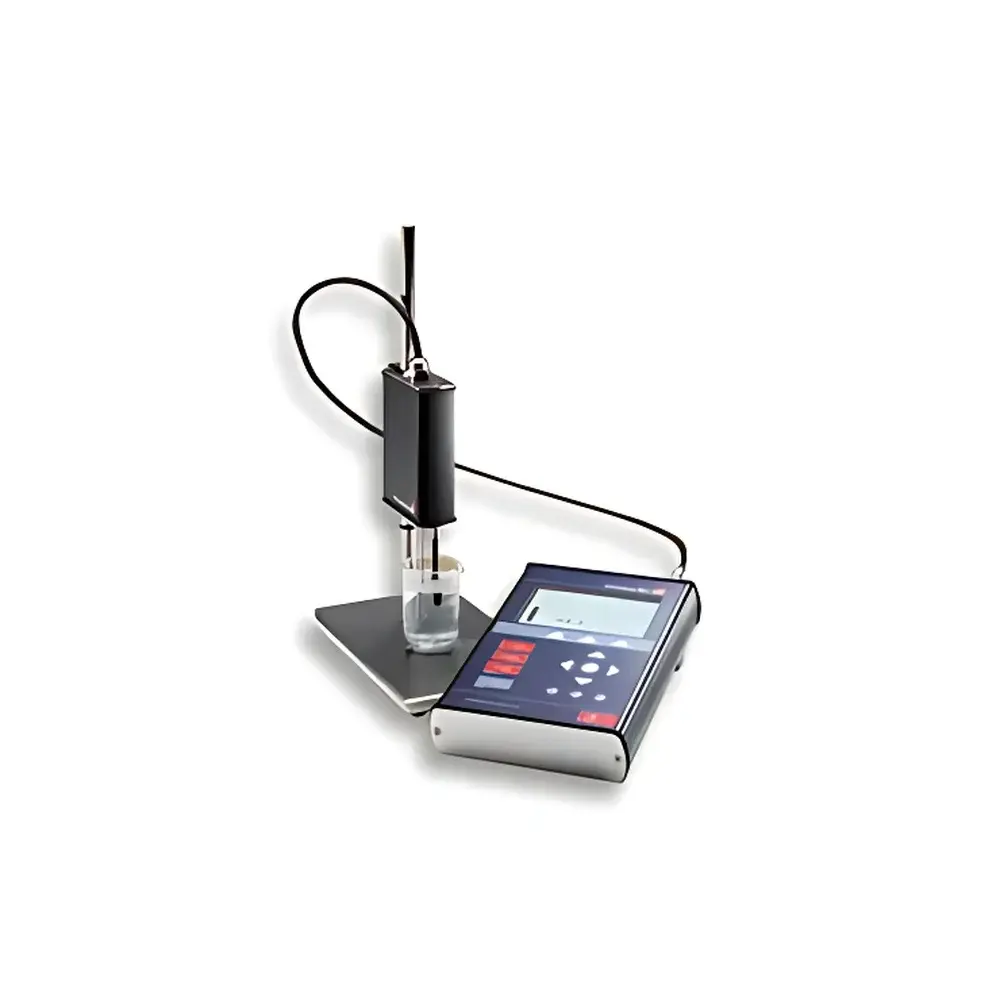
SITA t100 Dynamic Surface Tensiometer
| Brand | SITA |
|---|---|
| Origin | Germany |
| Model | t100 |
| Surface Tension Range | 10–100 mN/m |
| Resolution | 0.1 mN/m |
| Repeatability | ±0.5 mN/m |
| Bubble Lifetime Range | 15–100,000 ms |
| Temperature Control Range | −20 to +125 °C |
| Display | Color LCD |
| Power | USB 5 V/500 mA + Integrated Rechargeable Battery |
| Dimensions (Main Unit) | 200 × 140 × 60 mm |
| Weight | 1.87 kg |
Overview
The SITA t100 Dynamic Surface Tensiometer is an advanced, microprocessor-controlled instrument engineered for precise and reproducible measurement of dynamic surface tension using the maximum bubble pressure (MBP) method. Unlike traditional Wilhelmy plate or du Noüy ring techniques—whose results are sensitive to capillary immersion depth—the t100 eliminates this source of error by employing a gas-phase pressure differential approach: a calibrated micro-pump generates air bubbles through a fixed-diameter capillary immersed in the test liquid; as each bubble grows and detaches, the transient pressure inside the capillary is continuously monitored. The difference between the maximum and minimum pressure during bubble formation is directly related to surface tension via the Young–Laplace equation. This principle enables accurate quantification across a broad dynamic timescale—from highly transient interfacial processes (15 ms) to near-equilibrium conditions (100 s)—making the t100 particularly suited for characterizing surfactant adsorption kinetics, formulation stability, and interfacial relaxation behavior in R&D and QC environments.
Key Features
- Three operational modes: Auto (programmable bubble lifetime series), Online (continuous real-time monitoring), and Single (discrete point measurement)
- Immersion-depth-independent measurement architecture—no manual capillary positioning or recalibration required
- Integrated temperature-controlled sample stage with Peltier-based regulation (−20 °C to +125 °C), enabling thermodynamic surface tension profiling and aging studies
- High-resolution pressure transducer with ±0.5 mN/m repeatability and 0.1 mN/m resolution over 10–100 mN/m range
- Self-calibrating design using deionized water as reference standard—no external calibration fluids needed
- Portable form factor with built-in rechargeable battery (up to 8 h operation), rugged carry case, and USB-powered operation
- Color LCD touchscreen interface with intuitive menu navigation and on-device data review
Sample Compatibility & Compliance
The t100 accommodates aqueous and non-aqueous solutions, emulsions, polymer melts, and low-viscosity coatings without modification. Its open-cell design supports direct measurement of aggressive solvents and volatile formulations. All hardware and firmware comply with IEC 61326-1 (EMC for laboratory equipment) and IEC 61010-1 (safety requirements for electrical equipment). When operated with SITA-LabSolution software under controlled network conditions, audit trails, electronic signatures, and user access levels can be configured to support GLP/GMP workflows. While the instrument itself does not enforce 21 CFR Part 11 compliance, its data export formats (CSV, XML, PDF) and timestamped raw-data logging facilitate integration into validated laboratory information management systems (LIMS).
Software & Data Management
SITA-LabSolution is a Windows-based application designed for full experimental automation and traceable data handling. It enables users to define multi-step protocols—including variable bubble lifetimes, temperature ramps, concentration gradients, and replicate sequences—with programmable pause points and conditional logic. Up to four t100 units may be synchronized under a single software instance for parallel testing. All measurements are stored with metadata (operator ID, timestamp, environmental conditions, instrument serial number) in a local encrypted SQLite database. Reports are exportable in ISO/IEC 17025-compliant templates, including uncertainty estimation per ISO 14096 and statistical summaries (mean, SD, CV%). Raw pressure vs. time curves, surface tension vs. log(t) plots, and Arrhenius-type temperature dependencies are generated automatically.
Applications
- Surfactant characterization: Adsorption rate constants, critical micelle concentration (CMC) determination, and diffusion-controlled vs. kinetic-limited interface formation
- Formulation development: Stability assessment of agrochemical sprays, pharmaceutical emulsions, and personal care products under thermal stress or storage aging
- Quality control: Rapid verification of surfactant concentration in process streams using pre-established γ–c calibration curves
- Coating & ink R&D: Dynamic wettability prediction via surface tension evolution at millisecond-scale interfaces
- Academic research: Interfacial rheology coupling studies when integrated with optional oscillatory bubble modules
FAQ
What measurement principle does the t100 use, and why is it advantageous for dynamic analysis?
It employs the maximum bubble pressure (MBP) method, which captures surface tension evolution across five orders of magnitude in interface age (15 ms to 100 s) without mechanical repositioning or operator intervention.
Can the t100 measure surface tension of non-aqueous systems such as silicone oils or organic solvents?
Yes—provided the test liquid is non-corrosive to stainless steel capillaries and compatible with ambient air or inert purge gas (e.g., N₂, Ar) as the bubbling medium.
Is temperature control mandatory for accurate surface tension measurement?
While not mandatory, temperature stabilization is strongly recommended: surface tension exhibits well-documented thermal dependence (typically −0.1 to −0.2 mN/m per °C for aqueous surfactants), and uncontrolled drift compromises reproducibility.
How is calibration performed, and how often is it required?
Calibration uses deionized water at 25 °C (γ = 72.0 mN/m) and is fully automated; routine verification is advised before each analytical session or after extended idle periods.
Does the t100 support remote operation or integration with PLC-based manufacturing systems?
Via SITA-LabSolution’s TCP/IP API and OPC UA-compatible data export, the t100 can feed real-time surface tension values into SCADA or MES platforms for closed-loop process control applications.



