
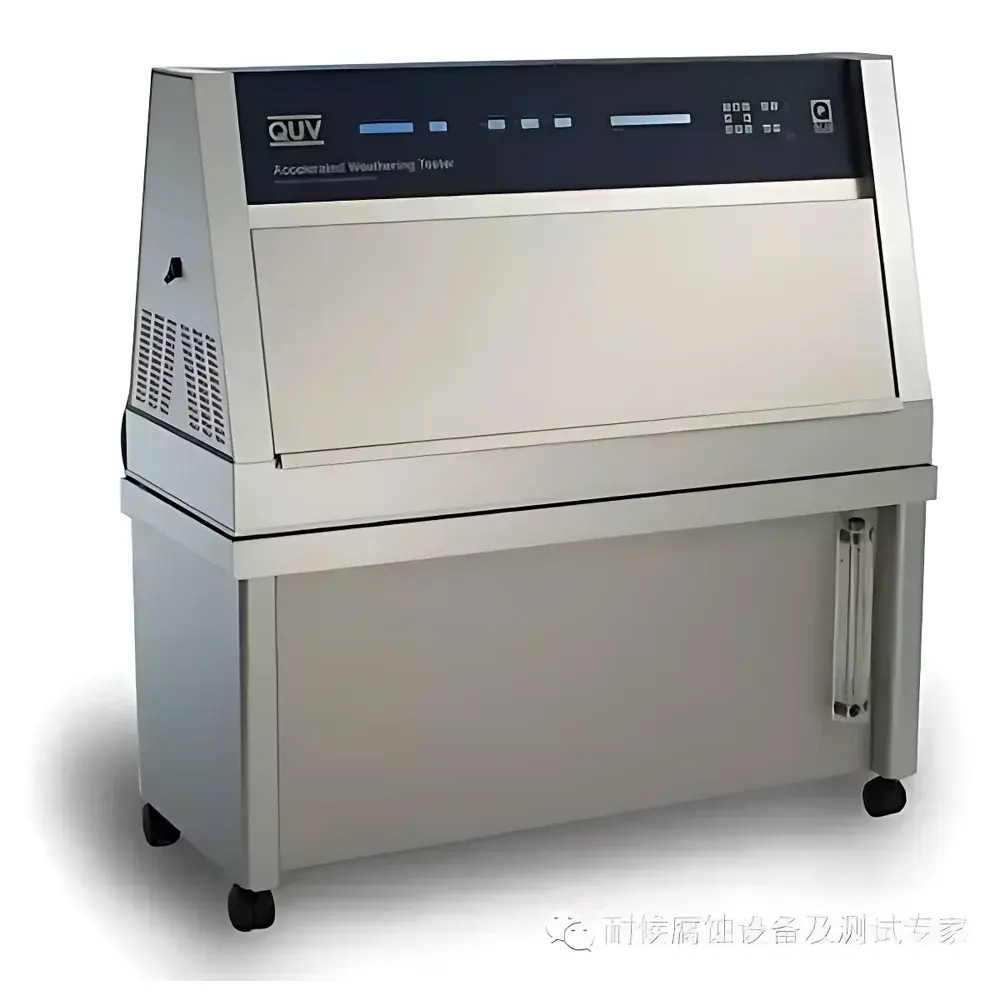
Q-LAB QUV/spray Ultraviolet Accelerated Weathering Tester
| Brand | Q-LAB |
|---|---|
| Origin | USA |
| Model | QUV/spray |
| UV Wavelength Range | 280–340 nm |
| Sample Capacity | 48 specimens (75 × 150 mm) |
| Condensation Temperature Range | 40–60 °C |
| Irradiance Control | Solar Eye® closed-loop feedback system |
| Lamp Options | UVA-340, UVB-313, Cool White fluorescent |
| Lamp Lifetime (avg.) | 5,000 h (UVA-340/UVB-313) |
| Power Supply | 120/60 V/Hz, 20 A or 230/50–60 V/Hz, 9 A |
| Water Consumption | 8 L/day (condensation) + spray cycle |
| Compliance | ASTM G154, ISO 4892-3, SAE J2020, JIS D0205, GB/T 14522, FDA 21 CFR Part 11 (software-enabled audit trail) |
Overview
The Q-LAB QUV/spray Ultraviolet Accelerated Weathering Tester is an industry-standard benchtop environmental test chamber engineered for precision simulation of short-wavelength ultraviolet (UV) radiation, condensation, and water spray—key stressors driving photochemical degradation in polymeric, coated, and composite materials. Unlike full-spectrum xenon arc testers, the QUV/spray operates on a targeted photobiological principle: it replicates the most damaging segment of terrestrial solar irradiance—the UV-B and UV-A bands (280–340 nm)—where photon energy exceeds bond dissociation thresholds for C–C, C–H, and C–O linkages. This wavelength-selective approach enables accelerated, mechanistically relevant aging with high reproducibility across laboratories. The system integrates three distinct exposure phases within a single cyclic program: UV irradiation (controlled by calibrated fluorescent lamps), dark condensation (simulating nocturnal dew formation via saturated humidity at elevated temperature), and automated water spray (mimicking rain-induced thermal shock and surface leaching). Cycle duration, irradiance setpoint, and phase sequencing are programmable per ASTM G154 Annex A1–A5, supporting both standard and custom protocols.
Key Features
- Solar Eye® irradiance control: Closed-loop optical feedback system continuously monitors real-time UV intensity at specimen plane and dynamically adjusts lamp output to maintain ±3% setpoint accuracy over lamp lifetime—eliminating manual recalibration and ensuring inter-laboratory comparability.
- Dual-mode exposure capability: Independent condensation and spray modules allow orthogonal stress application—e.g., UV + condensation for coating blistering studies, or UV + spray for automotive clearcoat erosion assessment.
- Modular lamp architecture: Interchangeable UVA-340 (sunlight-spectrum match down to 295 nm), UVB-313 (enhanced degradation for quality control), and Cool White fluorescent (for non-UV-specific yellowing tests) lamp arrays—each rated for 5,000 hours mean time to failure under continuous operation.
- ISO 17025-aligned calibration traceability: Built-in NIST-traceable UV radiometer with annual verification protocol; optional factory calibration certificate available per ISO/IEC 17025 requirements.
- Intuitive multilingual HMI: Touchscreen interface with five language options (English, French, Spanish, Italian, German); password-protected user levels for operator, technician, and administrator roles; GLP-compliant event logging with timestamped audit trail.
Sample Compatibility & Compliance
The QUV/spray accommodates up to 48 flat specimens (75 mm × 150 mm) mounted on standardized aluminum racks, ensuring uniform irradiance distribution per IEC 60068-2-5. Specimen holders are compatible with rigid plastics, painted metal panels, elastomers, textile laminates, and aerospace composites—provided thickness does not exceed 25 mm and thermal mass remains within chamber thermal inertia limits. Regulatory alignment includes full conformance with ASTM G154 (Standard Practice for Operating Fluorescent Ultraviolet (UV) Lamp Apparatus for Exposure of Non-Metallic Materials), ISO 4892-3 (Plastics — Methods of Exposure to Laboratory Light Sources — Part 3: Fluorescent UV Lamps), SAE J2020 (Automotive Exterior Materials), and JIS D0205 (Japanese Automotive Paint Standards). When configured with validated software and electronic signature modules, the system supports 21 CFR Part 11 compliance for pharmaceutical packaging stability testing and medical device material qualification under FDA-regulated environments.
Software & Data Management
QUV/spray systems ship with Q-Lab’s proprietary Windows-based Q-Support™ software, enabling remote monitoring, multi-chamber synchronization, and automated report generation in PDF or CSV formats. The software enforces ALCOA+ data integrity principles: Attributable (user ID + timestamp on all parameter changes), Legible (unambiguous numeric display), Contemporaneous (real-time logging without post-hoc edits), Original (raw sensor data preserved in encrypted binary files), Accurate (checksum-verified data transmission), Complete (full cycle history including alarms and lamp replacements), Consistent (chronological sequence enforced), Enduring (10-year retention policy configurable), and Available (role-based access to historical datasets). Audit trails are exportable for regulatory inspection and include metadata on firmware version, calibration status, and environmental deviations exceeding ±1.5 °C or ±5% irradiance tolerance.
Applications
- Polymer formulation development: Quantifying carbonyl index growth via FTIR correlation with QUV exposure time to predict service life of PVC roofing membranes.
- Aerospace coating validation: Assessing gloss retention and color shift (ΔE*cmc) of polyurethane topcoats per Boeing D6-17487 Rev. P after 1,000 h UV + condensation cycles.
- Automotive interior materials: Evaluating fogging resistance of instrument panel substrates under UV + spray thermal cycling per GMW14124.
- Medical device packaging: Verifying seal integrity and print legibility of Tyvek® pouches subjected to accelerated UV aging per ISO 11607-1 Annex B.
- Renewable energy components: Screening UV stability of EVA encapsulants in photovoltaic modules per IEC 61215-2 MQT10.
FAQ
What distinguishes QUV/spray from xenon arc weatherometers?
The QUV/spray targets only the 280–340 nm UV band—the primary driver of polymer chain scission—while xenon arc systems replicate full-spectrum sunlight (295–800 nm). QUV delivers higher acceleration factors for UV-sensitive materials but cannot assess IR-induced thermal degradation or visible-light fading mechanisms.
Is lamp spectral output certified per ISO 4892-3?
Yes. Each UVA-340 lamp batch undergoes spectroradiometric certification against ISO 4892-3 Annex B reference spectra, with spectral deviation reports provided upon request.
Can the QUV/spray meet GLP requirements for regulated testing?
When deployed with Q-Support™ software v5.2+, enabled electronic signatures, and documented calibration procedures, the system satisfies OECD GLP Principles Section 5.2.1 for analytical instrumentation.
How is water quality managed during spray cycles?
Deionized water (resistivity ≥1 MΩ·cm) is recommended to prevent mineral deposition on specimens; integrated conductivity sensors trigger maintenance alerts if feedwater purity falls below specification.
What maintenance intervals are required for long-term reliability?
Lamp replacement every 5,000 h, reflector cleaning every 500 h, and quarterly verification of thermocouple calibration against NIST-traceable references constitute the manufacturer-recommended preventive maintenance schedule.



