
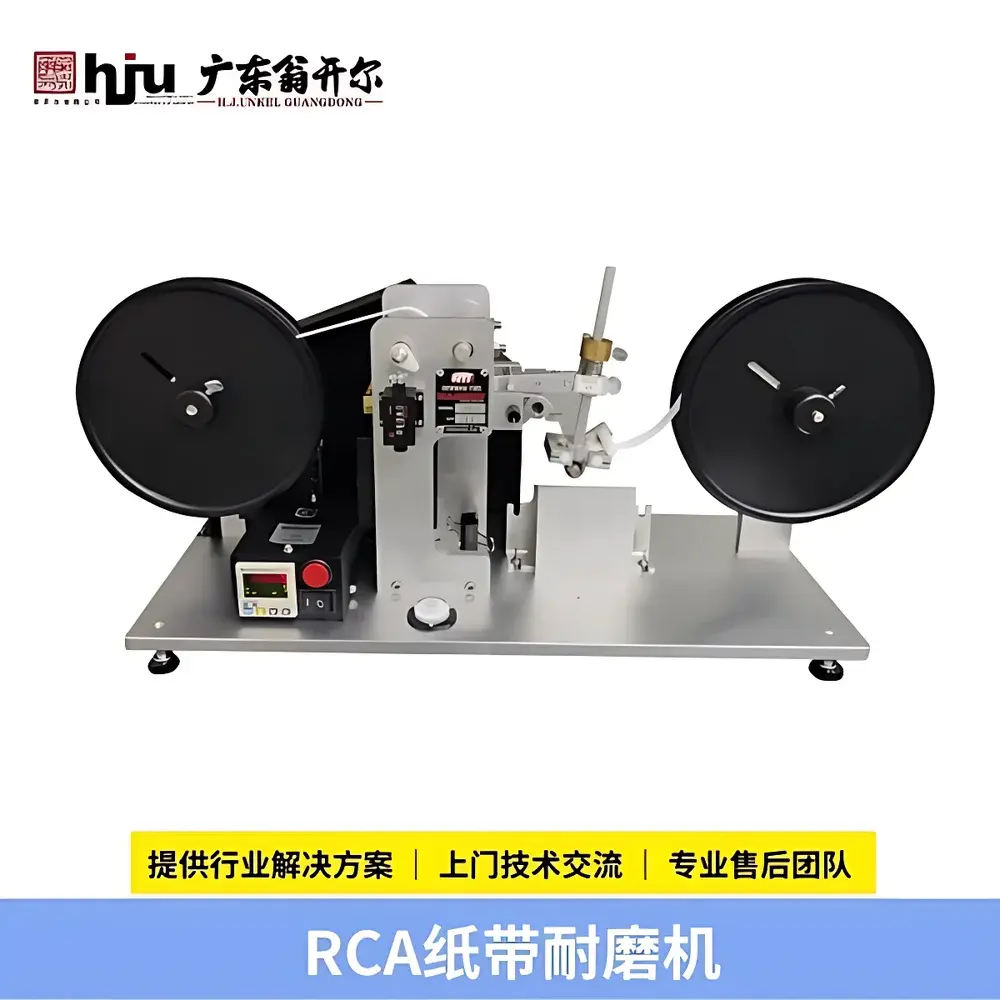
Norman Tool 7-IBB-CC RCA Abrasion Tester
| Brand | Norman Tool |
|---|---|
| Origin | USA |
| Model | 7-IBB-CC |
| Load Options | 55 g, 175 g, 275 g |
| Counter Type | Digital LCD (0–999,999 cycles) |
| Sample Mounting | Flat & 3D fixtures |
| Compliance | ASTM F2357-04 |
| Power Supply | 220 V, 50/60 Hz, 5 A |
| Weight | ~17 kg |
| Accessories | Calibration plate (certified), surface level gauge, hex key set, LED magnifier, two counterweights, three O-rings, 3D sample holder |
Overview
The Norman Tool 7-IBB-CC RCA Abrasion Tester is a precision-engineered tribological instrument designed to quantitatively evaluate the abrasion resistance of thin surface coatings and decorative finishes on polymeric, metallic, and composite substrates. Operating on the standardized RCA (Rubbing Cloth Abrasion) principle, it employs a rotating abrasive paper tape—typically 3M Scotch-Brite or equivalent—driven at a constant linear velocity via a motorized roller assembly. A calibrated normal load is applied through a lever-arm mechanism to a hardened steel or ceramic friction head, which maintains consistent contact pressure against the test specimen. The number of rotational cycles required to expose substrate material or reach a predefined wear threshold serves as the primary performance metric. This method provides high repeatability for comparative ranking of coating durability under controlled mechanical stress, making it especially relevant for quality assurance in consumer electronics manufacturing.
Key Features
- Dual-load calibration system with three standard test weights (55 g, 175 g, 275 g), enabling method flexibility across soft elastomers, hard plastics, and anodized metals
- Digital LCD cycle counter (0–999,999) with programmable stop function—eliminates operator dependency and supports automated endpoint detection
- Modular sample fixation: interchangeable flat-stage and 3D contoured holder accommodate planar PCBs, curved smartphone housings, and irregular PDA casings
- Integrated LED magnifier (10×) mounted on adjustable arm for real-time visual assessment of wear progression without sample removal
- Robust cast-aluminum frame and precision-ground roller shaft ensure long-term dimensional stability and minimal runout (<0.02 mm)
- Compliant with ASTM F2357-04 “Standard Test Method for Measuring Abrasion Resistance of Printed or Coated Surfaces Using the RCA Abrasion Test”
Sample Compatibility & Compliance
The 7-IBB-CC accommodates specimens up to 150 mm × 150 mm × 30 mm in dimension and is routinely deployed for evaluating ink adhesion on polycarbonate keypads, anti-fingerprint coatings on aluminum alloy laptop lids, UV-cured acrylic topcoats on ABS enclosures, and vapor-deposited metallization layers on PET films. Its mechanical design satisfies dimensional and force-tolerance requirements outlined in ASTM F2357-04, including specified roller diameter (12.7 mm ± 0.1 mm), tape tension control (±5%), and load application geometry. While not certified to ISO 5470-1 or DIN EN ISO 1518-1, its operational parameters align closely with those standards’ abrasion protocols—enabling cross-method correlation when validated per laboratory SOPs. The instrument supports GLP-compliant documentation when paired with audit-trail-enabled data logging software.
Software & Data Management
The 7-IBB-CC operates as a standalone electromechanical tester with no embedded firmware or network interface. However, its digital counter output (TTL pulse signal) can be integrated into external PC-based acquisition systems via optional I/O modules. Laboratories implementing 21 CFR Part 11 compliance may record cycle counts manually into validated LIMS platforms or use timestamped video capture synchronized with counter readouts. Norman Tool supplies traceable calibration certificates for the included certified reference plate (NIST-traceable surface roughness and hardness verification), supporting metrological traceability in ISO/IEC 17025-accredited environments. All mechanical adjustments—including lever-arm zeroing and roller parallelism—are documented in the user manual with torque specifications and calibration intervals.
Applications
- Quantitative validation of screen-printed legends on membrane switches prior to mass production release
- Comparative wear screening of hydrophobic nano-coatings on touch-panel overlays
- Process qualification of plasma-enhanced chemical vapor deposition (PECVD) SiO₂ barrier layers on flexible OLED substrates
- Supplier qualification testing for electroplated chrome trim on automotive interior components
- Accelerated aging studies correlating RCA cycles to field failure modes observed in handheld device drop tests
- Internal R&D benchmarking of novel UV-curable acrylate formulations against commercial benchmarks
FAQ
What is the difference between the 7-IBB and 7-IBB-CC models?
The 7-IBB uses a mechanical rotary counter, while the 7-IBB-CC features a programmable digital LCD counter with reset, pause, and preset stop functionality.
Can the tester be used with non-standard abrasive tapes?
Yes—provided tape width (19 mm nominal), backing material compatibility, and tensile strength meet ASTM F2357-04’s mechanical constraints; users must validate correlation against certified reference tapes.
Is the calibration plate NIST-traceable?
Yes—the supplied calibration plate includes a certificate of conformance with traceability to NIST SRM 2134 (surface roughness) and SRM 2135 (microhardness).
Does the instrument comply with FDA or EU regulatory requirements?
It is not a medical device nor subject to direct FDA regulation; however, its ASTM-compliant operation supports quality system evidence generation under ISO 13485 and MDR Annex II documentation requirements.
How often should the O-rings and roller bearings be replaced?
Norman Tool recommends inspection every 500 operational hours and replacement every 2,000 hours or upon visible compression set or eccentric wear—documented in Maintenance Log Sheet Rev. 3.2.



