
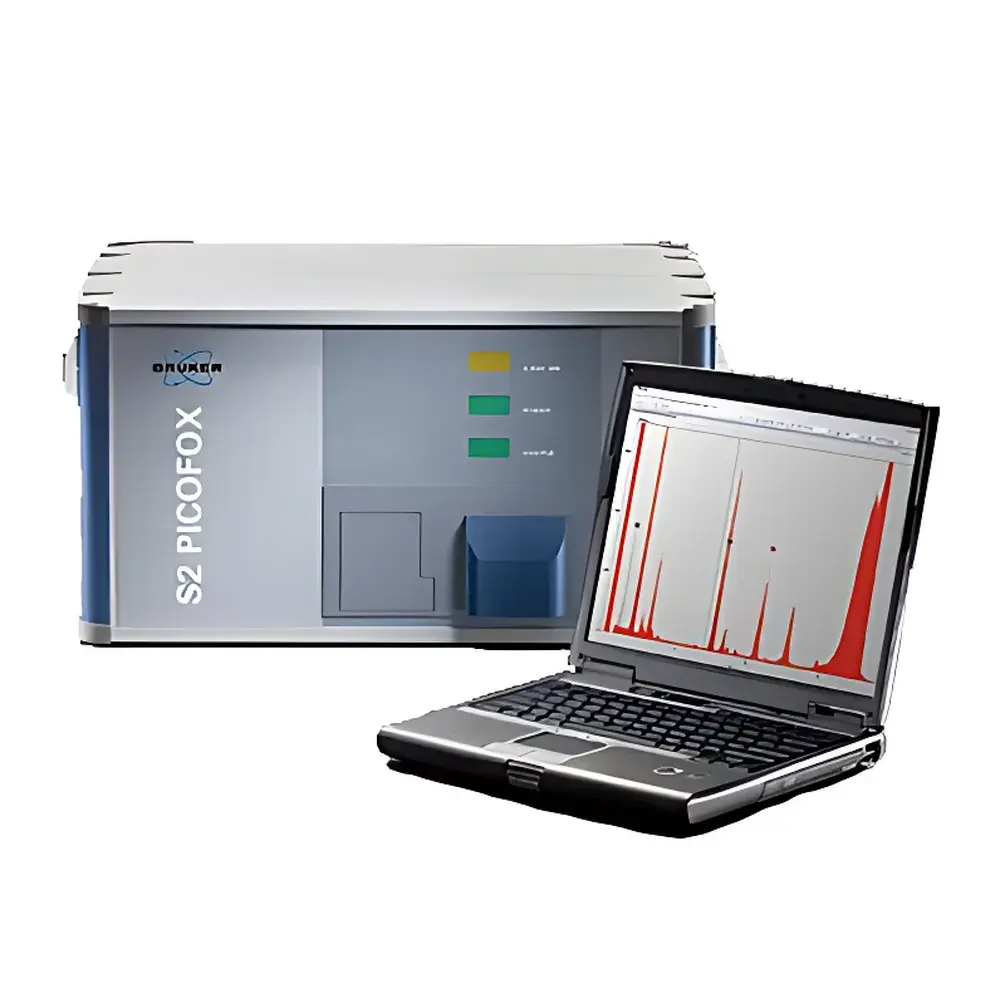
Bruker S2 PICOFOX Total Reflection X-Ray Fluorescence Spectrometer
| Brand | Bruker |
|---|---|
| Origin | Germany |
| Model | S2 PICOFOX |
| Configuration | Benchtop |
| Application Type | General Purpose |
| Elemental Range | Al (13) to U (92) |
| Detection Limit | down to 2 pg |
| Quantification Range | sub-ppb to 100% |
| Energy Resolution | <125 eV at Mn Kα (low count rate), <135 eV at Mn Kα (high count rate, 100 kcps) |
| Repeatability | ≤0.1% RSD |
| Detector | Fourth-generation XFlash® Silicon Drift Detector (SDD) with Peltier cooling |
| Sample Volume | 1–50 µL (liquids/suspensions), ≤10 µg (powders) |
| Automation Options | 1-position or 25-position auto-samplers |
Overview
The Bruker S2 PICOFOX is a benchtop total reflection X-ray fluorescence (TXRF) spectrometer engineered for ultra-trace elemental analysis with exceptional sensitivity, precision, and operational simplicity. Unlike conventional energy-dispersive X-ray fluorescence (ED-XRF) systems, TXRF operates on the principle of total external reflection: an incident X-ray beam strikes a flat, polished quartz carrier at a grazing angle (<0.1°), generating an evanescent wave that excites only the nanometer-thin sample layer deposited on the surface. This geometry suppresses background scattering from the substrate and matrix, resulting in signal-to-background ratios exceeding 10⁶ and enabling detection limits as low as 2 pg per element — equivalent to sub-part-per-quadrillion (sub-ppt) mass concentrations in liquid samples. The system is fully self-contained, requiring no liquid nitrogen, vacuum pumps, shielding gases, or external chiller units. Its compact footprint and robust mechanical design support deployment in regulated laboratories, field-mobile applications, and cleanroom environments alike.
Key Features
- Fourth-generation XFlash® silicon drift detector (SDD) with integrated Peltier cooling — eliminates cryogenic dependencies while maintaining high count-rate capability (up to 100 kcps) and energy resolution <125 eV at Mn Kα under low-flux conditions
- Grazing-incidence optics with monochromatic Mo Kα excitation (17.4 keV) and fixed-beam geometry optimized for reproducible total reflection conditions
- Pre-calibrated factory quantitative method library covering Al (Z=13) through U (Z=92); enables rapid quantification without user-prepared standards or matrix-matched calibration curves
- Two automated sampling configurations: single-position manual stage for rapid screening and 25-position programmable autosampler for unattended batch analysis (compatible with standard 10 mm quartz carriers)
- Integrated sample preparation module support — accommodates dried droplets, filtered residues, thin films, suspended particulates, digested biological fluids, and homogenized powders with minimal handling
- Compliance-ready firmware architecture supporting audit trails, electronic signatures, and data integrity protocols aligned with FDA 21 CFR Part 11 and EU Annex 11 requirements
Sample Compatibility & Compliance
The S2 PICOFOX accepts a broad range of sample forms without digestion or dilution: aqueous solutions, acid-digested environmental extracts, blood/urine supernatants, airborne particulate filters, thin-film coatings, and microgram-scale solid powders. All analyses are performed on disposable 10 mm × 10 mm quartz carriers, ensuring cross-contamination avoidance and traceability. The instrument meets IEC 61000-6-3 (EMC) and IEC 61010-1 (safety) standards. Its measurement methodology is referenced in ISO 18507:2021 (Water quality — Determination of trace elements by TXRF) and ASTM D8013-19 (Standard Practice for Trace Element Analysis of Aqueous Samples by TXRF). Routine performance verification follows Bruker’s certified QC protocol using NIST-traceable multielement standards.
Software & Data Management
The proprietary Bruker ESPRIT™ software provides full control over acquisition parameters, spectral deconvolution (using fundamental parameter-based modeling), peak integration, and quantification workflows. It supports GLP/GMP-compliant operation via role-based access control, secure user authentication, versioned method storage, and immutable raw-data archiving. All spectra and results are stored in vendor-neutral .spc and .csv formats; metadata includes timestamp, operator ID, carrier ID, ambient temperature/humidity logs, and detector live-time correction factors. Integration with LIMS platforms is enabled via ASTM E1384-compliant XML export and ODBC connectivity.
Applications
The S2 PICOFOX delivers validated performance across regulated and research domains: quantification of heavy metals (As, Cd, Pb, Hg) in drinking water per EPA Method 200.9; speciation-independent total element screening in pharmaceutical excipients (ICH Q3D); toxic element monitoring in clinical biofluids (e.g., urinary As/Bi/Cd for occupational exposure assessment); trace contamination analysis in semiconductor rinse water (Si, Fe, Cu, Ni at sub-ppq levels); and geochemical fingerprinting of rare earth elements in soil leachates. Its speed (<180 s per sample), minimal consumables, and lack of hazardous waste generation make it ideal for high-throughput environmental QA/QC labs and decentralized testing sites.
FAQ
Does the S2 PICOFOX require liquid nitrogen or vacuum pumping?
No — the XFlash® SDD uses thermoelectric (Peltier) cooling, and all measurements are conducted under ambient air conditions. No external gas supply, vacuum, or cryogens are needed.
Can it quantify light elements such as sodium or magnesium?
Yes — the system covers Z = 13 (Al) and higher; Na (Z = 11) and Mg (Z = 12) fall below the detectable range due to absorption in air and detector entrance window limitations.
Is method validation support available for regulatory submissions?
Yes — Bruker provides IQ/OQ documentation packages, uncertainty estimation templates per ISO/IEC 17025, and application notes aligned with USP /, EP 2.4.20, and CLSI EP29-A guidelines.
What is the typical throughput with the 25-position autosampler?
At standard 120 s acquisition time per sample and 10 s robotic positioning, up to 700 samples can be processed unattended per 24-hour cycle.
How is spectral interference managed during multi-element analysis?
ESPRIT™ employs iterative least-squares fitting with physically constrained background modeling and peak-shape libraries derived from first-principles simulations, minimizing overlap artifacts even for adjacent L-lines (e.g., Pb Mα / As Kα).




