
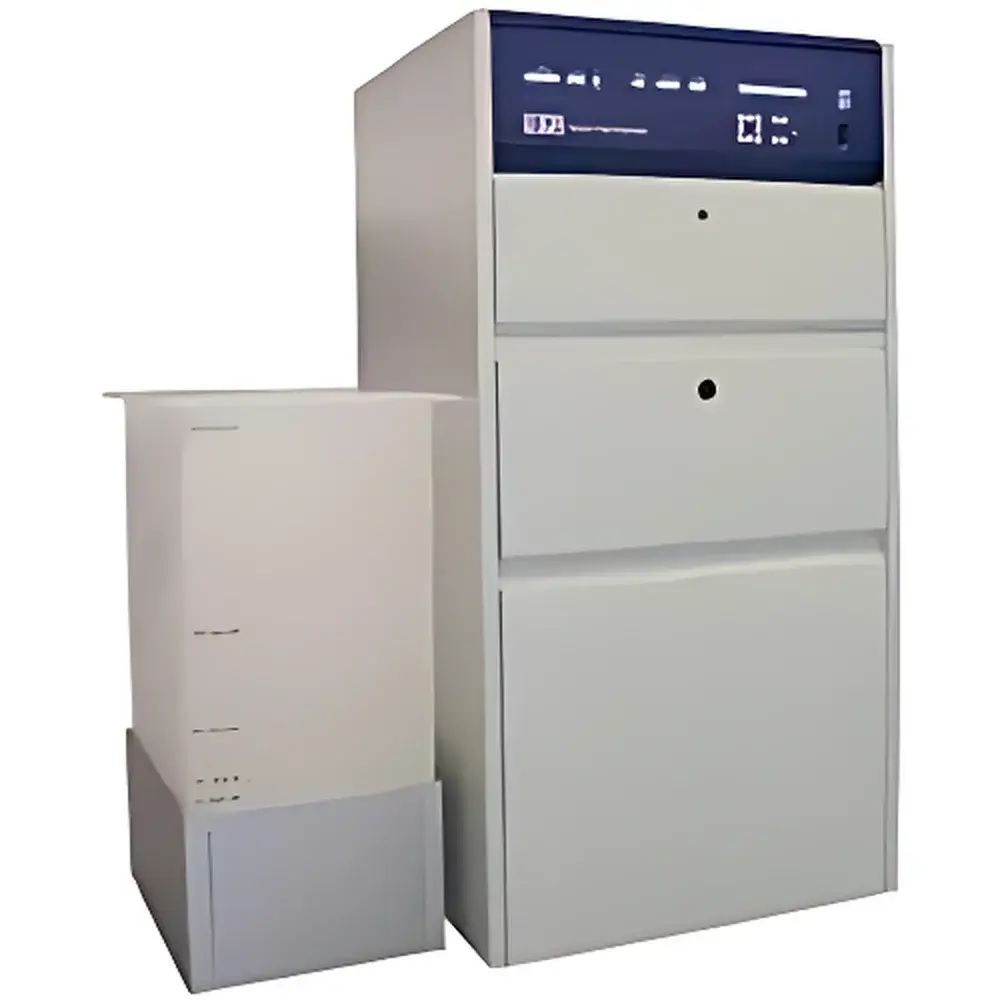
Q-LAB Xe-3 Xenon Arc Weathering Test Chamber Compliant with ASTM G155
| Brand | Q-LAB |
|---|---|
| Origin | USA |
| Model | Xe-3 |
| Light Source | Air-Cooled Xenon Arc Lamp (3 Lamps) |
| Spectral Filtering Options | Daylight, Window Glass, Extended UV |
| Irradiance Control | 0.35–0.55 W/m² @ 340 nm (adjustable) |
| Temperature Range | 10–90 °C (operational, chamber air) |
| Humidity Range | 10–95% RH (non-condensing), programmable |
| Sample Capacity | Flat-panel or 3D specimens on sliding tray |
| Compliance | Fully engineered to meet ASTM G155, ISO 4892-2, SAE J2527, AATCC TM16, and GB/T 16422.2 |
Overview
The Q-LAB Xe-3 Xenon Arc Weathering Test Chamber is a precision-engineered environmental simulation system designed for accelerated weathering and light stability evaluation of polymeric, automotive, textile, coating, and architectural materials. It operates on the principle of xenon arc irradiation—utilizing high-intensity, air-cooled xenon lamps filtered to replicate the spectral power distribution (SPD) of terrestrial sunlight, including ultraviolet (UV), visible, and near-infrared (NIR) radiation. As specified in ASTM G155, this standard governs apparatus requirements, operational protocols, and calibration criteria for xenon arc exposure systems used in qualitative and comparative durability assessments. The Xe-3 chamber integrates three independently monitored xenon lamps with interchangeable optical filters—daylight, window-glass (borosilicate), and extended-UV—to emulate diverse real-world exposure conditions: direct outdoor sunlight, indoor through-glass exposure, or aggressive UV-accelerated testing. Its closed-loop irradiance control system maintains traceable, stable output at user-selected wavelengths (e.g., 0.35–0.55 W/m² @ 340 nm), ensuring repeatability across laboratories and compliance with interlaboratory reproducibility benchmarks defined in ISO/IEC 17025-accredited testing environments.
Key Features
- Air-cooled triple-xenon lamp architecture delivering uniform irradiance across large sample areas (up to 6,000 cm² exposure surface)
- Real-time, closed-loop irradiance monitoring and feedback control via calibrated silicon photodiode sensor with NIST-traceable calibration certificate
- Three standardized optical filter configurations: Daylight (quartz inner + borosilicate outer), Window Glass (CIRA-type), and Extended UV (for research-grade acceleration)
- Programmable temperature and humidity profiles with independent PID control loops; chamber air temperature range: 10–90 °C; relative humidity: 10–95% RH (non-condensing)
- Sliding horizontal sample tray enabling rapid loading/unloading of flat or three-dimensional specimens without tooling or disassembly
- Integrated black panel thermometer (BPT) and white panel thermometer (WPT) for surface temperature monitoring per ASTM G151
- Robust stainless-steel chamber construction with insulated double-wall housing and corrosion-resistant internal components
- Compliance-ready design supporting audit trails, calibration logs, and parameter locking for GLP/GMP-aligned workflows
Sample Compatibility & Compliance
The Xe-3 accommodates rigid and flexible substrates—including painted panels, plastic injection-molded parts, textile swatches, roofing membranes, and coated electronics—via its adjustable flat-panel tray system. Specimen dimensions up to 120 × 120 cm are supported, with optional fixtures for angled or vertical mounting. All operational parameters adhere strictly to ASTM G155 Section 2 requirements for lamp spectral output, filter aging management, irradiance uniformity (±15% across test area), and chamber environmental stability. The system further satisfies ISO 4892-2:2013 (Plastics — Methods of exposure to laboratory light sources — Part 2: Xenon-arc sources), SAE J2527 (Automotive Interior Materials), and AATCC TM16 (Textile Colorfastness). Filter spectral validation is performed using a calibrated spectroradiometer per Q-Lab Technical Bulletin LX-5060, confirming conformance to Table 2 limits for window-glass-filtered irradiance (290–800 nm). Routine maintenance—including lamp replacement every 1,500 hours and annual filter inspection—is documented in accordance with manufacturer-recommended intervals to preserve measurement integrity.
Software & Data Management
The Xe-3 operates under Q-Lab’s proprietary SunTest™ software platform, providing intuitive GUI-based programming of multi-segment exposure cycles (irradiance, temperature, humidity, spray, dark periods). All critical parameters—including cumulative radiant exposure (J/cm²), chamber setpoints, sensor readings, and alarm events—are logged with timestamped, tamper-evident records. Data export supports CSV, XML, and PDF formats compatible with LIMS integration. For regulated environments, optional 21 CFR Part 11 compliance packages include electronic signatures, role-based access control, and full audit trail functionality—ensuring data integrity during FDA, ISO 9001, or ICH Q5C submissions. Calibration history, lamp usage hours, and filter service dates are automatically archived and retrievable for internal audits or third-party inspections.
Applications
This chamber serves as a primary tool in R&D, quality assurance, and regulatory submission testing across multiple sectors. In automotive engineering, it validates exterior trim fade resistance per GMW14124 and interior material gloss retention under simulated dashboard exposure. Coating manufacturers employ it for ISO 11341 cyclic corrosion/weathering correlation studies. Textile labs use window-glass filtration to assess upholstery colorfastness under retail lighting conditions (AATCC TM16-2021). Photovoltaic module encapsulants undergo long-term UV stability screening aligned with IEC 61215-2 MQT10. Additionally, the Xe-3 supports method development for ISO 16474-2 and ASTM D4329 immersion-cycle protocols when integrated with optional water spray and condensation modules.
FAQ
Does the Xe-3 meet ASTM G155 requirements for spectral irradiance distribution?
Yes—the system is configured with NIST-traceable spectral filters and calibrated sensors to satisfy all spectral, irradiance uniformity, and environmental control clauses in ASTM G155-22.
What is the expected service life of the xenon lamps and optical filters?
Lamps are rated for 1,500 hours of operation under nominal irradiance settings; filters retain spectral fidelity for ≥3,000 hours when maintained per Q-Lab LX-5060 guidelines.
Can the Xe-3 perform cyclic testing with wet/dry phases?
Yes—optional water spray nozzles and humidity-controlled condensation cycles enable full compliance with ASTM G154 and ISO 4892-3 combined exposure protocols.
Is remote monitoring and data export supported?
SunTest™ software includes Ethernet connectivity, email alerting, and scheduled automated report generation with secure cloud backup options.
How is irradiance calibrated and verified?
Calibration uses a NIST-traceable reference radiometer; quarterly verification is recommended, with full recalibration available through Q-Lab Certified Service Centers.



