
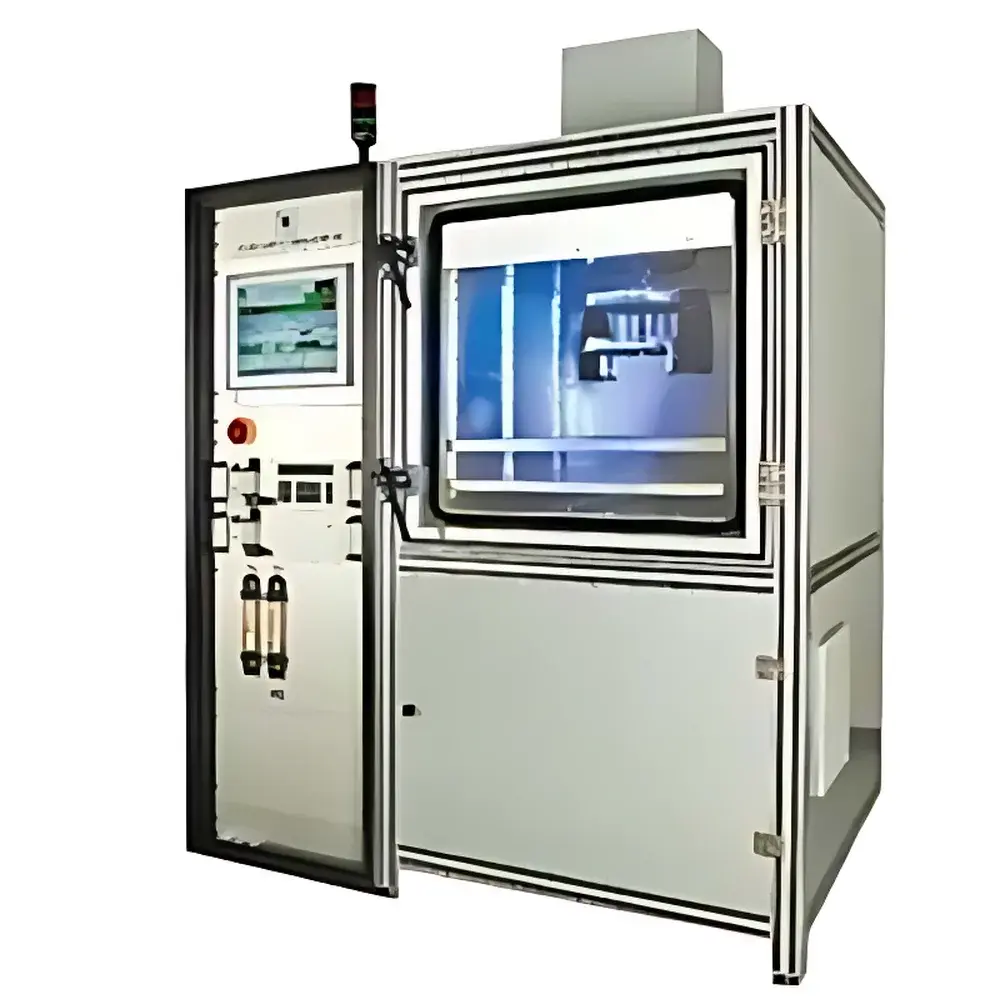
ANSEROS SIM 7500 Ozone Aging Test Chamber
| Origin | Germany |
|---|---|
| Manufacturer Type | Authorized Distributor |
| Origin Category | Imported |
| Model | SIM 7500 |
| Pricing | Upon Request |
Overview
The ANSEROS SIM 7500 Ozone Aging Test Chamber is a precision-engineered environmental test system designed to evaluate the ozone resistance of elastomeric materials under controlled, reproducible conditions. Based on the ASTM D1149, ISO 1431-1, and DIN EN 1431 standards, the chamber employs a closed-loop ozone generation and monitoring architecture to simulate accelerated atmospheric aging. It operates by generating stable ozone concentrations (typically 25–200 pphm) within a thermally regulated test volume, while maintaining precise control over temperature (–10 °C to +70 °C), relative humidity (10–80% RH), and air exchange rate (0.5–10 air changes/hour). The system utilizes UV-based ozone photolysis for real-time concentration measurement via the integrated MP5 UV-ozone analyzer—ensuring traceable, NIST-traceable calibration compliance. Its dual-mode capability supports both static exposure (specimen held under tension or free state) and dynamic testing (via horizontal rotating turntable), enabling evaluation of crack initiation and propagation kinetics in rubber compounds used in automotive seals, aerospace gaskets, power cable insulation, and railway traction components.
Key Features
- Industrial-grade Siemens SIMATIC S7 PLC controller with CE-certified emergency stop (CE-ESD) and redundant safety interlocks
- 10.4″ high-brightness TFT touchscreen HMI with multilingual interface (English, German, French, Spanish)
- Integrated UV photometric ozone analyzer (MP5 series) with ±2% full-scale accuracy and automatic zero/span validation
- Electrochemical ozone generator (COM series) with digital flow regulation and thermal overload protection
- Three-channel analog data logger (±0.1% FS resolution) for simultaneous recording of ozone concentration, temperature, and humidity
- Motorized horizontal turntable (0–10 rpm, adjustable torque limit) for dynamic strain application during exposure
- Automated safety door lock with dual-sensor verification (mechanical + magnetic) and forced ventilation interlock
- Optically clear quartz observation window (UV-transmissive, ozone-resistant) with anti-fog heating element
- Internal air velocity sensor and adjustable laminar flow baffles to ensure uniform ozone distribution (ISO 1431-1 airflow homogeneity ≥90%)
- Modular rack-mounted gas handling subsystem including mass flow controllers, catalytic ozone destruct unit, and HEPA/activated carbon filtration
Sample Compatibility & Compliance
The SIM 7500 accommodates standard test specimens per ASTM D1149 (dumbbell-shaped strips, ring specimens, or molded parts) up to 300 mm × 150 mm × 50 mm internal chamber dimensions. Specimen holders include stainless-steel tension jigs (for elongation control at 10–30%), non-tension racks, and custom fixture interfaces. All wetted components are constructed from 316L stainless steel or PTFE-coated aluminum to prevent catalytic ozone decomposition. The system meets CE marking requirements under Directive 2014/30/EU (EMC) and 2014/35/EU (LVD), and supports GLP-compliant audit trails via optional 21 CFR Part 11–enabled software modules. Calibration certificates for ozone sensor, temperature probes, and humidity transducers are provided with each unit and traceable to DAkkS-accredited laboratories.
Software & Data Management
The chamber is operated via ANSEROS ControlSuite™ v4.2—a Windows-based SCADA platform built on Siemens WinCC Runtime Advanced. It provides real-time process visualization, multi-parameter trend logging (up to 10,000 data points/sec), automated test sequence scripting (IEC 61131-3 compliant), and export to CSV, PDF, and XML formats. Raw sensor data is timestamped with microsecond precision and stored locally on an industrial SSD with RAID 1 redundancy. Optional cloud synchronization enables remote monitoring via secure TLS 1.3 API endpoints. Audit trail functionality logs all operator actions, parameter modifications, and alarm events with immutable digital signatures—fully aligned with FDA 21 CFR Part 11 and EU Annex 11 requirements for regulated environments.
Applications
- Accelerated ozone degradation testing of EPDM, CR, NBR, and FKM elastomers in automotive sealing systems
- Qualification of HV cable jacketing materials per IEC 60502-2 and IEEE 400.2
- Material screening for aerospace O-rings and hydraulic seals under MIL-DTL-6858F
- Failure mode analysis of rubber bellows and expansion joints in HVAC and industrial piping
- Research into antioxidant package efficacy and synergistic effects of UV/ozone co-exposure
- Validation of ISO 1431-1 conformance for supplier qualification programs in Tier-1 automotive supply chains
FAQ
What ozone concentration range does the SIM 7500 support?
The system delivers stable ozone concentrations from 25 pphm to 200 pphm, adjustable in 1 pphm increments, with long-term stability better than ±1.5% over 72-hour continuous operation.
Is the chamber compatible with dynamic mechanical loading during exposure?
Yes—the horizontal turntable enables rotational specimen movement, and optional pneumatic tensioning fixtures allow real-time strain modulation synchronized with ozone dosing profiles.
How is ozone concentration verified and calibrated?
Calibration uses primary-standard ozone generators traceable to PTB (Physikalisch-Technische Bundesanstalt), with annual verification performed using UV absorption spectrophotometry per ISO 13964.
Can the SIM 7500 be integrated into an existing LIMS or MES infrastructure?
Yes—OPC UA server integration is standard; RESTful API and Modbus TCP interfaces are available for direct connection to laboratory information management systems.
What maintenance intervals are recommended for critical subsystems?
UV lamp replacement every 6,000 hours; ozone generator electrode cleaning every 500 hours; MP5 analyzer zero/span check every 24 hours during active use; full DAkkS-traceable recalibration annually.



