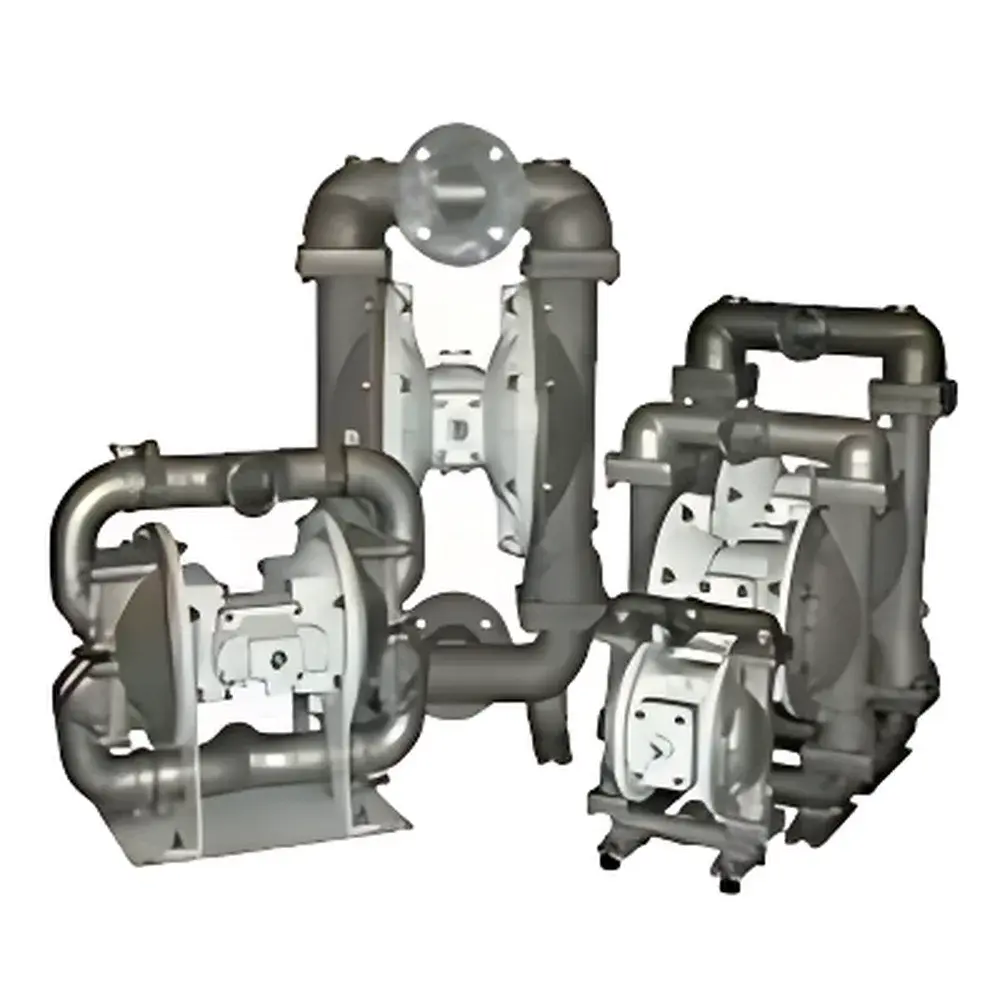
Warren Rupp FDA-Compliant Pneumatic Diaphragm Pump
| Brand | Warren Rupp |
|---|---|
| Origin | USA |
| Certification | FDA, USDA, ATEX, CSA, UL, CE |
| Material Compliance | FDA-grade 316 stainless steel wetted parts |
| Diaphragm Options | FDA Santoprene, FDA Nitrile, PTFE |
| Valve Types | Ball valve (1"–3") / Flap valve (2") |
| Flow Rate | 0–235 GPM |
| Solids Handling | Up to 2" diameter |
| Construction | FDA-compliant epoxy-coated aluminum housing, stainless steel hardware |
| Connection Standards | Tri-clamp (1", 1.5", 2"), ANSI法兰 (3") |
Overview
The Warren Rupp FDA-Compliant Pneumatic Diaphragm Pump is an engineered solution for sanitary fluid transfer in regulated life science and process industries. Based on the proven air-operated double-diaphragm (AODD) principle, it delivers positive displacement through reciprocating diaphragm motion driven by compressed air—eliminating the need for mechanical seals, shafts, or lubricants in the fluid path. Its sealless, dry-run capable architecture ensures operational safety during intermittent flow or empty-line conditions, while the self-priming capability (up to 20 ft suction lift) enables reliable start-up without manual priming. Designed specifically for applications demanding regulatory traceability and material biocompatibility, this pump meets stringent U.S. FDA 21 CFR Part 112 and Part 117 requirements for food contact surfaces, as well as USDA Agricultural Marketing Service standards for meat and poultry processing environments.
Key Features
- FDA-compliant wetted materials: 316 stainless steel liquid-end castings, with optional diaphragms and valves manufactured from FDA-listed Santoprene™ thermoplastic elastomer, FDA-grade nitrile rubber, or chemically inert PTFE.
- Sanitary connection configurations: Tri-clamp (DIN 11851 / SMS 1144) fittings standard on 1″, 1.5″, and 2″ models; ANSI B16.5 Class 150 flanged discharge on 3″ units for integration into validated piping systems.
- Explosion-proof compliance: Certified to ATEX II 2G Ex ib IIB T4 Gb, CSA C22.2 No. 157, UL 508A, and CE Machinery Directive 2006/42/EC—suitable for Zone 1/Zone 21 classified areas.
- Robust dry-run tolerance: Engineered for continuous operation without fluid present, preventing diaphragm overheating or premature failure—a critical requirement in batch transfer and CIP/SIP cycles.
- Variable flow control: Achieved via adjustable air inlet pressure (20–125 psi) and dual-port exhaust silencing, enabling precise volumetric delivery from 0 to 235 GPM without throttling valves.
- Maintenance-intuitive design: Bolted main chamber construction allows full internal access without specialized tools; modular valve assemblies facilitate rapid replacement of wear components under GLP/GMP documentation protocols.
Sample Compatibility & Compliance
This pump handles non-homogeneous, shear-sensitive, and abrasive media—including fruit pulps, yeast slurries, vaccine suspensions, cosmetic emulsions, and high-viscosity pharmaceutical gels—without degradation. Its absence of dynamic seals prevents particle entrapment and biofilm formation, supporting cleaning validation per ASTM F3037 (Sanitary Process Equipment Cleaning Verification) and ISO 14644-1 Class 5–8 cleanroom compatibility when installed with appropriate filtration and venting. All wetted surface finishes comply with ASME BPE-2022 SF3 (electropolished Ra ≤ 0.4 µm) and are documented with full material traceability certificates (MTRs), including heat lot numbers for 316 SS components.
Software & Data Management
While inherently analog in actuation, the pump integrates seamlessly into automated process control architectures via optional air supply monitoring modules (e.g., digital pressure transducers with 4–20 mA output) and proximity sensors for stroke counting. When deployed within FDA 21 CFR Part 11–compliant environments, its operational parameters—including totalized flow volume, cycle count, and air consumption—are logged via connected SCADA or MES platforms with audit-trail enabled timestamping, electronic signatures, and role-based access controls. Calibration records and maintenance logs adhere to ALCOA+ principles (Attributable, Legible, Contemporaneous, Original, Accurate, Complete, Consistent, Enduring, Available).
Applications
- Pharmaceutical: Transfer of API suspensions, buffer solutions, and sterile intermediates in isolator and RABS environments.
- Biotechnology: Yeast/bacterial broth recirculation in fermenters; harvest line transfer prior to centrifugation or depth filtration.
- Food & Beverage: Moving viscous sauces, dairy concentrates, and particulate-laden juices without shear-induced phase separation.
- Cosmetics: Metered dispensing of silicone-based formulations and pigment dispersions requiring zero metal ion leaching.
- Contract Manufacturing: Multi-product facility use where rapid changeover, cleanability, and regulatory audit readiness are mandatory.
FAQ
Does this pump meet FDA requirements for direct food contact?
Yes—the entire wetted path is constructed from FDA-listed materials per 21 CFR §177.2600 (elastomers) and §177.1550 (stainless steel), with third-party certification documentation available upon request.
Can it handle solids larger than 1 inch?
The 2″ flap-valve configuration accommodates spherical solids up to 2 inches in diameter; ball-valve variants are rated for up to 1.5 inches depending on viscosity and flow velocity.
Is validation support provided for GMP installations?
Warren Rupp supplies IQ/OQ protocol templates aligned with ASTM E2500 and ISPE Baseline Guide Volumes 4 & 5, including material compatibility matrices, surface finish verification methods, and cleaning effectiveness test plans.
What compressed air quality is required?
Instrument-grade air per ISO 8573-1 Class 2:2:2 (oil content ≤ 0.1 mg/m³, particles ≤ 0.1 µm, dew point −40°C) is recommended to prevent diaphragm abrasion and ensure consistent actuation force.
Are spare parts traceable to original equipment manufacturer (OEM) specifications?
All replacement diaphragms, valves, and fasteners carry OEM part numbers and are supplied with CoA (Certificate of Analysis) and CoC (Certificate of Conformance) referencing ASTM F2291 and ASME BPE-2022 revision history.