
Q-Lab Xe-3-HSC Xenon Arc Weathering Test Chamber
| Brand | Q-Lab |
|---|---|
| Origin | USA |
| Model | Xe-3-HSC |
| Humidity Control | Standard RH control (20–95% RH, ±2% RH accuracy) |
| Temperature Range | 31–120°C (black panel), ambient air temperature independently monitored and controlled |
| Irradiance Control | SOLAR EYE broadband feedback system at 340 nm, 420 nm, or TUV |
| Lamp Configuration | 3 × air-cooled xenon arc lamps (1500 h rated life) |
| Sample Tray Dimensions | 451 mm × 718 mm |
| Max Sample Capacity | 51 × 51 mm × 102 mm specimens |
| Optional Features | Water spray (dual-nozzle, purified water only), refrigerated cooling unit (enables sub-ambient black panel temperatures), dual-fluid spray (e.g., acid rain simulation) |
Overview
The Q-Lab Xe-3-HSC Xenon Arc Weathering Test Chamber is an advanced, full-spectrum accelerated weathering instrument engineered for precision simulation of solar radiation, temperature, and moisture exposure in laboratory environments. It employs a calibrated 3-lamp air-cooled xenon arc light source to replicate the spectral power distribution (SPD) of natural sunlight across UV, visible, and near-infrared wavelengths — from 295 nm to 800 nm — with fidelity validated against CIE No. 85 and ISO 4892-2 standards. Unlike narrowband UV fluorescent systems, the Xe-3-HSC delivers photobiologically relevant irradiance profiles essential for evaluating photochemical degradation mechanisms in polymers, coatings, textiles, automotive interiors, pharmaceutical packaging, and cosmetic formulations. Its horizontally oriented sample plane, combined with independent black panel temperature (BPT) and chamber air temperature (CAT) control, enables rigorous thermal management aligned with ASTM G155 and ISO 11341 test protocols. The system operates under programmable irradiance setpoints, dynamic humidity regulation, and optional water spray — all synchronized within defined light/dark cycles to emulate real-world diurnal and seasonal stressors.
Key Features
- Air-cooled xenon arc lamp system with three 1500-hour-rated lamps — no external water chiller required, reducing infrastructure complexity and operational cost.
- Standard integrated relative humidity (RH) control (20–95% RH, ±2% RH accuracy) with real-time monitoring of RH, BPT, and CAT on a single intuitive interface.
- SOLAR EYE irradiance feedback control system maintaining stable spectral output at user-selectable wavelengths: 340 nm (UV-A), 420 nm (visible edge), or total UV (TUV, 300–400 nm).
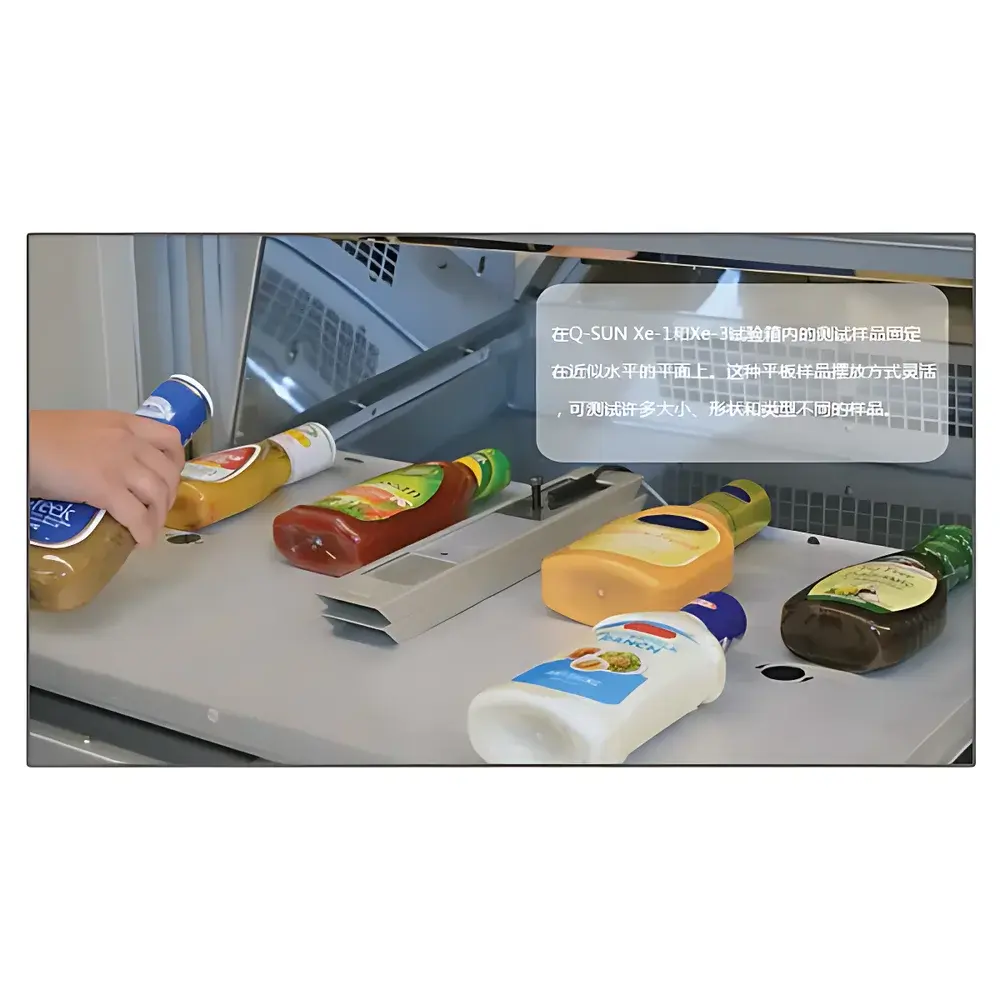
- Horizontal sample tray (451 mm × 718 mm) accommodating heterogeneous geometries — flat panels, 3D components, and irregularly shaped specimens — with optional custom fixtures and multi-angle holders.
- Dual-nozzle purified water spray system operable during light or dark phases; supports optional dual-fluid delivery (e.g., synthetic acid rain) for corrosion and leaching studies.
- Refrigerated cooling unit option enabling black panel temperatures as low as 31°C under high irradiance — critical for thermally sensitive materials including biologics, ophthalmic solutions, and emulsion-based cosmetics per USP and ICH Q1A(R2) guidance.
- Long-life optical filter sets — Daylight, Window Glass (Window-Q, Window-B/SL, Window-IR), and Extended UV (UV-Q/B) — engineered for spectral stability over extended service life; Window-IR filters require periodic replacement per manufacturer calibration schedule.
Sample Compatibility & Compliance
The Xe-3-HSC accommodates diverse material classes without mechanical modification: rigid and flexible substrates, powder-coated metals, laminated composites, printed electronics, and sterile-packaged medical devices. Its open-tray architecture supports direct mounting of commercial-grade packaging (e.g., blister cards, HDPE bottles, aluminum foil pouches) and permits in-situ visual assessment without interrupting test sequences. The chamber meets functional requirements of ASTM D4329 (plastics), ASTM D4459 (interior automotive), ISO 105-B02 (textiles), AATCC TM16 (lightfastness), and SAE J2412/J2527 (automotive exterior). All firmware and data logging comply with FDA 21 CFR Part 11 electronic record and signature requirements when configured with audit trail-enabled software. Calibration traceability is maintained to NIST-traceable radiometric standards, and humidity sensors are certified to ISO/IEC 17025-accredited laboratories.
Software & Data Management
The Xe-3-HSC operates via Q-Lab’s proprietary Windows-based Q-SUN Software Suite, supporting fully automated method execution, real-time parameter trending, and configurable alarm thresholds. Each test run generates timestamped, encrypted binary logs containing irradiance history, temperature/humidity profiles, lamp voltage/current, and spray event timestamps — exportable in CSV, PDF, or XML formats for LIMS integration. Audit trails record all user actions, parameter changes, and calibration events with operator ID and time stamp. For GLP/GMP environments, optional 21 CFR Part 11 compliance packages include electronic signatures, role-based access control, and immutable log archiving. Remote monitoring is enabled via Ethernet/IP with TLS 1.2 encryption; no cloud dependency or third-party telemetry is employed.
Applications
This instrument serves R&D, QC, and regulatory validation labs across industries requiring predictive durability assessment under solar-driven aging stressors. In automotive engineering, it validates dashboard material fade resistance per GMW14124 and Ford CETP 00.00-L-467. In pharmaceutical development, it supports photostability testing of APIs and final dosage forms per ICH Q5C and Q1B guidelines — particularly where low-temperature irradiation prevents thermal artifact formation. Coating formulators use it to rank gloss retention and chalking behavior of architectural paints under ASTM D4587 cyclic condensation. Textile manufacturers assess colorfastness of dyed fabrics under AATCC TM16-2016 conditions. Packaging engineers evaluate barrier integrity and print adhesion of flexible laminates exposed to simulated retail lighting environments.
FAQ
What type of water is required for humidity and spray functions?
Deionized or distilled water with conductivity ≤1 µS/cm is mandatory. Tap or softened water will cause mineral deposits, sensor drift, and premature failure of humidification nozzles and spray manifolds.
Can the Xe-3-HSC operate without the refrigeration option at sub-ambient temperatures?
No. Ambient cooling alone cannot maintain black panel temperatures below ~40°C under standard irradiance settings. The dedicated refrigeration unit is required for tests specifying ≤35°C BPT per ICH Q1A(R2) or ISO 11341 Annex B.
How often must filters be replaced?
Daylight and Window-B/SL filters are designed for indefinite service life under normal operation. Window-IR filters degrade measurably after ~1,200 hours of cumulative exposure and must be replaced per Q-Lab’s calibration protocol to maintain IR spectral fidelity.
Is lamp alignment or recalibration required between lamp replacements?
No. The Xe-3-HSC uses fixed-focus lamp housings and factory-aligned reflectors. Lamp replacement is a plug-and-play procedure; SOLAR EYE automatically compensates for lamp aging and output variance.
Does the system support third-party test method import (e.g., ASTM, ISO)?
Yes. Q-SUN Software includes preloaded templates for >120 international standards. Users may also define custom cycles with stepwise irradiance, temperature, humidity, and spray parameters — all saved as reusable, version-controlled methods.



