
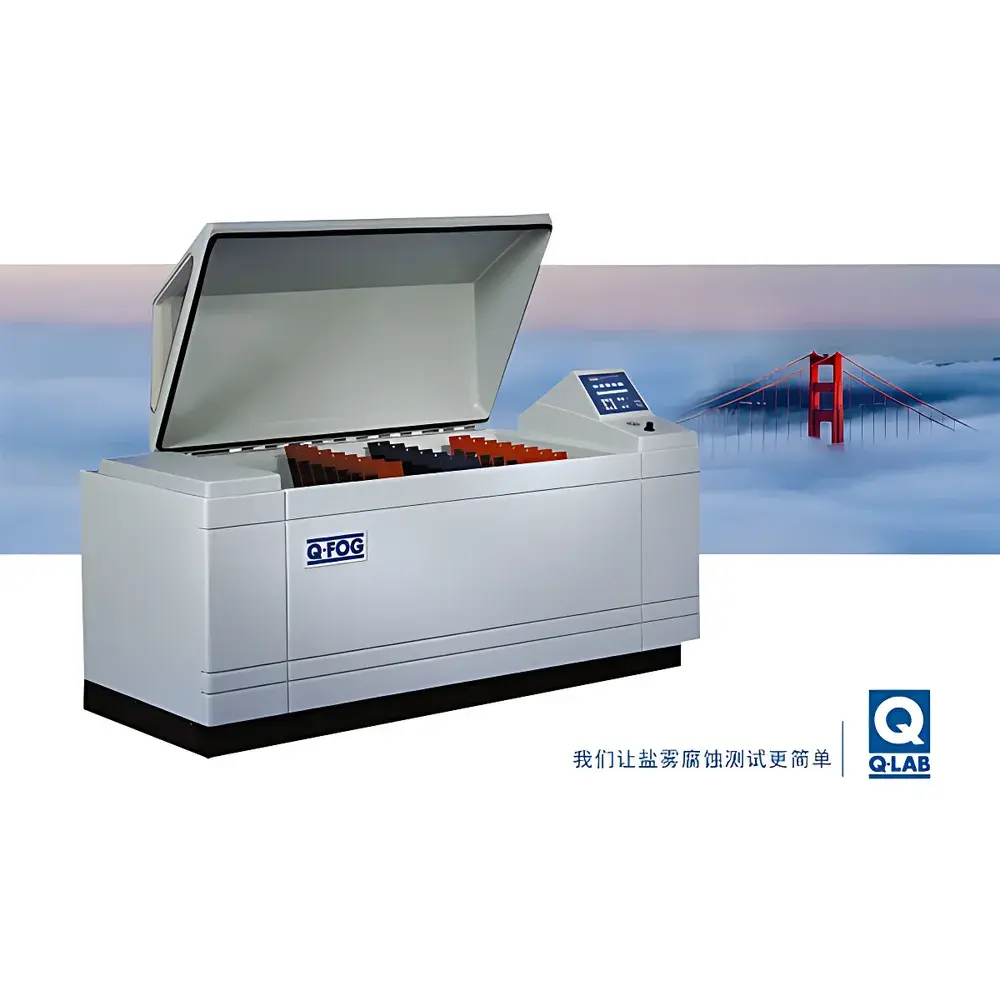
Q-Lab Q-FOG CCT600 Automated Cyclic Corrosion Test Chamber
| Brand | Q-Lab |
|---|---|
| Origin | USA |
| Model | Q-FOG CCT600 |
| Salt Spray Deposition Rate | 0.5–3 mL/h·80 cm² |
| Temperature Range | Ambient to 70 °C |
| Chamber Capacity | 640 L |
| Cycle Modes | Neutral Salt Spray (NSS), Prohesion™, and 100% RH Humidity Conditioning |
Overview
The Q-Lab Q-FOG CCT600 Automated Cyclic Corrosion Test Chamber is an engineered solution for accelerated corrosion testing under controlled, reproducible laboratory conditions. Based on the fundamental principles of cyclic corrosion testing (CCT), it replicates key environmental stressors—salt deposition, high-humidity exposure, dry-off phases, and ambient storage—in programmable sequences within a single chamber. Unlike traditional static salt spray chambers governed solely by ASTM B117, the CCT600 implements dynamic, multi-phase test protocols aligned with automotive OEM specifications (e.g., GMW 14872, Ford CETP 00.00-L-467, SAE J2334) and international standards including ISO 11997-1/2 and VDA 621-415. Its design reflects decades of field correlation research demonstrating that cyclic exposure yields corrosion morphologies, pit initiation patterns, and relative material degradation rates significantly closer to real-world atmospheric service than continuous salt fog alone.
Key Features
- Single-chamber automation for full-cycle testing: integrates neutral salt spray (NSS), Prohesion™ (acidified chloride + drying), and 100% relative humidity conditioning without manual sample transfer.
- Precise, independent control of salt spray deposition rate (0.5–3 mL/h·80 cm²) via variable-speed peristaltic pump and regulated compressed air pressure—enabling accurate reproduction of standardized spray geometry and droplet distribution.
- Temperature range from ambient to 70 °C, with high-stability PID-controlled heating and calibrated RTD sensors ensuring ±0.5 °C uniformity across the 640 L working volume.
- Integrated viewing window with internal LED illumination for real-time visual monitoring of specimen condition and spray pattern integrity during operation.
- Self-diagnostic controller with predictive maintenance alerts, scheduled service reminders, and automatic safety shutdown upon critical fault detection (e.g., low solution level, overtemperature, pump failure).
- Corrosion-resistant chamber construction using fiber-reinforced polymer (FRP) with stainless steel hardware; non-metallic internal components prevent galvanic interference and ensure long-term chemical stability.
Sample Compatibility & Compliance
The Q-FOG CCT600 accommodates flat panels, coated substrates, fasteners, electronic enclosures, and assembled automotive components up to 600 mm in height. Specimen racks are adjustable and non-conductive to eliminate stray current paths. The system complies with regulatory and quality framework requirements for validation-critical environments: full audit trail capability supports GLP and GMP workflows; controller firmware adheres to IEC 62443-3-3 security guidelines; data logging meets FDA 21 CFR Part 11 requirements when paired with Q-Lab’s optional Q-Drive software (electronic signatures, user access levels, immutable records). It is routinely deployed in laboratories accredited to ISO/IEC 17025 and certified for automotive PPAP submissions.
Software & Data Management
Control and monitoring are managed through Q-Lab’s proprietary Q-Drive software (Windows-based, USB or Ethernet interface), which provides intuitive test method library management, real-time parameter visualization, and automated report generation. Each test run logs timestamped temperature, humidity, spray status, and chamber door position. Raw data exports to CSV or XML formats for integration into LIMS or statistical analysis platforms (e.g., JMP, Minitab). Optional cloud-enabled remote diagnostics allow authorized service engineers to perform preliminary troubleshooting without onsite visits—reducing downtime and supporting preventive maintenance planning.
Applications
Primary applications include qualification testing of automotive exterior trim, chassis components, and battery enclosures; evaluation of aerospace alloy coatings and sealants; comparative assessment of paint systems (e-coat, powder coat, clear coat); validation of corrosion inhibitors in industrial fasteners; and R&D screening of new metallic alloys and surface treatments. The CCT600 is widely adopted by Tier 1 suppliers, OEM engineering labs, and independent testing facilities performing third-party certification to ASTM D609, ISO 9227, and JIS Z2371—particularly where correlation to outdoor exposure data is required for warranty validation or material selection.
FAQ
What standards does the Q-FOG CCT600 support out of the box?
It natively executes ASTM B117 (NSS), ASTM G85 Annex A5 (Prohesion™), and ISO 11997-1/2 cyclic test methods. Custom profiles can be programmed to match proprietary OEM specifications.
Is the chamber suitable for testing electronic assemblies?
Yes—provided specimens are pre-conditioned per IEC 60068-2-52 or equivalent, and humidity ramp rates are configured to avoid condensation-induced shorting during transitions.
How is calibration traceability maintained?
Temperature and humidity sensors are NIST-traceable; annual verification services include as-found/as-left reports compliant with ISO/IEC 17025.
Can the CCT600 operate unattended for extended cycles?
Yes—its robust architecture, redundant safety interlocks, and auto-refill solution reservoir support uninterrupted operation for up to 30-day test sequences.
Does Q-Lab provide method development support?
Yes—Q-Lab Application Engineers offer protocol optimization consulting, correlation studies against field exposure sites, and technical documentation packages for IQ/OQ/PQ validation.



