
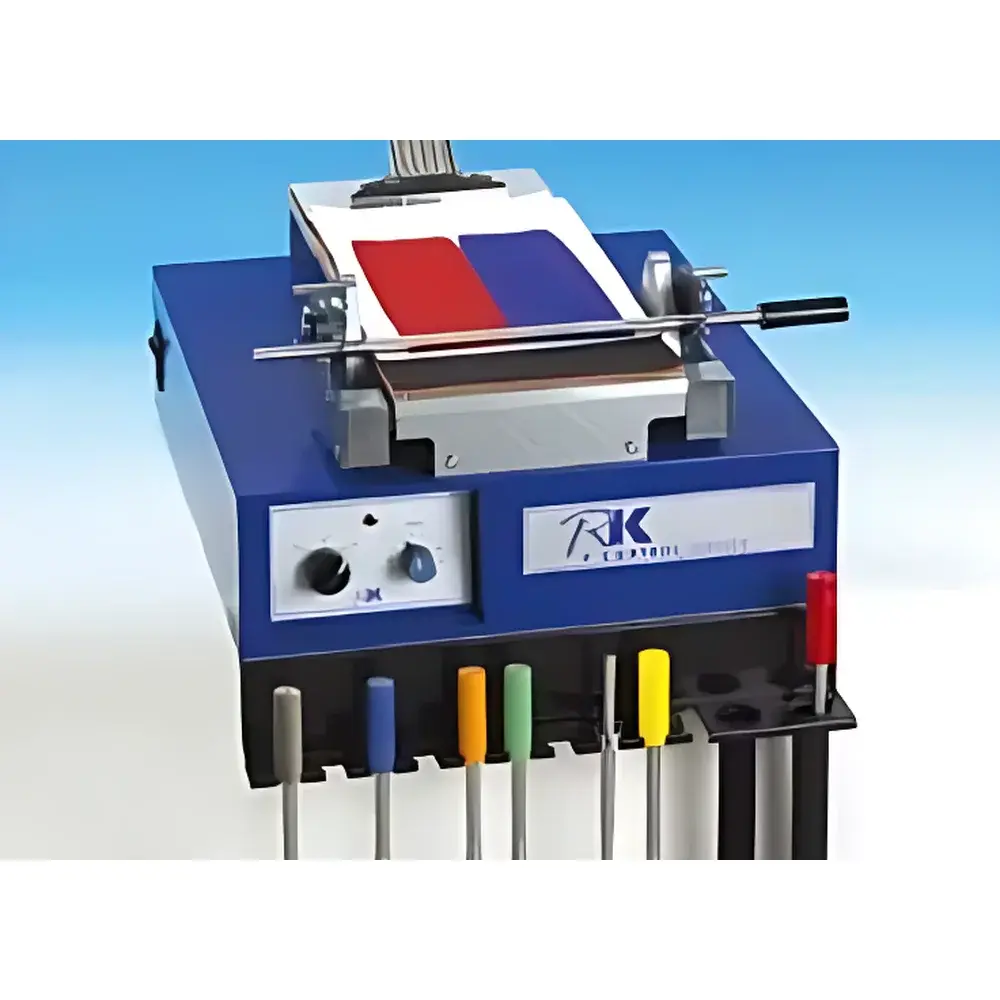
RK K101 Motorized Laboratory Film Applicator
| Brand | RK |
|---|---|
| Origin | United Kingdom |
| Model | RK K101 |
| Coating Width | 170 × 250 mm |
| Bed Type | Vacuum, Magnetic, Heated & Glass Options Available |
| Standard Speed Range | 2–15 m/min |
| Drive Option | Electric or Pneumatic |
| Compliance | ASTM D823-53, BS 3900 Part 5 |
| Wet Film Thickness Range | 4–150 µm (via standardized wire-wound applicator rods) |
| Bed Configuration | Modular interchangeable substrate holders |
Overview
The RK K101 Motorized Laboratory Film Applicator is an engineered precision instrument designed for reproducible, controlled deposition of liquid coatings onto flat substrates under laboratory and QC conditions. Based on the well-established draw-down principle using calibrated wire-wound applicator rods (also known as Mayer rods), the K101 applies uniform wet films with high inter- and intra-run consistency—critical for color matching, gloss evaluation, adhesion testing, and regulatory-compliant formulation development. Its motorized linear translation mechanism eliminates manual variability in speed and pressure, directly addressing a primary source of measurement uncertainty in manual film application. The system operates on a rigid, vibration-damped base frame and integrates seamlessly into ISO/IEC 17025-accredited laboratories where traceable, operator-independent sample preparation is mandated.
Key Features
- Precision-controlled linear motion with adjustable speed from 2 to 15 meters per minute—calibrated and repeatable within ±0.2 m/min across full range.
- Modular bed system supporting five interchangeable substrate mounting configurations: vacuum-chuck (A- and B-type), magnetic clamping, heated plate (up to 120 °C), and optically flat glass bed—enabling compatibility with paper, metal, plastic, foil, and composite panels.
- Dedicated rod holder with positive locking mechanism for rapid, tool-free exchange of standardized ASTM D823-53 and BS 3900 Part 5 compliant wire-wound applicators.
- Wet film thickness capability spanning 4 µm to 150 µm, achieved via certified rods with nominal diameters corresponding to defined wet film thicknesses (e.g., 4 µm, 12 µm, 50 µm, 100 µm, etc.).
- Optional electric or pneumatic drive selection—electric version includes digital speed control and start/stop footswitch; pneumatic variant supports integration into cleanroom or explosion-proof environments.
- Structural rigidity optimized for minimal deflection during traverse, ensuring edge-to-edge thickness uniformity across the full 170 × 250 mm coating zone.
Sample Compatibility & Compliance
The RK K101 accommodates rigid and semi-rigid substrates up to 3 mm thick and weighing ≤5 kg. Common applications include coated paper, aluminum foil, PET film, cold-rolled steel panels (for corrosion testing), and automotive primer substrates. All mechanical and operational parameters comply with ASTM D823-53 (“Standard Practice for Producing Films of Uniform Thickness of Paint, Varnish, and Related Products on Test Panels”), BS 3900 Part 5, and ISO 2808 (“Paints and varnishes — Determination of film thickness”). The device supports GLP-compliant workflows through documented speed calibration logs and rod traceability records. When paired with validated applicator rods and certified reference standards, the system contributes to data integrity requirements under FDA 21 CFR Part 11 when integrated with compliant LIMS or ELN platforms.
Software & Data Management
While the K101 operates as a stand-alone electromechanical instrument, its speed controller outputs analog (0–10 V) and digital (RS-485 Modbus RTU) signals for integration into automated lab networks. Optional firmware upgrades enable timestamped operation logging—including speed setpoint, run duration, rod ID, and operator code—when connected to external SCADA or MES systems. Rod calibration certificates (traceable to NPL or UKAS-accredited labs) are supplied with each applicator set, and users are advised to maintain a rod usage log per ISO/IEC 17025 clause 7.7 to ensure continued metrological validity.
Applications
- Color formulation and spectrophotometric validation in paint, ink, and cosmetic R&D labs.
- Preparation of test panels for ASTM D3359 (cross-hatch adhesion), ASTM D4587 (QUV weathering), and ISO 6272 (impact resistance).
- QC release testing of industrial coatings where batch-to-batch film thickness repeatability is specified in internal quality agreements.
- Development of functional thin films (e.g., conductive inks, anti-fog coatings, barrier layers) requiring precise wet-film dosing prior to drying/curing.
- Academic research in surface science, rheology of non-Newtonian coating fluids, and solvent evaporation kinetics modeling.
FAQ
What substrate sizes are supported on the RK K101?
The standard configuration accepts substrates measuring 170 × 250 mm. Interchangeable bed modules allow adaptation to larger formats, though the K101 itself is dimensionally optimized for this base size.
Can the K101 be used with volatile organic solvents?
Yes—provided appropriate ventilation and spark-proof drive selection (pneumatic option recommended for Class I Div 1 environments). Rod material (typically stainless steel or ceramic-coated) must be chemically compatible with the coating formulation.
Is speed calibration traceable to national standards?
The factory calibration certificate includes speed verification against a NIST-traceable tachometer. Users may perform in-house verification using a handheld optical tachometer with ±0.1% accuracy.
How often should applicator rods be recalibrated or replaced?
Rods should be inspected before each use for wear, deformation, or residue buildup. Recalibration is recommended annually or after 500 coating cycles—whichever occurs first—using a certified micrometer and surface roughness tester per ISO 2808 Annex A.
Does the K101 meet requirements for ISO/IEC 17025 accreditation?
Yes—the instrument’s design, documented calibration procedures, and maintenance log structure fully support compliance with ISO/IEC 17025:2017 clauses 6.4 (equipment) and 7.7 (sampling), provided users implement a site-specific equipment management procedure.






