


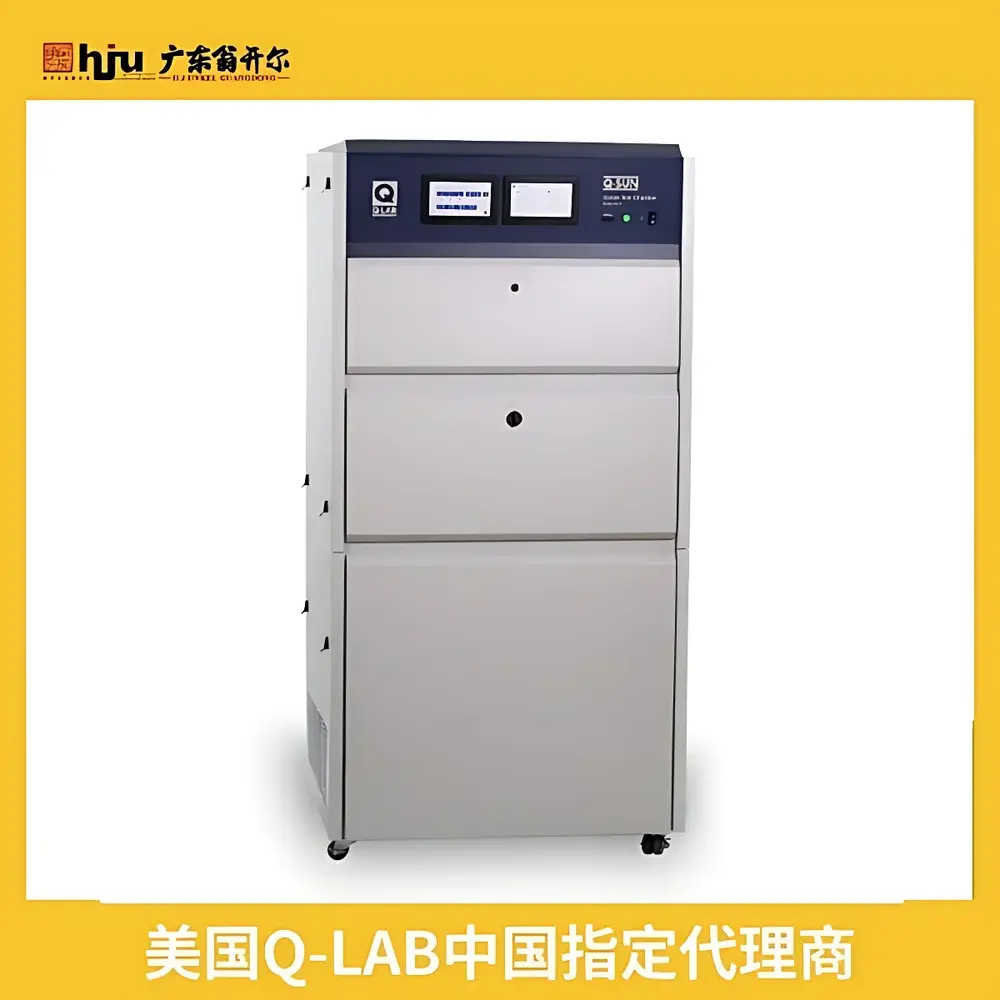

Q-Lab Q-SUN Xe-3 Water-Cooled Xenon Arc Weathering Test Chamber
| Brand | Q-Lab |
|---|---|
| Origin | USA |
| Model | Q-SUN Xe-3 (Water-Cooled) |
| Xenon Lamp Power | 1800 W |
| Irradiance | Up to 1.30 W/m²/nm @ 340 nm, 2.40 W/m²/nm @ 420 nm |
| Temperature Range | 42–120 °C (Black Panel), Adjustable via Black Panel Sensor |
| Humidity Control | Standard Relative Humidity (RH) Control |
| Light Cycle | Programmable per test standard |
| Water Requirements | Deionized or purified water for humidity, spray, and back-spray functions |
| Filter Configuration | Triple-filter system (e.g., Daylight-Q/B, Window-Q, Window-IR) |
| Lamp Quantity | 3 lamps per unit |
| Lamp Lifetime | ~1500 hours |
Overview
The Q-Lab Q-SUN Xe-3 Water-Cooled Xenon Arc Weathering Test Chamber is an ASTM- and ISO-compliant accelerated weathering instrument engineered to replicate full-spectrum solar radiation—including UV, visible, and near-infrared wavelengths—with high fidelity to natural sunlight exposure conditions. Unlike air-cooled xenon systems, the Xe-3 employs a closed-loop water-cooling architecture that enables stable, high-intensity irradiance output while maintaining precise thermal management of the lamp envelope and optical path. This design ensures long-term spectral stability, reduced lamp degradation, and consistent irradiance distribution across the test plane—critical for interlaboratory reproducibility in materials qualification per standards such as ASTM G155, ISO 4892-2, SAE J2527, and AATCC TM16.
Key Features
- Triple-lamp water-cooled xenon source: 1800 W quartz-envelope lamps delivering uniform irradiance up to 1.30 W/m²/nm at 340 nm and 2.40 W/m²/nm at 420 nm—calibrated traceably to NIST-traceable reference cells.
- SOLAR EYE irradiance feedback control: Real-time monitoring and automatic adjustment of spectral power at user-selectable bands (340 nm, 420 nm, or TUV), ensuring compliance with irradiance setpoints throughout lamp aging.
- Black panel temperature (BPT) control: Dual-sensor capability (standard BPT + optional chamber air sensor) enables independent regulation of surface temperature (42–120 °C range) and ambient conditions—essential for simulating real-world thermal loading on coated, polymeric, or composite substrates.
- Triple-filter optical system: Interchangeable filter sets (e.g., Daylight-Q/B for outdoor exposure, Window-Q for indoor through-glass simulation, Window-IR for extended IR transmission) maintain spectral integrity over time; only Window-IR filters require scheduled replacement per Q-Lab’s maintenance protocol.
- Integrated humidity control: Standard RH regulation (20–95% range, ±3% accuracy) synchronized with irradiance and temperature profiles—validated per ASTM D4329 and ISO 4892-2 Annex A requirements for cyclic wet/dry exposure protocols.
- Modular water-based exposure options: Factory-integrated spray (front-only), back-spray (SAE J2527-compliant dual-side wetting), dual-spray (for sequential or simultaneous application of secondary chemistries), and refrigerated cooling (Xe-3-HSC) enabling low-temperature testing down to 31 °C at 50% RH—critical for pharmaceutical packaging and cosmetic stability studies.
Sample Compatibility & Compliance
The Xe-3 accommodates flat and three-dimensional specimens on a 451 mm × 718 mm sample tray, supporting up to 55 standard 51 mm × 102 mm coupons or custom fixtures. Its open-plan geometry allows mounting of automotive trim, architectural sealants, textile swatches, and medical device housings without spatial constraint. All configurations meet GLP documentation requirements: Ethernet connectivity enables audit-ready data logging, timestamped event tracking, and secure remote diagnostics. The system complies with FDA 21 CFR Part 11 when paired with Q-Lab’s validated “Virtual Strip Chart” software, providing electronic signatures, change history, and role-based access control for regulated environments.
Software & Data Management
The embedded controller supports five languages (English, French, Spanish, Italian, German) and features self-diagnostic routines, predictive service alerts, and fail-safe shutdown logic. Optional Virtual Strip Chart PC software provides automated acquisition of irradiance, BPT, RH, and chamber air temperature at user-defined intervals (1–60 sec resolution). Data exports natively to CSV or Excel-compatible formats and can be transmitted via SMTP to Q-Lab’s global technical support team for rapid root-cause analysis. All logged parameters are stored with metadata including calibration certificate IDs, filter lot numbers, and lamp usage hours—ensuring full traceability for ISO/IEC 17025-accredited laboratories.
Applications
The Q-SUN Xe-3 serves R&D, QC, and regulatory validation labs across industries requiring photostability, colorfastness, and material degradation assessment. Typical use cases include: UV resistance evaluation of automotive clearcoats per GMW14124; fade resistance testing of interior textiles under SAE J2412; shelf-life prediction of UV-sensitive drug formulations per ICH Q1B; weathering performance of roofing membranes (ASTM D6901); and outdoor durability validation of OLED display encapsulants. Its ability to decouple irradiance intensity, thermal load, and moisture cycling makes it uniquely suited for failure-mode isolation in multi-stress degradation studies.
FAQ
Does the Xe-3 require periodic recalibration of its irradiance sensors?
Yes—Q-Lab recommends annual verification using a NIST-traceable radiometer; field calibration kits and certified reference cells are available through authorized distributors.
What water purity specifications are required for humidity and spray functions?
Deionized water with resistivity ≥1 MΩ·cm and total organic carbon (TOC) < 50 ppb is mandatory to prevent nozzle clogging and mineral deposition on optics or samples.
Can the Xe-3 operate without the SOLAR EYE irradiance control system?
No—the SOLAR EYE is integral to all Xe-3 models and cannot be disabled; it is required for compliance with irradiance-controlled test methods.
Is third-party validation support available for 21 CFR Part 11 compliance?
Yes—Q-Lab provides IQ/OQ documentation templates, validation protocols, and on-site execution support for pharmaceutical and medical device manufacturers undergoing FDA or EMA audits.
How often must Window-IR filters be replaced?
Q-Lab specifies replacement every 1,000 hours of operation or annually—whichever occurs first—to maintain spectral fidelity in infrared-heavy exposure profiles.



