
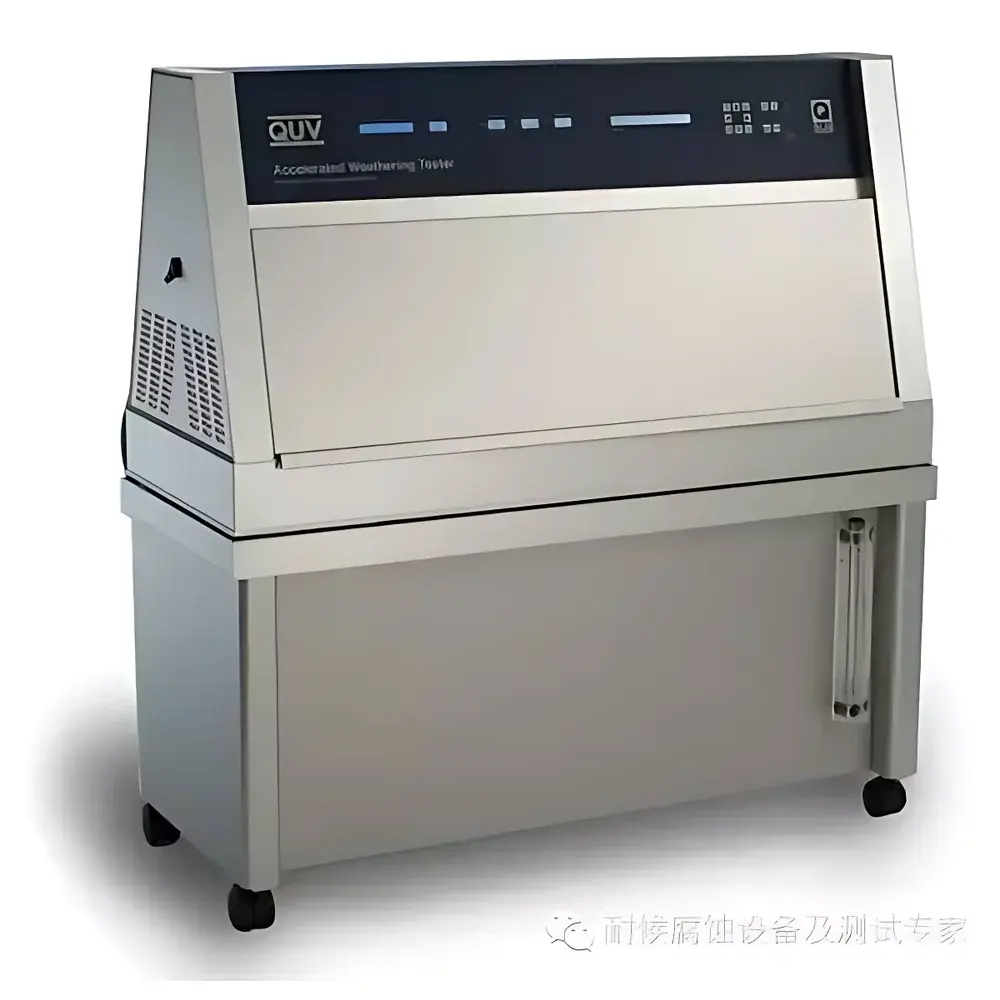
Q-LAB QUV Accelerated Weathering Tester
| Brand | Q-LAB |
|---|---|
| Origin | USA |
| Model | QUV/se / QUV/spray / QUV/cw / QUV/basic |
| UV Lamp Options | UVA-340 (295–365 nm), UVA-313 (250–370 nm) |
| Black Panel Temperature Range | 40–80 °C |
| Condensation Temperature Range | 40–60 °C |
| Chamber Dimensions (L×W×H) | Varies by model |
| Sample Capacity | Up to 50 specimens (75 × 150 mm) |
| Power Supply | 120/230 V, 50/60 Hz, up to 1800 W |
| Water Consumption | 8 L/day (condensation), 7 L/min (spray) |
| Lamp Lifetime | 1600–5000 h (model-dependent) |
| Compliance | ISO 4892-3, ASTM G154, ASTM D4329, SAE J2020, IEC 60068-2-5 |
Overview
The Q-LAB QUV Accelerated Weathering Tester is an industry-standard benchtop ultraviolet (UV) exposure system engineered for precision simulation of solar radiation-induced degradation in polymeric, coating, and composite materials. Unlike full-spectrum xenon arc or carbon arc testers, the QUV leverages fluorescent UV lamps—primarily UVA-340 and UVA-313—to isolate and intensify the most photochemically active portion of sunlight: the UV-A and short-wave UV-B spectral region (250–370 nm). Though UV radiation constitutes only ~5% of total solar energy, it drives >80% of photodegradation mechanisms—including chain scission, oxidation, and chromophore bleaching—in organic materials. The QUV’s design adheres to fundamental principles of photochemical kinetics: accelerated aging is achieved not by arbitrary intensity scaling, but by controlled irradiance, calibrated black panel temperature, and synchronized moisture cycling that replicates thermally driven diffusion-limited hydrolysis and condensation-driven surface wetting.
Key Features
- Calibrated UV Irradiance Control: Digital irradiance monitoring and feedback regulation ensure stable output across lamp life; compliant with ISO 4892-3 Class 1 requirements for spectral match and radiometric traceability.
- Multi-Mode Environmental Cycling: Independent control of UV irradiation, condensation (via heated water reservoir and chamber wall cooling), and water spray enables replication of diurnal cycles—e.g., UV exposure followed by overnight dew formation or midday thermal shock from rain.
- Black Panel Thermometry: Precision black panel sensors (ASTM D4329-compliant) directly measure specimen surface temperature under irradiation, critical for correlating Arrhenius-based degradation rates with real-world service conditions.
- Modular Lamp Compatibility: Interchangeable UVA-340 lamps (optimal for outdoor correlation) and UVA-313 lamps (for aggressive screening or indoor-use material evaluation); all lamps certified per Q-LAB’s ISO/IEC 17025-accredited calibration protocol.
- Robust Chamber Architecture: Stainless steel interior, quartz UV-transmitting lamp housings, and corrosion-resistant condensate collection system ensure long-term operational stability and minimal maintenance over 5,000-hour lamp lifetimes.
Sample Compatibility & Compliance
The QUV accommodates standard 75 mm × 150 mm flat specimens (up to 50 per cycle in QUV/basic; 48 in QUV/se, QUV/spray, and QUV/cw models), with optional fixtures for 3D parts, coated panels, and textile swatches. All configurations meet ISO 4892-3 (Plastics — Methods of exposure to laboratory light sources — Part 3: Fluorescent UV lamps), ASTM G154 (Standard Practice for Operating Fluorescent Ultraviolet (UV) Lamp Apparatus for Exposure of Nonmetallic Materials), and ASTM D4329 (Standard Practice for Fluorescent UV Exposure of Plastics). For regulated industries, the system supports GLP-compliant data logging (with timestamped irradiance, temperature, and cycle phase metadata) and may be validated against FDA 21 CFR Part 11 requirements when integrated with compliant LIMS or electronic lab notebook platforms.
Software & Data Management
QUV systems operate via Q-LAB’s proprietary Q-Support™ software (Windows-based), enabling programmable multi-step exposure profiles—including ramped irradiance, stepped condensation duration, and timed spray intervals. All operational parameters are logged at 1-minute intervals with hardware-level timestamps. Export formats include CSV and XML for integration into statistical analysis tools (e.g., JMP, Minitab) or enterprise quality management systems (QMS). Audit trails record user login, method changes, calibration events, and alarm history—fully traceable for ISO 9001, IATF 16949, or pharmaceutical GMP audits. Optional Ethernet connectivity enables remote monitoring and centralized fleet management across multi-site laboratories.
Applications
- Evaluation of automotive exterior coatings (clearcoats, basecoats) per SAE J2020 and GMW14124.
- Accelerated qualification of architectural sealants, roofing membranes, and PVC window profiles against ASTM D6901 and EN 1297.
- Stability assessment of medical device polymer housings (e.g., polycarbonate, ABS) under ISO 10993-12 biocompatibility testing frameworks.
- Comparative ranking of pigment durability in printing inks and packaging films per ISO 12040 and TAPPI T 453.
- Correlation studies between QUV exposure hours and Florida or Arizona outdoor exposure data—using empirical regression models anchored to reference materials (e.g., NIST SRM 2241).
FAQ
How does QUV condensation differ from humidity-controlled chambers?
Condensation in QUV systems replicates nocturnal dew formation via controlled thermal gradient—chamber walls are cooled while the water reservoir remains heated—producing pure water condensate on specimen surfaces. This differs fundamentally from relative humidity (RH) control, which saturates air but does not guarantee surface wetting.
Can QUV results be directly converted to years of outdoor exposure?
No. Acceleration factors vary by material chemistry, geographic location, orientation, and microclimate. QUV provides comparative, not absolute, durability rankings. Correlation requires parallel outdoor exposure of reference standards under identical conditions.
What maintenance is required for long-term calibration integrity?
Lamp replacement every 1,600–5,000 hours (per type), quarterly verification of black panel sensor calibration using NIST-traceable references, and annual full-system performance validation per ASTM G151 Annex A3.
Is spray functionality necessary for all material types?
Spray is essential for evaluating thermal shock resistance (e.g., painted metal substrates) and stress corrosion in coated fasteners—but unnecessary for indoor-use plastics where condensation alone dominates degradation pathways.
How is irradiance uniformity verified across the specimen plane?
Q-LAB provides a certified irradiance mapping report for each shipped unit, confirming ±15% uniformity across the exposure area per ISO 4892-3 Annex B. Field verification uses a calibrated UV radiometer with cosine-corrected detector.



