
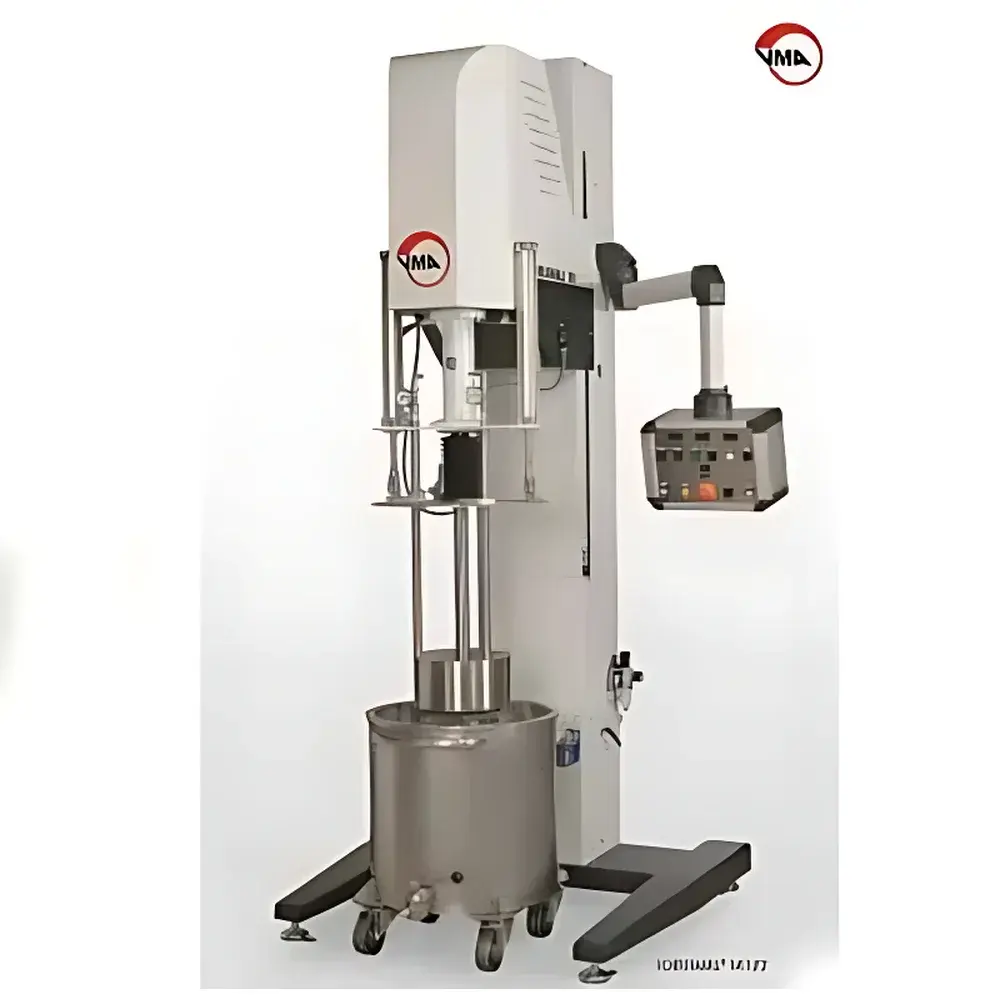
VMA TORUSMILL SK122 High-Speed Laboratory Disperser
| Brand | VMA |
|---|---|
| Origin | Germany |
| Model | SK122 |
| Instrument Type | Bead Mill |
| Sample Suitability | Hard Materials |
| Feed Particle Size | <15 mm |
| Final Particle Size | <40 µm |
| Batch Grinding Capacity | 35–400 L |
| Motor Power | 22 kW |
| Chamber Volume Range | 75–500 L |
| Discharge Fineness | <0.01 mm |
| Configuration Options | Explosion-Proof (Zones 0/1/2), Vacuum-Integrated, PLC-Controlled, Ceramic-Wetted Components |
Overview
The VMA TORUSMILL SK122 is a high-energy, circulation-type bead mill engineered for laboratory-scale dispersion and ultrafine grinding of hard, abrasive, or highly filled materials. Operating on the principle of dynamic media attrition—where premixed slurry is continuously pumped through a stationary grinding chamber containing ceramic or steel beads—the SK122 delivers controlled mechanical energy transfer via high-speed rotor-stator interaction and patented impeller-driven recirculation. Unlike conventional batch mills, the SK122 integrates an internal centrifugal pump wheel and bottom-mounted disperser disc to minimize dead volume and enforce turbulent, laminar-free flow paths within the grinding vessel. This architecture ensures consistent residence time distribution, narrow particle size distribution (PSD), and reproducible sub-40 µm final grind across diverse formulations—including pigment pastes, battery cathode slurries, ceramic suspensions, and pharmaceutical nanosuspensions.
Key Features
- 22 kW high-efficiency motor with variable-frequency drive (VFD) for precise speed control (typically 500–3,000 rpm at rotor tip)
- Patented dual-function grinding basket: combines high-shear dispersion disc at base and optimized bead-retaining geometry for stable media bed formation
- Modular clamping system accommodating cylindrical vessels from 75 L to 500 L—enabling scalable process development from lab to pilot scale
- Low dead-volume design (<2% of total chamber volume) achieved via integrated bottom disperser and axial flow path optimization
- Robust stainless-steel construction with optional ceramic-wetted components (zirconia-lined chamber, SiC shaft seals, alumina grinding media) for chemical resistance and reduced contamination
- Configurable safety interfaces: ATEX-certified explosion-proof variants (Zone 0, 1, and 2), vacuum-capable lid assemblies for oxygen-sensitive processing, and IP65-rated PLC control cabinets with HMI touchscreen
Sample Compatibility & Compliance
The SK122 accommodates feed particles up to 15 mm in diameter and achieves final D90 values consistently below 40 µm—with typical D50 values in the 0.5–5 µm range depending on formulation viscosity, media size (0.3–2.0 mm), and residence time. It is validated for use with high-density (>3.5 g/cm³), high-hardness (>8 Mohs) materials including silicon carbide, tungsten carbide, lithium iron phosphate, and titanium dioxide. The system complies with ISO 8502-2 (surface cleanliness), EN 61000-6-2/-4 (EMC immunity/emission), and optionally meets FDA 21 CFR Part 11 requirements when paired with audit-trail-enabled PLC firmware. Full GMP/GLP documentation packages—including IQ/OQ protocols, material traceability logs, and calibration certificates for torque and temperature sensors—are available upon request.
Software & Data Management
The standard control interface includes a CE-compliant PLC with real-time monitoring of motor load, chamber temperature (±0.5 °C), inlet/outlet pressure differential, and cumulative energy input (kWh/kg). Optional software modules support automated recipe management, trend logging (CSV export), and integration into LIMS or MES platforms via OPC UA or Modbus TCP. All process parameters are timestamped and stored with user authentication; electronic signatures and change history tracking satisfy ALCOA+ data integrity principles. Remote diagnostics and firmware updates are supported over secure Ethernet connections without compromising network segmentation requirements.
Applications
- Development and optimization of electrode slurries for Li-ion and solid-state batteries
- Production of stable nanoceramic dispersions for additive manufacturing feedstocks
- Preparation of high-gloss automotive and industrial coatings requiring <10 µm agglomerate content
- Pharmaceutical nanomilling of BCS Class II/IV APIs under controlled thermal conditions
- Rheological modification of cementitious systems and geopolymers via particle size tailoring
- Recycling-process refinement of spent catalyst powders and metallurgical residues
FAQ
What is the minimum recommended batch volume for reliable operation?
The SK122 requires a minimum fill level of 35 L to ensure adequate media coverage and thermal stability during continuous circulation.
Can the SK122 be used for solvent-based systems?
Yes—provided appropriate explosion-proof certification (ATEX Zone 1 or 2) and compatible wetted materials (e.g., PTFE-sealed bearings, ceramic shaft sleeves) are selected.
Is temperature control integrated into the base configuration?
Jacketed vessel support is standard; external chiller integration (−10 °C to +80 °C) is available via DIN 28120 flanged ports with PID-regulated flow control.
How does the SK122 compare to planetary ball mills for hard-material grinding?
Unlike impact-dominated planetary mills, the SK122 applies shear- and attrition-dominated forces at higher energy density, enabling narrower PSD, lower contamination, and better scalability to production volumes.
What maintenance intervals are specified for the grinding basket and disperser disc?
Inspection is recommended every 500 operating hours; replacement intervals depend on abrasivity but typically exceed 2,000 hours for zirconia-reinforced components under standard pigment dispersion protocols.



