
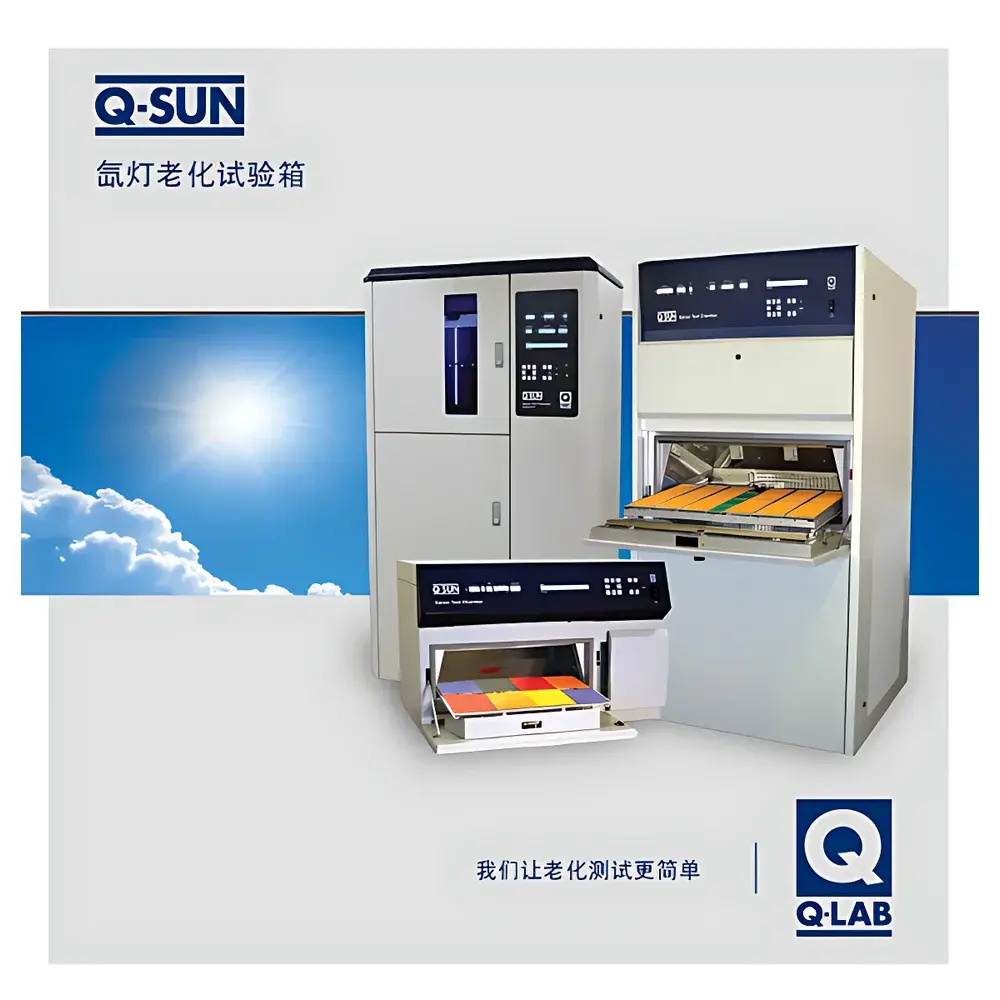
Q-Lab Xe-3-HS Xenon Arc Weathering Test Chamber
| Brand | Q-Lab |
|---|---|
| Origin | USA |
| Model | Xe-3-HS |
| Light Source | High-Stability Xenon Arc Lamp |
| Spectral Range | 290–800 nm (full-spectrum solar simulation) |
| Black Standard Temperature Control | 35–110°C |
| Relative Humidity Range | 10–95% RH |
| Water Spray Function | Programmable intermittent rain simulation |
| Lamp Life | ≥1500 hours |
| Compliance | ASTM G155, ISO 4892-2, AATCC TM16, SAE J2527, and other international weathering standards |
Overview
The Q-Lab Xe-3-HS Xenon Arc Weathering Test Chamber is an engineered solution for accelerated material degradation testing under controlled, reproducible conditions that simulate natural outdoor and indoor light exposure environments. Utilizing a high-stability, full-spectrum xenon arc lamp, the system replicates the critical UV, visible, and near-infrared components of terrestrial sunlight—enabling precise correlation with real-world aging phenomena such as photodegradation, thermal oxidation, hydrolytic cleavage, and pigment fading. Designed in accordance with fundamental principles of photochemical kinetics and radiometric calibration, the Xe-3-HS operates on a calibrated irradiance control architecture, ensuring consistent photon flux delivery across test cycles. Its modular chamber design integrates tightly coupled thermal, hygral, and irradiative stressors—allowing users to isolate or combine variables in alignment with standardized exposure protocols.
Key Features
- Full-spectrum xenon arc lamp system with spectral output traceable to NIST-certified reference standards (290–800 nm), including critical UV-B (280–315 nm) and UV-A (315–400 nm) bands
- Black standard temperature sensor feedback loop for precise specimen surface temperature control (35–110°C range), enabling compliance with ASTM G155 Class III and ISO 4892-2 Cycle 1–4 requirements
- Programmable relative humidity control (10–95% RH) with condensation-resistant humidity generation and monitoring, supporting moisture-coupled degradation studies per ASTM D4355 and ISO 105-B02
- Integrally mounted water spray system with adjustable frequency, duration, and pressure—designed to replicate thermal shock and mechanical erosion effects of natural rainfall events
- Optimized air-cooled lamp housing and forced convection airflow management for stable irradiance uniformity (±15% across specimen plane per ASTM G155 Annex A2)
- Energy-efficient lamp power regulation and low-maintenance optical train—reducing operational cost without compromising spectral fidelity or test repeatability
Sample Compatibility & Compliance
The Xe-3-HS accommodates flat-panel specimens up to 120 mm × 240 mm (standard rack configuration), with optional multi-tier trays for high-throughput screening. It supports rigid and flexible substrates—including polymers, coatings, textiles, automotive interior/exterior trim, architectural sealants, and packaging films. All operational parameters are fully programmable and auditable, meeting GLP/GMP data integrity expectations. The system complies with key international weathering standards including ASTM G155 (xenon-arc apparatus), ISO 4892-2 (methods for plastics), AATCC TM16 (textile colorfastness), SAE J2527 (automotive exterior materials), and FDA-relevant photostability guidance for pharmaceutical packaging per ICH Q1B. Calibration certificates and irradiance verification reports are available upon request for regulatory submissions.
Software & Data Management
Control and monitoring are managed via Q-Lab’s proprietary QUASAR™ software platform, which provides intuitive scheduling, real-time parameter logging, and automated pass/fail evaluation against user-defined thresholds. All test logs—including irradiance history, temperature/humidity profiles, spray event timestamps, and lamp operating hours—are stored with time-stamped, tamper-evident audit trails compliant with 21 CFR Part 11 requirements. Export functionality supports CSV, PDF, and XML formats for integration into LIMS or enterprise quality systems. Remote diagnostics and firmware updates are supported over secure HTTPS connections, minimizing downtime and ensuring long-term method consistency.
Applications
The Xe-3-HS serves as a primary tool in R&D laboratories and QC departments across industries where light-induced degradation impacts product lifetime and regulatory acceptance. Typical use cases include: evaluating UV stabilizer efficacy in polyolefins and PVC compounds; assessing color retention of automotive clearcoats under simulated Florida exposure; validating fade resistance of inkjet-printed signage materials; qualifying photostability of medical device polymer housings; and verifying durability of architectural silicone sealants per ASTM C1442. Its ability to decouple and recombine environmental stressors makes it especially valuable for root-cause analysis of synergistic failure modes—e.g., humidity-accelerated photooxidation in polyurethane elastomers.
FAQ
What spectral irradiance level does the Xe-3-HS maintain during testing?
The system delivers programmable irradiance levels between 0.35 and 0.55 W/m² @ 340 nm, adjustable in 0.05 W/m² increments, with continuous closed-loop monitoring via integrated UV radiometer.
Can the Xe-3-HS perform cyclic testing with dark periods?
Yes—it supports fully customizable light/dark cycles, including condensation-only phases, with independent control of temperature, humidity, and spray timing.
Is lamp calibration required before each test run?
No; the system performs automatic zero-point and span calibration at startup using factory-traceable reference sensors—requiring only annual verification per Q-Lab Technical Bulletin TB-001.
How is specimen temperature measured and controlled?
A black standard thermometer (BST) mounted adjacent to the sample plane provides direct measurement of absorbed radiant energy; temperature is regulated via proportional-integral-derivative (PID) feedback to the chamber heating/cooling system.
Does the Xe-3-HS support third-party software integration?
Yes—QUASAR™ provides OPC UA and RESTful API interfaces for integration with LabVIEW, MATLAB, and enterprise MES/QMS platforms.



