
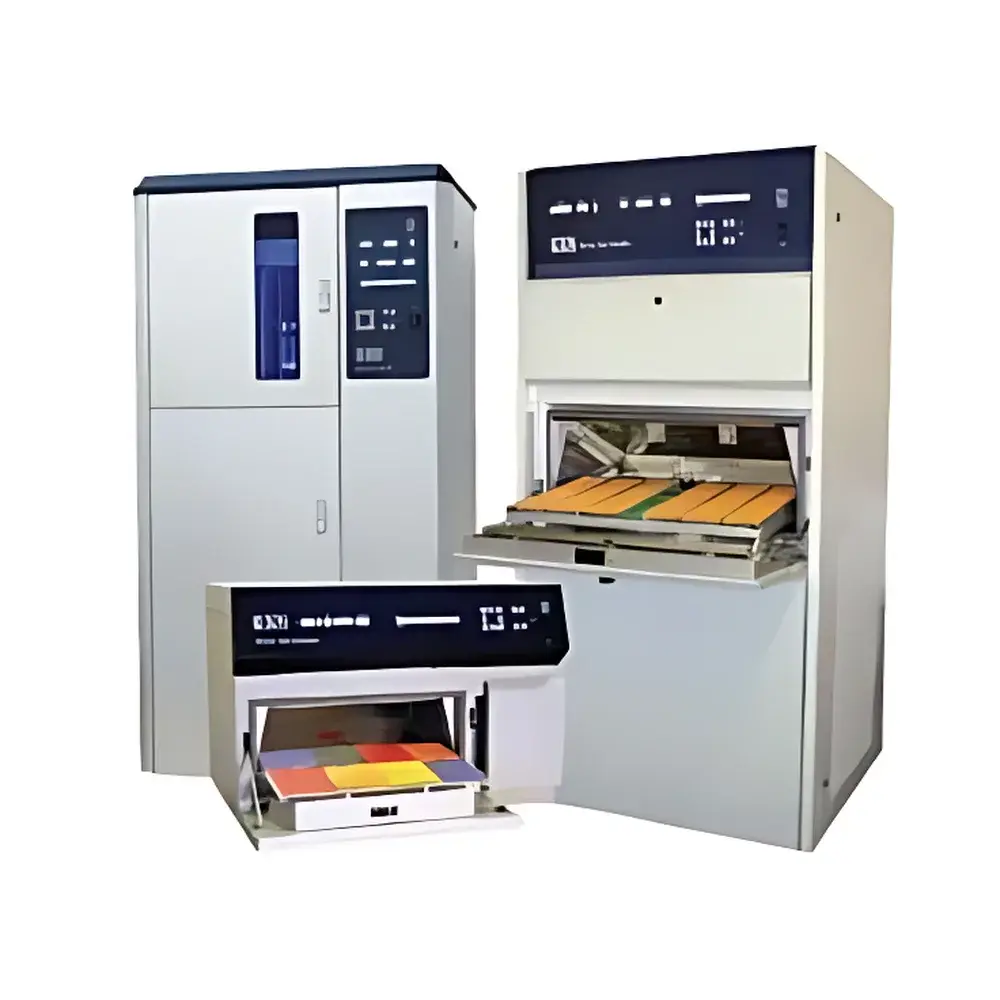
Q-LAB Q-SUN Xe-3 Xenon Arc Weathering Test Chamber
| Brand | Q-LAB |
|---|---|
| Origin | USA |
| Model | Q-SUN Xe-3 |
| Lamp Power | 1800 W |
| Sample Tray Dimensions | 451 mm × 718 mm |
| Light Source | Triple Independent Xenon Arc Lamps |
| Spectral Range | Full-spectrum solar simulation (UV, visible, near-IR) |
| Irradiance Control | SOLAR EYE® closed-loop feedback system |
| Temperature Monitoring | Black panel temperature + chamber air temperature |
| Humidity Control | Optional integrated RH control |
| Water Spray Options | Front spray, back spray, dual spray (e.g., acid rain simulation), optional refrigerated cooling unit |
| Compliance | ASTM G151, ASTM G155, ISO 4892-2, ISO 11341, AATCC TM16, SAE J2527, IEC 60068-2-5, GB/T 8427, and over 40 international weathering standards |
| Software Interface | Multilingual (English, French, Spanish, Italian, German), Ethernet-enabled data logging, AUTOCAL® automated calibration, self-diagnostic alerts |
| Operating Mode | Continuous unattended operation |
Overview
The Q-LAB Q-SUN Xe-3 Xenon Arc Weathering Test Chamber is an engineered solution for accelerated light stability, colorfastness, and photodegradation testing of materials exposed to outdoor or indoor sunlight environments. It employs three independently operated 1800 W xenon arc lamps to deliver a continuous, full-spectrum solar irradiance—spanning ultraviolet (290–400 nm), visible (400–700 nm), and near-infrared (700–1100 nm) wavelengths—that closely replicates natural terrestrial sunlight under controlled laboratory conditions. Unlike UV fluorescent or metal halide systems, xenon arc technology provides the most spectrally accurate simulation of solar radiation, enabling reliable prediction of real-world aging behavior—including yellowing, chalking, gloss loss, cracking, and fading—across polymers, coatings, textiles, automotive interiors, packaging, and architectural finishes. The chamber operates continuously 24/7, delivering irradiance equivalent to peak summer noon sun intensity—up to 1.25 W/m² @ 340 nm—without diurnal cycling, thereby compressing years of outdoor exposure into weeks or months of accelerated testing.
Key Features
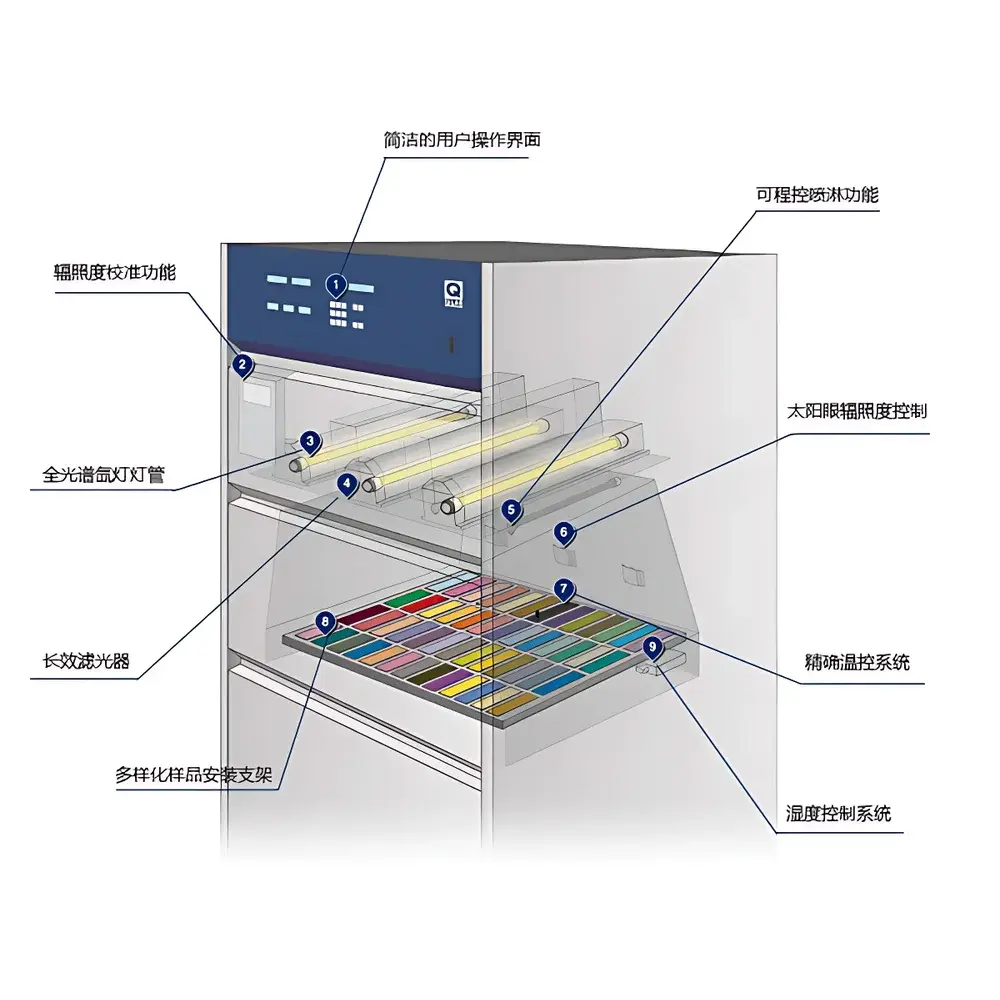
- Triple 1800 W xenon arc lamp configuration ensures uniform irradiance distribution and extended lamp life with balanced spectral output.
- Horizontal sample orientation on a 451 mm × 718 mm sliding tray enables realistic 3D specimen exposure and rapid loading/unloading without tools.
- SOLAR EYE® irradiance monitoring and feedback control maintains precise, repeatable spectral power at user-selected wavelengths (e.g., 340 nm, 420 nm, or TUV).
- Independent black panel temperature (BPT) and chamber air temperature sensors enable simultaneous thermal stress profiling per ISO 4892-2 and ASTM G155 protocols.
- Integrated humidity control (optional) meets requirements for cyclic wet/dry exposure in standards such as ISO 11341 and AATCC TM169.
- Modular water spray system supports front spray, back spray, dual spray (for sequential or co-applied simulants like acid rain), and programmable spray duration/frequency.
- Refrigerated cooling option (Xe-3-HC/Xe-3-HSC models) extends operational range to sub-ambient temperatures, supporting low-temperature photostability studies per PV 1303 and VDA 675242.
- AUTOCAL® automated calibration eliminates manual radiometer adjustments; traceable to NIST-certified reference standards.
- Industrial-grade touchscreen interface with five language options (English, French, Spanish, Italian, German) and embedded Ethernet port for remote monitoring, data export, and audit-ready event logging.
Sample Compatibility & Compliance
The Q-SUN Xe-3 accommodates flat, curved, or three-dimensional specimens up to 50 mm in height, including coated panels, textile swatches, plastic housings, automotive trim, and printed labels. Its horizontal exposure geometry minimizes edge shadowing and facilitates direct comparison with field exposure results. The system is validated for compliance with over 40 internationally recognized weathering standards—including ASTM G151 (accelerated exposure apparatus), ASTM G155 (xenon-arc exposure), ISO 4892-2 (methods for plastics), ISO 105-B02/B04/B06 (textile colorfastness), SAE J2412/J2527 (automotive component durability), IEC 60068-2-5 (environmental testing), and China’s GB/T 8427–2019 (textiles) and GB/T 14576–2022 (coatings). All configurations support GLP-compliant operation with timestamped event logs, user access controls, and 21 CFR Part 11–ready software options upon request.
Software & Data Management
The embedded controller features deterministic real-time scheduling and stores full test profiles—including irradiance setpoints, temperature/humidity ramps, spray sequences, and calibration history—with no external PC dependency. Data is logged at user-defined intervals (1 sec to 60 min) and exported via Ethernet to CSV or XML formats compatible with LIMS and statistical analysis platforms. Built-in self-diagnostics monitor lamp voltage, cooling fan status, humidity sensor drift, and filter degradation, issuing actionable alerts before parameter deviation exceeds tolerance limits. Firmware updates are delivered via secure HTTPS; all calibration events are digitally signed and archived with operator ID and timestamp for full traceability.
Applications
This instrument serves laboratories conducting R&D, quality assurance, and regulatory validation across diverse sectors: polymer formulation labs assessing UV stabilizer efficacy; textile manufacturers validating AATCC TM16 colorfastness ratings; automotive Tier 1 suppliers qualifying interior trims per GMW 3930 or Ford CETP; solar panel encapsulant developers screening yellowing resistance per IEC 61215; and packaging engineers evaluating ink adhesion under simulated retail lighting. Its ability to decouple spectral, thermal, and moisture stress variables makes it indispensable for root-cause analysis of photodegradation mechanisms—particularly where synergistic effects between UV dose, condensation cycles, and thermal cycling drive failure.
FAQ
What spectral filters are available for the Q-SUN Xe-3, and how do they affect test outcomes?
Q-LAB offers Daylight, Window Glass, and Extended UV filters. The Daylight filter replicates unfiltered terrestrial sunlight (290–800 nm); the Window Glass filter blocks UV-B and short UV-A (<320 nm), simulating indoor exposure behind standard glass; the Extended UV filter enhances UV-B output for aggressive screening. Filter selection directly impacts degradation rate and failure mode—e.g., window glass filtration suppresses chalking in acrylics but accelerates yellowing in certain polyolefins.
Can the Q-SUN Xe-3 meet ISO 4892-2 Class 1 irradiance uniformity requirements?
Yes. When operated per Q-LAB’s recommended lamp alignment, filter replacement schedule, and tray positioning protocol, the Xe-3 achieves ≤ ±15% irradiance uniformity across the exposure plane—exceeding ISO 4892-2 Class 1 (±20%) specifications.
Is the SOLAR EYE® system compliant with ASTM G155 calibration traceability requirements?
Yes. SOLAR EYE® uses factory-calibrated, NIST-traceable photodiodes and performs automatic zero-offset correction during idle periods. Calibration certificates include uncertainty budgets and are issued per ISO/IEC 17025-accredited procedures.
How often must xenon lamps be replaced, and what is the typical lifetime?
Lamp life averages 1,500–2,000 hours under continuous operation at 0.35–0.55 W/m² @ 340 nm. Q-LAB recommends replacement after 1,800 hours or when irradiance output falls below 90% of initial value—monitored automatically by SOLAR EYE®.
Does the Q-SUN Xe-3 support automated pass/fail reporting against predefined acceptance criteria?
While the base controller does not perform statistical pass/fail decisions, its structured data export enables integration with third-party QA software (e.g., Minitab, JMP, or custom Python scripts) that apply user-defined thresholds to delta-E, gloss retention, or tensile strength loss metrics.



