
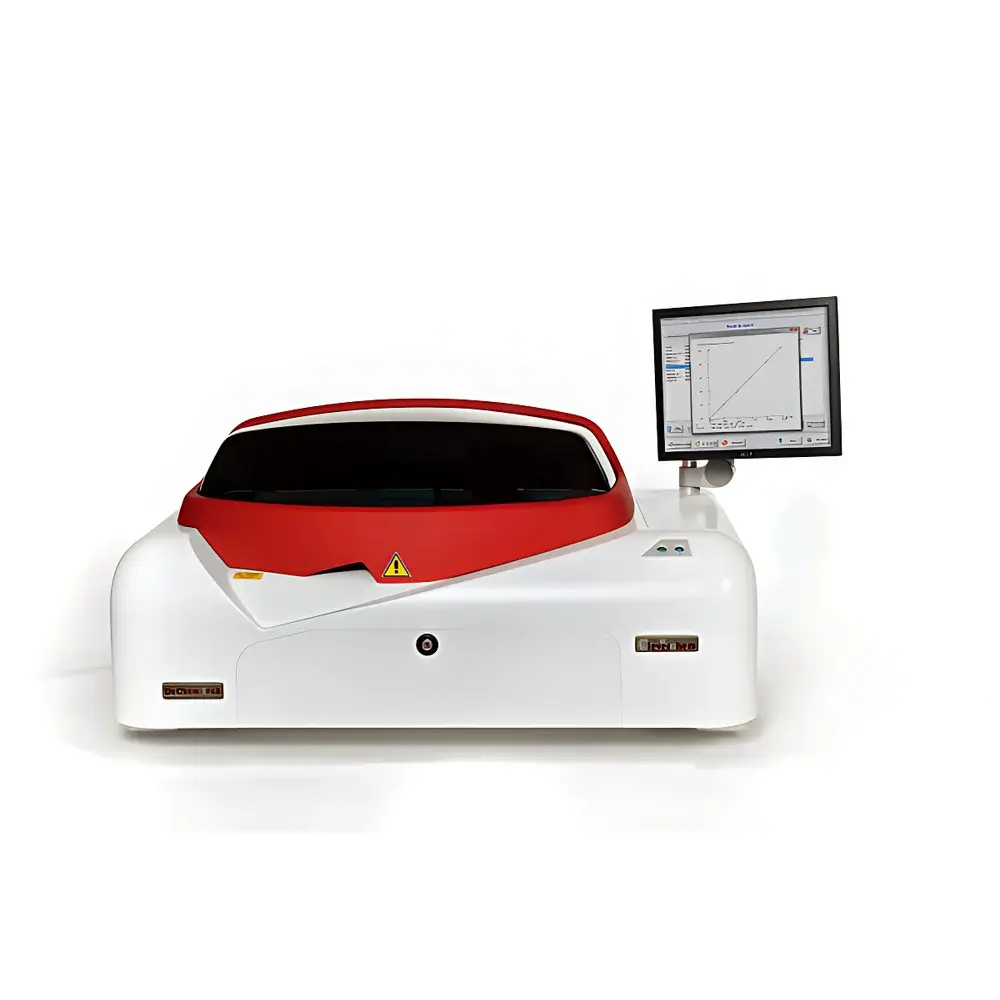
DeChem-Tech Cleverchem 380Plus Discrete Auto Analyzer
| Brand | DeChem-Tech |
|---|---|
| Origin | Germany |
| Model | Cleverchem 380Plus |
| Sample Capacity | 119 positions (expandable to 129) |
| Reagent Positions | 49 |
| Wavelength Range | 400–900 nm |
| Cuvette Path Length | 10 mm |
| Light Source | Tungsten-Halogen Lamp |
| Detection Principle | Photometric Colorimetry (Discrete Flow Analysis) |
| Maximum Throughput | 350 samples/hour |
| Sample Volume Range | 1–900 µL |
| Reagent Volume Range | 1–450 µL |
| Dilution Factor | Up to 100× (in-cuvette) |
| Cuvette Material | Fused Quartz (64-position carousel) |
| Cleaning | 8-step Ultrasonic + WECO Peristaltic Pump System |
| Compliance | ASTM, ISO, EPA, and GB methods |
| Software | GLP-compliant with audit trail, sample/blank correction, and 21 CFR Part 11-ready configuration options |
Overview
The DeChem-Tech Cleverchem 380Plus is a high-precision discrete auto analyzer engineered for photometric colorimetric analysis in environmental, agricultural, food, and industrial laboratories. Unlike continuous flow or segmented flow systems, the Cleverchem 380Plus implements true discrete analysis: each sample and reagent combination is processed individually in a dedicated quartz cuvette, eliminating cross-contamination and enabling rigorous method traceability. The system operates on the Beer–Lambert principle—measuring absorbance at user-selectable wavelengths (400–900 nm) following controlled chemical reactions (e.g., diazotization, molybdenum blue, indophenol blue). Its tungsten-halogen light source ensures stable spectral output across the visible range, while the 10-mm pathlength fused quartz cuvettes deliver high optical reproducibility and long-term durability. Designed and manufactured in Germany, the platform supports full automation of calibration, dilution, blank correction, and multi-step washing—making it suitable for routine compliance testing under ISO/IEC 17025, EPA Methods (e.g., 353.2, 365.4), and ISO standards (e.g., ISO 11905-1 for nitrate, ISO 6878 for phosphate).
Key Features
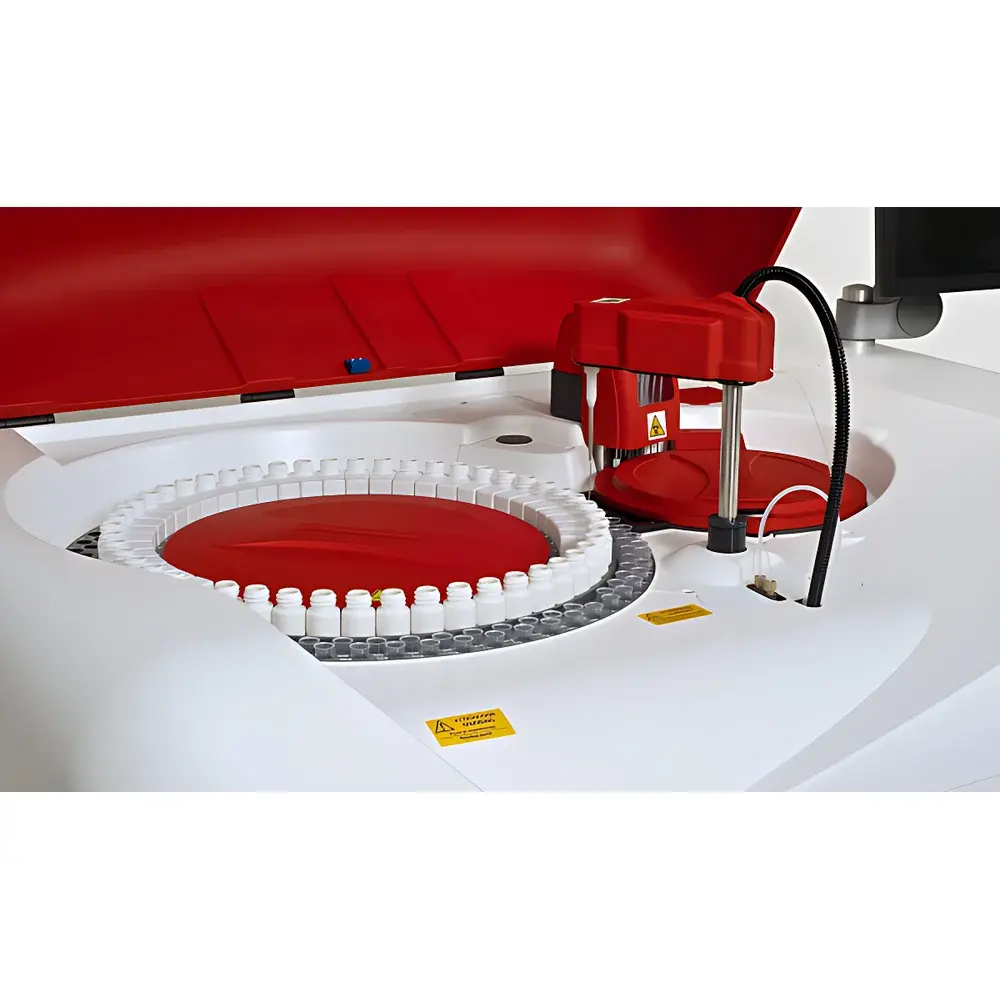
- Discrete cuvette-based architecture with 64-position fused quartz cuvette carousel—each cuvette undergoes optical validation post-cleaning before reuse.
- 8-step ultrasonic cleaning station combined with WECO-controlled peristaltic pumps ensures >99.9% carryover elimination between samples.
- 119 standard sample positions (expandable to 129), with 10 reagent positions configurable as auxiliary sample slots for flexible batch loading.
- 49 refrigerated reagent positions (4–12 °C optional), supporting temperature-sensitive assays such as enzymatic or unstable chromogenic reactions.
- In-cuvette dilution module (1 mL chamber) enables automatic 2× to 100× dilution of out-of-range samples and precise standard curve preparation without external hardware.
- True dual-blank correction: independent measurement of both reagent blank and sample blank prior to analyte quantification, minimizing matrix interference.
- Integrated waste management: sealed waste collection with liquid-level sensors, volatile compound containment, and overflow prevention—meeting OSHA and CLP hazard mitigation requirements.
- Robust mechanical design includes anti-vibration cuvette positioning (8-point stabilization), PTFE-coated mixing probes, and sub-4 µm inline filtration for wash solutions.
Sample Compatibility & Compliance
The Cleverchem 380Plus accommodates aqueous matrices including seawater, wastewater, soil extracts, plant digests, fertilizer solutions, food homogenates, tobacco leachates, and wine/vinegar filtrates. Sample volume flexibility (1–900 µL) and programmable aspiration protocols allow direct analysis of turbid or particulate-laden samples when paired with optional centrifugation or filtration preprocessing. All validated methods align with internationally recognized regulatory frameworks: U.S. EPA-approved procedures for nutrients and metals; ISO standards for water quality (e.g., ISO 15681-2 for orthophosphate); and Chinese GB/T methods (e.g., GB/T 5750.5–2023 for ammonia nitrogen). The system’s architecture supports GLP and GMP workflows through configurable audit trails, electronic signatures, and instrument qualification documentation packages (IQ/OQ/PQ templates available upon request).
Software & Data Management
Control and data acquisition are managed via Cleverchem Control Software—a Windows-based application supporting multilingual UI (English and Chinese). The software provides real-time monitoring of all fluidic events, error logging with timestamped diagnostics, and customizable report generation compliant with LIMS export formats (CSV, XML, PDF). Critical data integrity features include 21 CFR Part 11–ready configurations (role-based access control, electronic signatures, immutable audit trails), automatic backup scheduling, and version-controlled method storage. Calibration curves are generated using weighted linear regression or polynomial fitting; outlier rejection algorithms flag non-conforming points based on user-defined residual thresholds. All raw absorbance values, blank-subtracted signals, and intermediate reaction kinetics are stored for retrospective review and method revalidation.
Applications
- Water & Wastewater: Total nitrogen (TN), total phosphorus (TP), ammonium-N, nitrate-N, nitrite-N, orthophosphate, silicate, sulfate, sulfide, chloride, Cr(VI), acidity, alkalinity, hardness, Fe, Mn, Al, Cu, Zn, Mg, cyanide, phenols.
- Soil & Plant Tissue: NH₄⁺-N, NO₃⁻-N, NO₂⁻-N, available P, exchangeable K, boron, total N/P, sulfate-S, chloride, carbonate alkalinity.
- Fertilizers: Water-soluble P, ammoniacal N, nitrate N, citrate-soluble P, sulfate, chloride, boron, heavy metals (via digestion followed by colorimetric detection).
- Food & Beverage: SO₂ (free/bound), total sulfites, nitrate/nitrite in cured meats, total Kjeldahl nitrogen (TKN), phosphates in dairy, cyanide in cassava, acetic acid in vinegar, organic acids in wine (malic, lactic, tartaric).
- Tobacco & Agriculture: Nicotine, reducing sugars, total sugars, HCN, volatile alkaloids, nitrate, phosphate, potassium, chlorine.
FAQ
What distinguishes discrete analysis from continuous flow or segmented flow methods?
Discrete analysis processes one sample-reagent reaction per dedicated cuvette, eliminating stream segmentation artifacts and enabling strict adherence to classical wet-chemistry protocols—including variable incubation times, multi-reagent additions, and post-reaction dilutions—all within a single cuvette.
Can the Cleverchem 380Plus perform EPA Method 365.4 for orthophosphate without modification?
Yes—the system includes pre-programmed, fully validated methods for EPA 365.4, including molybdenum blue reaction kinetics, ascorbic acid reduction, and automated blank subtraction. Method parameters are locked and exportable for laboratory accreditation submissions.
Is third-party reagent compatibility supported?
All reagents—including domestic Chinese suppliers—are compatible provided they meet purity specifications (e.g., ACS grade) and do not contain interfering surfactants or suspended solids. The 4-µm inline filter protects fluidic pathways from particulate clogging.
How is data integrity ensured during long unattended runs?
The software logs every hardware event (valve actuation, pump rotation, lamp warm-up, cuvette position), timestamps all measurements, and generates checksum-verified raw data files. Interruptions trigger automatic recovery sequences without data loss.
What maintenance intervals are recommended for optimal performance?
Daily: visual inspection of tubing, waste level, and cuvette cleanliness.
Weekly: calibration verification with NIST-traceable standards and WECO pump tubing replacement.
Quarterly: lamp intensity validation, cuvette optical transmission check, and full fluidic path decontamination.



