
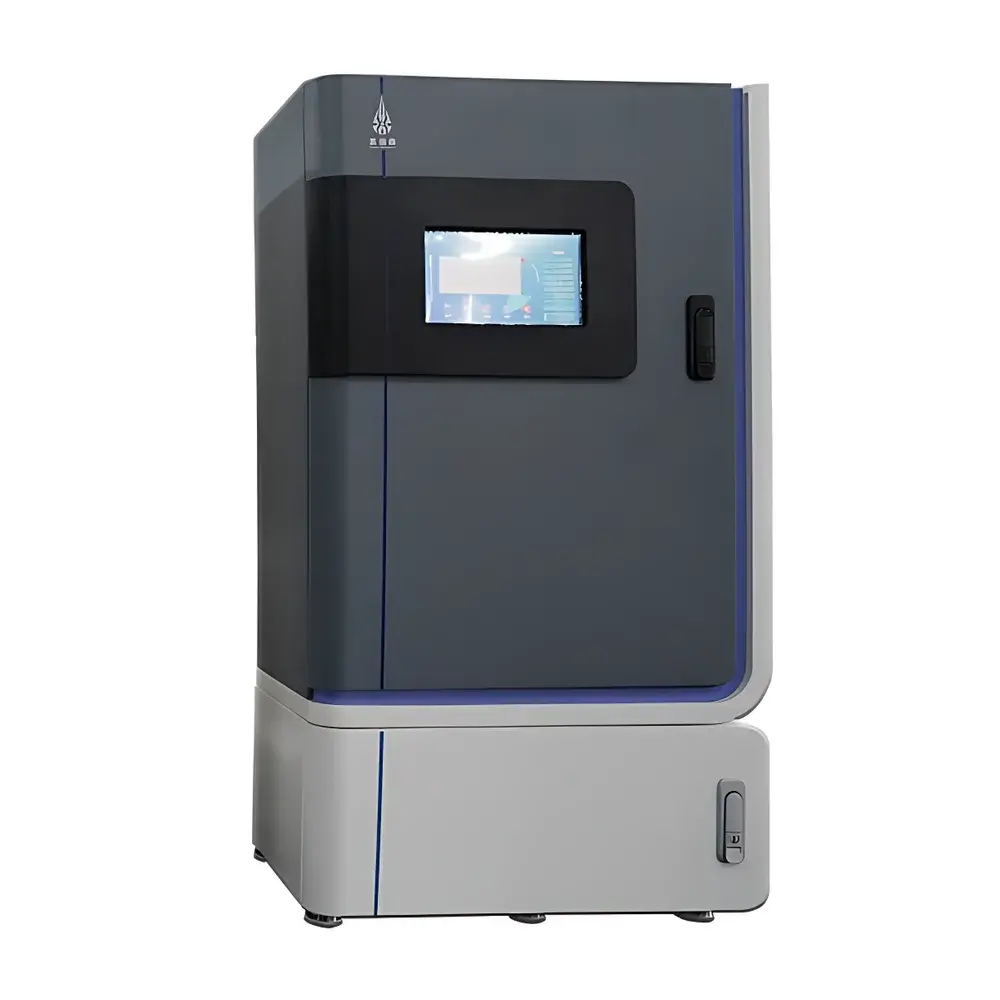
WaterWhisperer WW-COD Online Water Quality Analyzer
| Origin | Shenzhen, China |
|---|---|
| Manufacturer Type | Authorized Distributor |
| Model | WaterWhisperer WW-COD |
| Price Range | USD 14,000 – 28,000 |
| Instrument Type | Online COD Analyzer |
| Measured Parameter | Chemical Oxygen Demand (COD) |
| Detection Principle | Spectrophotometric Measurement after Acidic Potassium Permanganate Digestion |
| Communication Interface | RS232, RS485, MODBUS RTU |
| Data Storage | 2000 records |
| Power Recovery | Auto-restart after power outage |
| Operating Environment | 5–40 °C, ≤85% RH non-condensing |
| Installation Options | Wall-mount, benchtop |
| Compliance | Designed to support ISO 15705:2002 (COD by permanganate method), ASTM D1253, and GLP-aligned data integrity practices |
Overview
The WaterWhisperer WW-COD Online Water Quality Analyzer is a compact, fully automated spectrophotometric system engineered for continuous, unattended monitoring of Chemical Oxygen Demand (COD) in natural and treated water matrices. It implements the acidic potassium permanganate digestion method—standardized under ISO 15705:2002 and ASTM D1253—as its core analytical principle. Following filtration, the sample is precisely metered into a thermostatically controlled digestion tube, where sequential reagent addition (KMnO₄ and sulfuric acid), high-temperature oxidation (100 °C), and controlled cooling are executed within a closed-loop fluidic path. The resulting colored reaction product is quantified via fixed-wavelength photometry (typically 525 nm or 546 nm, depending on calibration configuration), and concentration is calculated using factory-established calibration curves stored in non-volatile memory. The instrument’s architecture prioritizes measurement reproducibility over extended deployment cycles, with minimal drift (<±3% FS/month) under routine operation and built-in thermal stabilization of optical and detection components.
Key Features
- Integrated modular design: Digestion, mixing, and colorimetric detection modules are co-located within a single chassis, reducing footprint by >40% versus conventional benchtop analyzers and minimizing internal tubing length to suppress carryover and cross-contamination.
- Intelligent diagnostics engine: Real-time monitoring of pump actuation, reagent level, waste volume, and optical baseline stability; automatic alerts triggered for low reagent, depleted deionized water, or high waste tank fill level.
- Adaptive calibration protocol: Supports scheduled auto-calibration at user-defined intervals (e.g., every 6/12/24 hours) and manual recalibration with standard solutions; linear range adjustment is configurable without firmware update.
- Dual-channel option available: Enables simultaneous monitoring of two adjacent sampling points (e.g., influent and effluent) using shared control logic and power supply—reducing site infrastructure requirements.
- Robust signal processing: Dual-stage analog filtering and 24-bit ADC resolution minimize noise-induced variance; temperature-compensated photodiode array ensures stable absorbance readings across ambient fluctuations (5–40 °C).
- Fail-safe operational continuity: Auto-restart function resumes analysis sequence post-power interruption; all critical states (valve positions, heater status, error logs) are retained in EEPROM.
Sample Compatibility & Compliance
The WW-COD analyzer is validated for use with river water, surface water, estuarine inflow, municipal wastewater influent/effluent, and industrial process streams meeting inlet filtration specifications (≤100 µm particulate). It complies with physical and functional requirements aligned with ISO/IEC 17025 quality management frameworks for environmental testing laboratories. Data integrity safeguards include write-once audit logging of all operator actions, time-stamped event records, and dual-tier access control (administrator vs. operator roles) conforming to principles outlined in FDA 21 CFR Part 11 for electronic records. Reagent refrigeration module (optional) maintains KMnO₄ solution stability per manufacturer shelf-life guidance, extending usable life up to 90 days.
Software & Data Management
Embedded firmware supports MODBUS RTU over RS485 for seamless integration into SCADA or PLC-based supervisory systems. Local HMI provides real-time status visualization, alarm history review, and manual override capability. Remote connectivity is enabled via integrated 5G/LTE modem (optional) or Ethernet interface, allowing secure cloud-based access through TLS 1.2–encrypted endpoints. All measurement data—including raw absorbance values, calculated COD concentrations, diagnostic flags, and timestamped maintenance events—are stored locally (2000-entry circular buffer) and exportable via USB 2.0 mass storage mode. No proprietary software installation is required for data retrieval; CSV-formatted logs open natively in spreadsheet applications.
Applications
- Real-time compliance monitoring at wastewater treatment plant discharge points per national effluent standards (e.g., China’s GB 18918-2002, EU Urban Wastewater Treatment Directive).
- Early-warning detection of organic load surges in river basins and reservoir intakes.
- Performance verification of tertiary treatment units (e.g., activated carbon filters, ozonation stages).
- Industrial pretreatment verification for electroplating, food processing, and pharmaceutical manufacturing facilities.
- Long-term trend analysis in ecological monitoring networks where low-maintenance, solar-compatible instrumentation is required.
FAQ
What digestion method does the WaterWhisperer WW-COD employ?
It uses the acidic potassium permanganate (KMnO₄) oxidation method per ISO 15705:2002, suitable for low-to-moderate COD ranges (typically 0–50 mg/L O₂ as COD).
Is remote firmware update supported?
No—firmware updates require local USB connection and authenticated administrator credentials to preserve system validation integrity.
Can the analyzer operate without external network connectivity?
Yes; all core analytical functions, data logging, and local alarm generation operate autonomously without cloud or network dependency.
What is the typical reagent consumption rate?
Approximately 1.2 mL per analysis cycle for KMnO₄ solution and 0.8 mL for sulfuric acid, assuming standard 2-hour measurement interval.
Does the system meet electromagnetic compatibility (EMC) requirements for industrial environments?
Yes—it complies with IEC 61326-1:2013 Class A emission limits and immunity levels appropriate for water utility control rooms and outdoor kiosk installations.







