
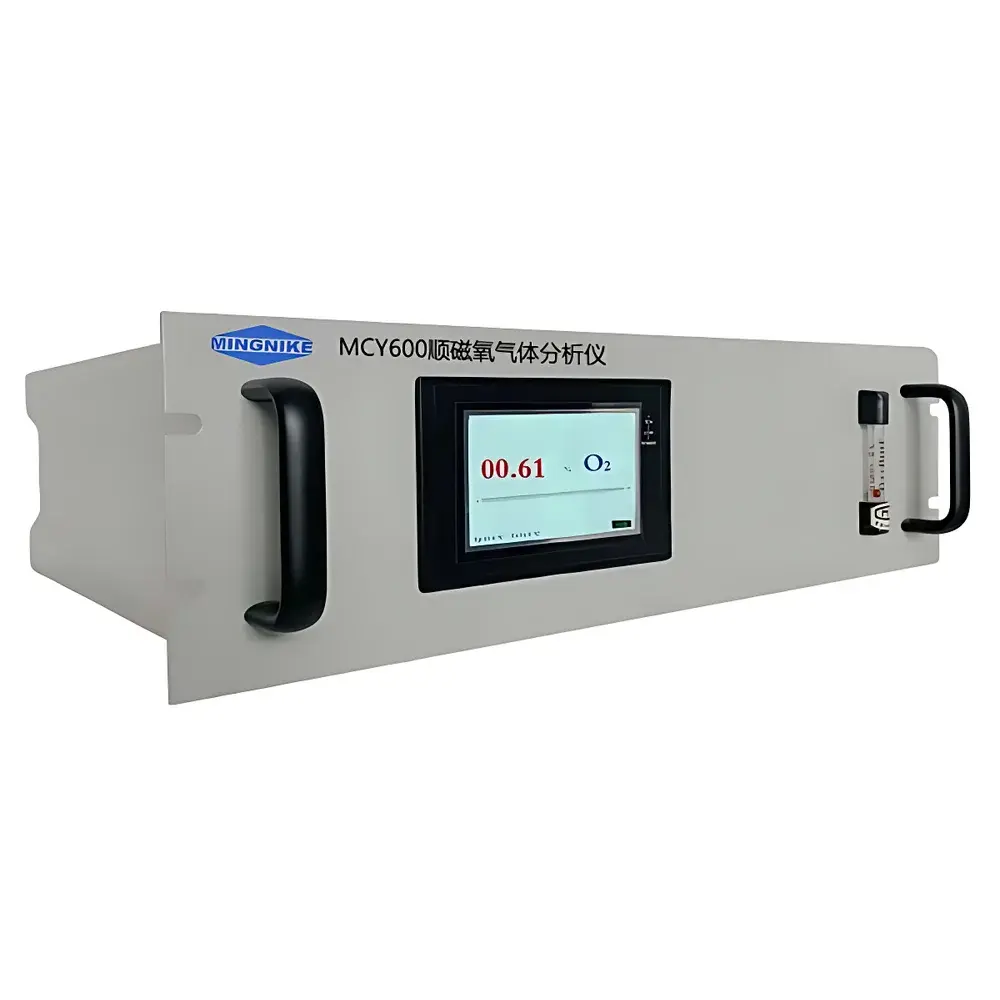
MNK MCY600 Paramagnetic Oxygen Analyzer
| Brand | MNK |
|---|---|
| Origin | Beijing, China |
| Model | MCY600 |
| Operating Temperature | 5–45 °C |
| Sample Gas Pressure | up to 20 kPa (gauge) |
| Sample Flow Rate | 0.2–1.0 L/min |
| Power Supply | 12–24 VDC |
| Output Signal | 4–20 mA |
| Communication Interface | RS485 (Modbus RTU) |
| Measurement Ranges | 0–5%, 0–10%, 0–21%, 0–50%, 0–90%, 90–100%, 0–100% O₂ (v/v) |
| Linearity Error | ±2% FS |
| Stability | ±2% FS / 7 days |
| Repeatability | ±1% FS |
| Cross-Interference Resistance | NH₃, CO, CO₂, CH₄ |
| Corrosive Gas Tolerance | Yes (e.g., H₂S) |
| Sensor Type | Thermal-Magnetic Paramagnetic Detection |
| Vibration Immunity | High |
| Consumable-Free Design | Yes |
Overview
The MNK MCY600 Paramagnetic Oxygen Analyzer is a precision gas measurement instrument engineered for continuous, real-time oxygen concentration analysis in industrial process control and regulated laboratory environments. It operates on the fundamental physical principle of paramagnetism: molecular oxygen (O₂) exhibits strong, temperature-dependent paramagnetic susceptibility—significantly higher than that of common background gases such as N₂, CO₂, Ar, and CH₄. When exposed to a non-uniform magnetic field, O₂ molecules experience a net force proportional to their concentration, enabling quantitative detection without chemical reaction or consumable reagents. Unlike electrochemical or zirconia-based sensors, the MCY600 employs a thermal-magnetic detection architecture—combining a precisely controlled magnetic field with thermally sensitive flow sensing—to deliver stable, drift-resistant measurements across wide dynamic ranges. Designed in alignment with pharmacopeial requirements—including the Chinese Pharmacopoeia (ChP) 2020 Edition—and suitable for GMP-compliant manufacturing environments, the analyzer supports critical applications where regulatory traceability, long-term baseline stability, and immunity to common interferents are non-negotiable.
Key Features
- Paramagnetic detection core with thermal-magnetic transduction—no catalytic surfaces, no electrolytes, no replacement cells.
- High selectivity for O₂ in complex gas matrices; validated resistance to cross-sensitivity from NH₃, CO, CO₂, CH₄, and hydrocarbons.
- Robust mechanical design with intrinsic immunity to mechanical vibration and ambient shock—suitable for installation on skids, compressors, and mobile analytical platforms.
- Corrosion-tolerant gas path construction enables direct sampling of streams containing low-to-moderate concentrations of acidic or sulfur-bearing species (e.g., H₂S, SO₂).
- Wide configurable range selection—from trace-level (0–5% O₂) to pure-oxygen verification (90–100% O₂)—with consistent ±1% FS repeatability across all spans.
- Low-power 12–24 VDC operation and industry-standard 4–20 mA analog output with Modbus RTU over RS485 for integration into DCS, SCADA, and PLC systems.
Sample Compatibility & Compliance
The MCY600 accommodates dry or moderately humid sample gases within a pressure envelope of up to 20 kPa (gauge) and a volumetric flow range of 0.2–1.0 L/min. Particulate filtration (≤5 µm) and condensate removal are recommended upstream of the analyzer inlet. The instrument meets electromagnetic compatibility (EMC) requirements per IEC 61326-1 for industrial environments and conforms to functional safety considerations relevant to continuous emission monitoring (CEM) and pharmaceutical utility gas qualification. While not certified to ATEX or IECEx, its intrinsically safe-compatible electrical interface allows deployment in classified zones when paired with appropriate barrier systems. For regulated use—particularly in pharmaceutical manufacturing—the analyzer supports audit-ready documentation packages, including factory calibration certificates (NIST-traceable), linearity verification reports, and sensor aging characterization data aligned with USP Analytical Instrument Qualification guidance.
Software & Data Management
The MCY600 operates autonomously without embedded firmware-based configuration software. All operational parameters—including span selection, zero adjustment, damping time, and alarm thresholds—are set via Modbus register mapping, enabling full remote configuration through supervisory control systems. Analog output scaling is fully programmable per range, supporting linear or custom polynomial mapping where required by process-specific calibration curves. Raw sensor diagnostics—including coil temperature, magnetic field strength, and thermal gradient stability—are accessible via Modbus for predictive maintenance logging. While the device itself does not store historical data, its RS485 interface is compatible with third-party historian platforms compliant with ISA-88/ISA-95 data models and FDA 21 CFR Part 11 electronic record requirements when deployed with validated acquisition software and access controls.
Applications
- Pharmaceutical nitrogen and oxygen utility gas monitoring per ChP and USP , including medical oxygen purity verification (99.5% v/v minimum) and nitrous oxide blend analysis.
- In-line oxygen monitoring in PSA and VSA oxygen generation plants for feed air, product stream, and tail gas optimization.
- Quality assurance of specialty gas mixtures (e.g., laser cutting blends, modified atmosphere packaging gases, calibration standards).
- Combustion air/fuel ratio control in low-emission burners and thermal oxidizers.
- Research-grade O₂ quantification in controlled-atmosphere chambers, fermentation bioreactors, and hypoxia/hyperoxia exposure studies.
FAQ
Does the MCY600 require periodic recalibration?
Yes—while the thermal-magnetic sensor exhibits excellent long-term stability (±2% FS over 7 days), routine calibration against certified zero and span gases is recommended every 3–6 months depending on application severity and regulatory requirements.
Can it measure oxygen in high-CO₂ environments, such as biogas or flue gas?
Yes—the analyzer demonstrates minimal cross-interference from CO₂, making it suitable for CO₂-rich streams provided moisture and particulates are removed upstream.
Is the instrument suitable for Class 1 Div 1 hazardous locations?
No—the MCY600 is not intrinsically safe certified; however, it may be installed in hazardous areas using approved galvanic isolators or Zener barriers meeting IEC 60079-11.
What is the minimum detectable oxygen concentration?
The lower limit of quantitation (LLOQ) is application-dependent but typically ≤0.1% O₂ for the 0–5% range, based on signal-to-noise ratio and system noise floor under stabilized conditions.
Does it support digital communication protocols other than Modbus RTU?
No—RS485 Modbus RTU is the sole digital interface; however, protocol gateways can translate Modbus to BACnet, Profibus, or Ethernet/IP in integrated control architectures.
Related Products







