
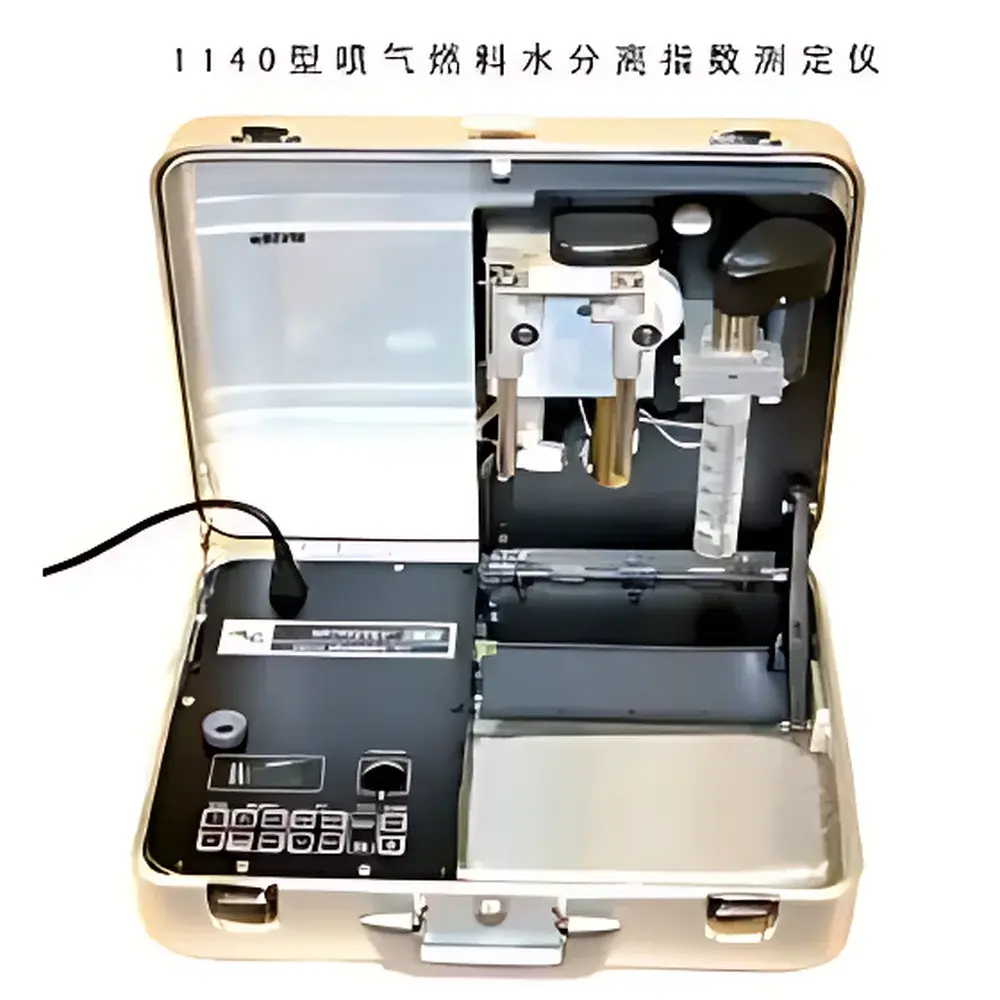
EMCEE Model 1140 Jet Fuel Water Separation Index Analyzer
| Brand | EMCEE |
|---|---|
| Origin | USA |
| Model | 1140 |
| Standard Compliance | ASTM D3948, SH/T 0616–1995 |
| Test Principle | Gravimetric optical transmittance measurement of water separation kinetics in jet fuel |
| Accessories Included | Precision glass syringes, calibrated transfer pipettes, test cuvettes, reference standards |
| Configuration | Portable benchtop unit with integrated timer and optical sensor module |
Overview
The EMCEE Model 1140 Jet Fuel Water Separation Index Analyzer is a precision-engineered, portable instrument designed for quantitative assessment of the water separation performance of aviation turbine fuels—specifically Jet A, Jet A-1, JP-5, and JP-8. It operates on the principle of gravimetric optical transmittance analysis: a standardized volume of fuel, pre-saturated with a defined quantity of distilled water (typically 30 ppm), is vigorously mixed with an emulsifying agent (a proprietary surfactant solution) to form a temporary water-in-fuel emulsion. The mixture is then transferred into a calibrated vertical test cuvette and placed in the analyzer’s optical path. As free water coalesces and separates under gravity, the instrument continuously monitors the change in light transmittance at 635 nm through the fuel column. The Water Separation Index (WSI) is calculated as the time (in seconds) required for the transmittance to reach 70% of its final stabilized value—representing the point at which >90% of separable water has settled below the optical detection zone. This method directly correlates with real-world filter separator performance and is mandated by international aviation fuel quality assurance protocols.
Key Features
- Portable, self-contained benchtop design with built-in optical sensor, LED light source, photodetector array, and microprocessor-controlled timing circuitry
- Pre-calibrated optical path optimized for jet fuel refractive index (nD ≈ 1.43–1.44) and minimal spectral interference from hydrocarbon matrix
- Integrated digital timer with ±0.1 s resolution and automatic WSI endpoint detection algorithm per ASTM D3948 Section 8.3
- Robust aluminum chassis with anti-vibration feet and ambient temperature compensation (15–30 °C operating range)
- No external PC or software required for basic operation; results displayed on high-contrast LCD screen with data hold function
- Compliance-ready documentation package including factory calibration certificate traceable to NIST SRM 2036 (transmittance standards)
Sample Compatibility & Compliance
The Model 1140 is validated exclusively for aviation turbine fuels meeting ASTM D1655, DEF STAN 91-91, and GB 6537 specifications. It is not suitable for diesel, gasoline, biodiesel blends, or fuels containing >0.1% ethanol or methanol due to altered interfacial tension and coalescence dynamics. All test procedures strictly adhere to ASTM D3948–22 “Standard Test Method for Determining Water Separation Characteristics of Aviation Turbine Fuels by Portable Separometer” and its Chinese national equivalent SH/T 0616–1995. The instrument supports GLP-compliant operation when used with documented SOPs, analyst training records, and periodic verification using certified reference materials (e.g., EMCEE WSI Reference Set RM-1140). Data output meets minimum requirements for FDA 21 CFR Part 11 audit trails when paired with optional EMCEE DataLink software (sold separately).
Software & Data Management
While standalone operation requires no software, the optional EMCEE DataLink v3.2 application enables full traceability for regulated environments. It provides password-protected user accounts, electronic signature capture, automated PDF report generation (including timestamped raw transmittance curves), and export to CSV or LIMS-compatible XML formats. All data files include embedded metadata: operator ID, sample ID, ambient temperature/humidity, instrument serial number, firmware version, and calibration expiration date. Audit logs record every parameter change, result modification, or calibration event with ISO 8601 timestamps and IP address (for networked installations). The system architecture complies with Annex 11 (EU GMP) and USP analytical instrument qualification guidelines.
Applications
- Routine quality control testing of incoming jet fuel batches at refinery terminals and airport fuel farms
- Verification of fuel additive effectiveness (e.g., static dissipater additives, corrosion inhibitors) on water separation kinetics
- Monitoring filter separator performance degradation over service life
- Investigation of fuel contamination events involving surfactants, glycol ethers, or microbial growth metabolites
- Supporting ASTM D3241 (Jet Fuel Thermal Oxidation Test) correlation studies where water separation behavior influences deposit formation
- Third-party certification testing for military fuel procurement (MIL-DTL-83133F, MIL-DTL-5624U)
FAQ
What is the recommended frequency for instrument verification?
Verification using EMCEE RM-1140 reference standards shall be performed before each daily test sequence and after any maintenance event.
Can the Model 1140 be used for fuels outside the jet fuel specification?
No. Its optical calibration, mixing dynamics, and WSI algorithm are empirically derived only for aviation turbine fuels meeting ASTM D1655 and DEF STAN 91-91.
Is the 1140 compliant with ISO/IEC 17025 requirements for accredited testing laboratories?
Yes—when operated within documented QMS framework, including annual third-party metrological calibration, uncertainty budgeting per GUM, and participation in PT schemes such as FUELSTAT® Proficiency Testing.
How are consumables qualified for use with the Model 1140?
All syringes and pipettes must be Class A volumetric glassware certified to ISO 648 and ISO 8655; EMCEE-supplied accessories carry individual calibration certificates with tolerance limits ±0.5% at 10 mL and 50 mL volumes.
Does the analyzer require routine optical cleaning?
Yes—the quartz optical window must be cleaned with reagent-grade isopropanol and lint-free optical tissue before each test series to prevent hydrocarbon film buildup affecting transmittance baseline.






