
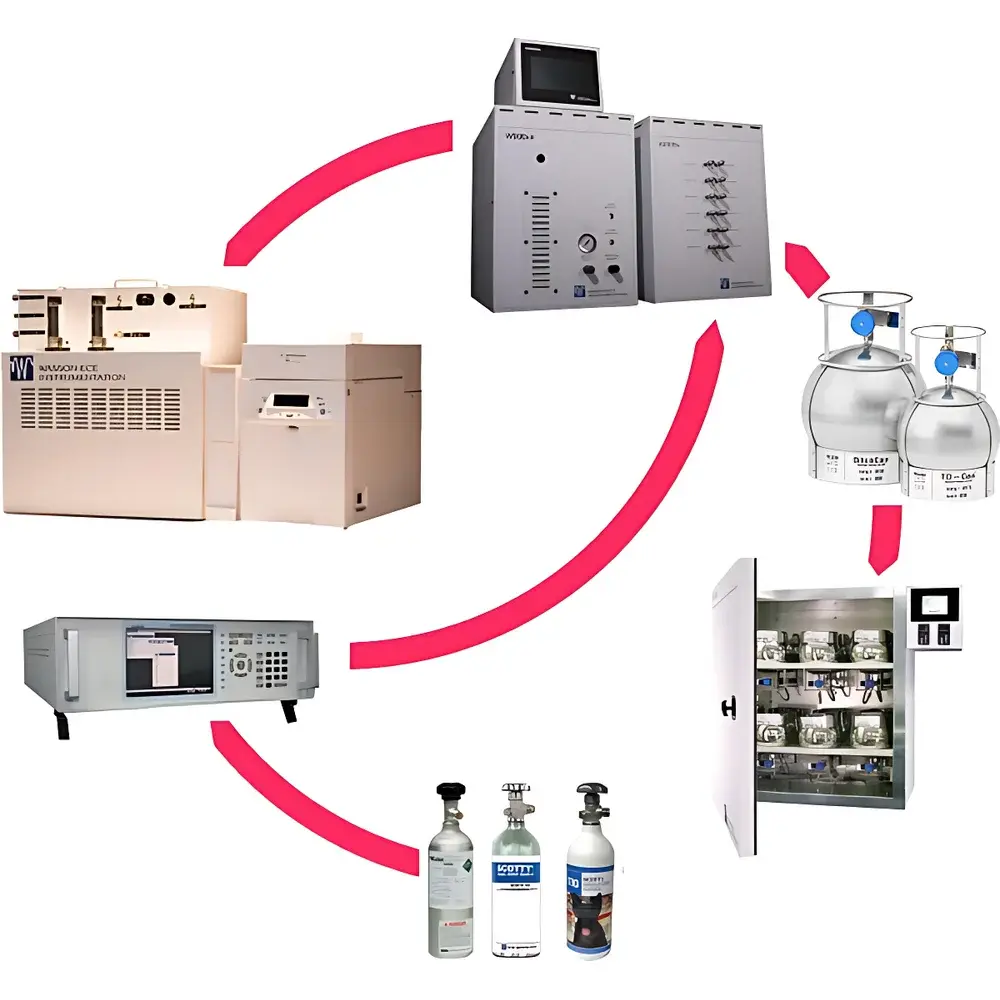
Environmental Air VOC Monitoring System
| Brand | MNK |
|---|---|
| Origin | USA |
| Manufacturer Type | Authorized Distributor |
| Product Origin | Imported |
| Model | VOC |
| Pricing | Available Upon Request |
Overview
The MNK VOC Environmental Air Monitoring System is a fully integrated, laboratory-grade analytical platform engineered for the quantitative detection and speciation of volatile organic compounds (VOCs) in ambient air, workplace atmospheres, and emission source streams. Built upon EPA Method TO-14A and TO-15 compliance architecture, the system employs cryogenic pre-concentration coupled with gas chromatography–mass spectrometry (GC–MS) or GC–flame ionization detection (GC–FID) to achieve sub-part-per-trillion (pptv) detection limits for over 100 priority VOCs—including benzene, toluene, ethylbenzene, xylenes (BTEX), chlorinated solvents, aldehydes, and halogenated hydrocarbons. The system operates on a validated two-stage thermal desorption principle: first, whole-air samples are collected in electropolished, silanized stainless-steel canisters; second, VOCs are cryogenically focused, thermally desorbed, and transferred quantitatively to the GC column with minimal breakthrough or fractionation. This architecture ensures high reproducibility (RSD < 5% across replicate analyses), robustness against humidity interference, and trace-level accuracy required for regulatory reporting under U.S. EPA, ISO 16017-1, and EU Directive 2008/50/EC frameworks.
Key Features
- Fully automated canister-based sampling workflow—from field collection through laboratory analysis—minimizing manual handling and contamination risk
- Integrated canister cleaning station with heated purge, vacuum bake-out, and helium leak testing to meet EPA TO-14A preconditioning requirements
- Cryogenic pre-concentrator equipped with dual-stage cooling (−160 °C trap, −30 °C focusing loop) and programmable thermal desorption for optimal compound recovery across C2–C12 volatility range
- Auto-sampler compatible with 6-, 11-, and 30-L SUMMA®-type electropolished canisters and Tedlar® gas bags (via optional bag autosampler module)
- Dynamic dilution calibrator with mass flow controllers (MFCs) certified to NIST-traceable standards, supporting multi-point calibration per EPA TO-15 Appendix A
- TO-14/TO-15 certified reference gas generator capable of producing stable, humidified standard mixtures at concentrations from 0.1 ppbv to 10 ppmv
- Modular design allowing seamless integration with third-party GC–MS systems (Agilent, Thermo, Shimadzu) or dedicated VOC analyzers
Sample Compatibility & Compliance
The system supports diverse sampling media including stainless-steel canisters (siliconized or electropolished), inert-coated gas bags, and sorbent tubes (with optional thermal desorption interface). All hardware components—including valves, fittings, and transfer lines—are passivated using SilcoNert® or Sulfinert® surface treatments to prevent adsorption, catalytic decomposition, or memory effects. The platform is designed and validated for full compliance with U.S. EPA Methods TO-14A (ambient air), TO-15 (indoor air and source testing), and Compendium Method IP-1A (workplace monitoring). It also aligns with ISO 16017-1 for VOC determination in indoor and outdoor air, and supports GLP-compliant data generation per 21 CFR Part 11 when paired with audit-trail-enabled software.
Software & Data Management
Control and data acquisition are managed via MNK’s proprietary VOC-Link™ software suite, which provides method-driven automation, real-time system diagnostics, and electronic logbook functionality. The software enforces sequence-based calibration verification, automatic peak integration using retention time locking (RTL), and built-in spectral library matching (NIST MS Search). All raw data, instrument parameters, and audit trails are stored in a secure, timestamped database compliant with FDA 21 CFR Part 11 requirements—including user authentication, electronic signatures, and immutable record retention. Export formats include .csv, .cdf, and ASTM E1947-compliant XML for LIMS integration.
Applications
- Ambient air quality monitoring networks (e.g., EPA Photochemical Assessment Monitoring Stations – PAMS)
- Industrial hygiene assessments in manufacturing, petrochemical, and pharmaceutical facilities
- Source emission testing from stacks, vents, and fugitive release points
- Indoor air quality investigations in schools, offices, and residential buildings
- Emergency response and hazardous materials incident characterization
- Method development and validation for regulatory compliance laboratories
FAQ
Does the system support unattended operation for long-term ambient monitoring?
Yes—the canister autosampler and pre-concentrator are configured for 7-day unattended batch processing, with automated calibration checks and failure alerts routed via SNMP or email.
Can the system analyze reactive or unstable VOCs such as formaldehyde or acrolein?
Formaldehyde requires derivatization or specialized sorbent trapping (e.g., DNPH cartridges); the core canister/GC–MS workflow is optimized for stable, non-polar to moderately polar VOCs per TO-15 scope. Optional add-ons support aldehyde analysis.
Is on-site installation and IQ/OQ/PQ validation included?
MNK-certified field engineers provide installation, operational qualification (OQ), and performance qualification (PQ) aligned with ISO/IEC 17025 and ASTM D5466 protocols; site-specific IQ documentation is customer-supplied.
What maintenance intervals are recommended for the pre-concentrator and canister cleaner?
Pre-concentrator traps require replacement every 500–1,000 runs depending on sample matrix; canister cleaning stations undergo quarterly vacuum integrity and leak rate verification per EPA TO-14A Section 8.3.







