
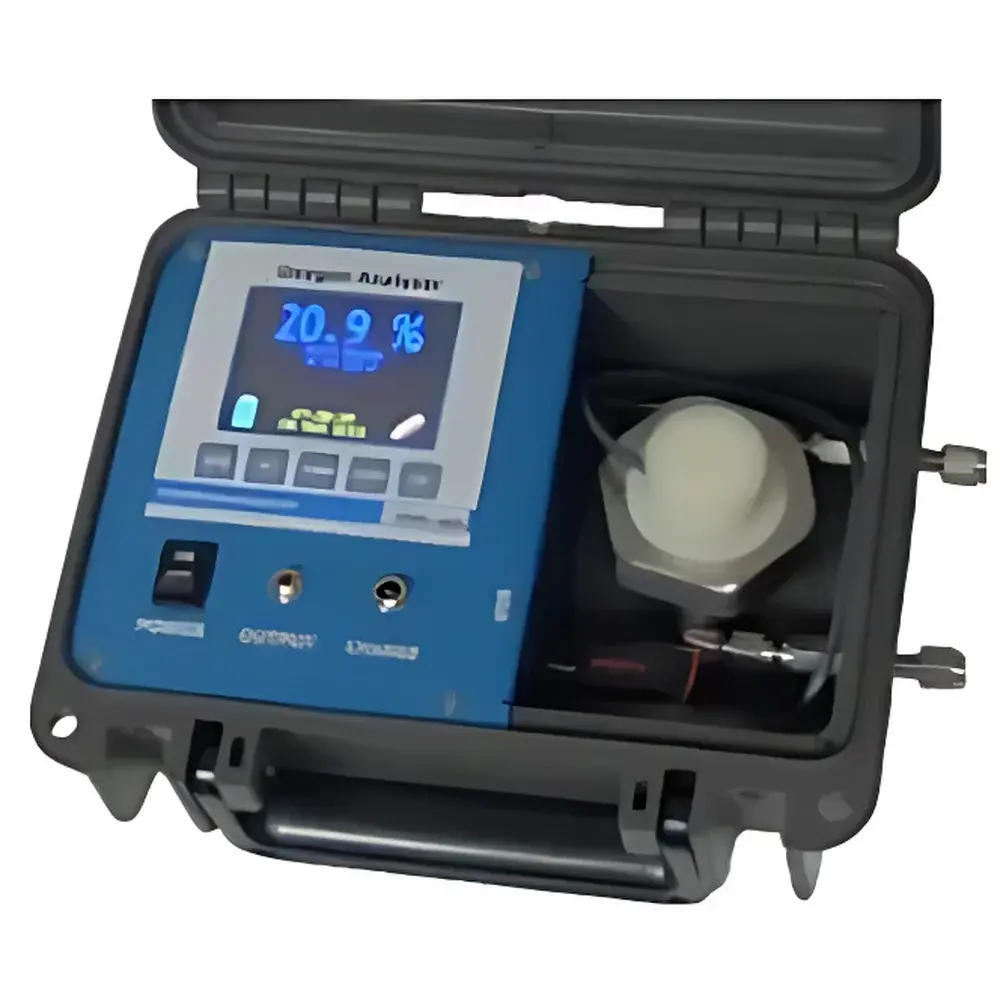
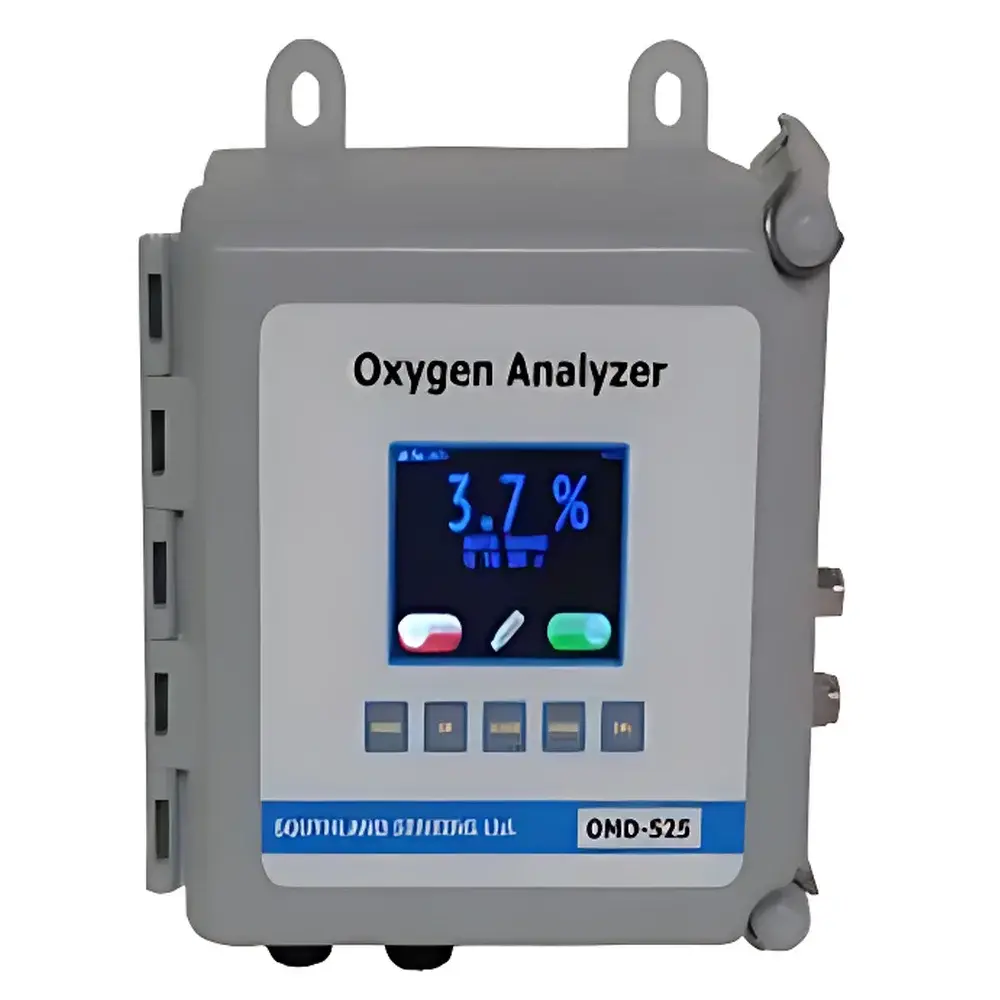
Southland MOMD480/MOMD525 Oxygen Analyzer
| Brand | Southland |
|---|---|
| Origin | USA |
| Model | MOMD480, MOMD525 |
| Measurement Principle | Electrochemical (Galvanic Cell) |
| Range Options | 0–1%/5%/10%/25%/100% (MOMD480) |
| Accuracy | ±1% FS |
| Display | Backlit Color LCD |
| Enclosure Rating | IP66 / NEMA 4X |
| Output | Dual Adjustable Relay Alarms (MOMD525) |
| Operating Environment | Inert, N₂, H₂, CO₂-containing, or mixed gas matrices |
| Compliance | CE, Class I, Div. 1, Groups B, C, D (MOMD625 variant) |
Overview
The Southland MOMD480 and MOMD525 Oxygen Analyzers are precision electrochemical instruments engineered for reliable, real-time oxygen concentration measurement across a wide dynamic range—from trace-level detection at 10 ppm to full-scale purity verification at 100%. Utilizing galvanic (fuel-cell-type) oxygen sensor technology, these analyzers operate without external power applied to the sensing element, delivering inherently stable zero and span characteristics with minimal drift over time. Unlike paramagnetic or zirconia-based systems, galvanic sensors offer high selectivity for O₂ in complex gas matrices—including nitrogen, hydrogen, argon, helium, and CO₂-rich environments—making them especially suitable for industrial inerting, semiconductor purge monitoring, heat-treatment furnace atmosphere control, and pharmaceutical nitrogen blanket validation. Both models feature field-proven sensor architecture with integrated temperature and pressure compensation, enabling consistent performance under variable ambient conditions.
Key Features
- Galvanic oxygen sensor with 12-month warranty and proven long-term stability (typical sensor life: 2–3 years depending on exposure profile)
- High-resolution color LCD display with intuitive menu navigation and contextual soft-key labeling
- Five pre-configured measurement ranges (MOMD480): 0–1%, 0–5%, 0–10%, 0–25%, and 0–100% O₂; auto-ranging and manual range selection modes
- Multi-range capability (MOMD525): 0–10 ppm, 0–100 ppm, 0–1000 ppm, 0–1%, and 0–25% O₂—optimized for both trace and bulk oxygen applications
- Ruggedized enclosure rated IP66 and NEMA 4X, certified for outdoor, washdown, and corrosive industrial environments
- Dual programmable relay outputs with adjustable delay and latching/non-latching modes (MOMD525); configurable for high/low alarms or maintenance alerts
- Built-in battery status indicator and low-battery warning on display (MOMD480 portable version)
- No internal moving parts or consumable gases—minimal maintenance requirements and low total cost of ownership
Sample Compatibility & Compliance
These analyzers are validated for continuous operation in non-corrosive, non-condensing gas streams containing oxygen concentrations from sub-ppm levels up to atmospheric saturation. They are compatible with inert carrier gases (N₂, Ar, He), reducing atmospheres (H₂ < 5%), and acidic backgrounds including CO₂ (up to 100%). Sensor response is unaffected by flow rate within 0.5–2.0 L/min, eliminating need for precise flow controllers in most installations. All units comply with CE marking requirements per Directive 2014/30/EU (EMC) and 2014/35/EU (LVD). The MOMD625 variant (not detailed here but part of the same platform) carries ATEX/IECEx certification for hazardous areas: Class I, Division 1, Groups B, C, D per NEC 500 and CSA C22.2 No. 157. Units meet functional safety considerations aligned with IEC 61508 SIL 2 for alarm-critical applications when deployed with appropriate system integration.
Software & Data Management
While the MOMD480 and MOMD525 operate as standalone analyzers with embedded firmware, they support analog 4–20 mA output (isolated, HART-enabled on request) and RS-232/RS-485 serial communication (Modbus RTU protocol) for integration into distributed control systems (DCS), SCADA platforms, or laboratory data acquisition networks. Optional configuration software allows calibration logging, alarm threshold adjustment, and firmware updates via USB interface. Audit trails—including calibration date, operator ID (if networked), and sensor health diagnostics—are retained in non-volatile memory. When deployed in regulated environments (e.g., FDA-regulated pharmaceutical manufacturing), the system supports 21 CFR Part 11-compliant data handling when paired with validated third-party data historians or LIMS interfaces that enforce electronic signature, role-based access, and change control protocols.
Applications
- Monitoring oxygen ingress in nitrogen-purged storage tanks and piping systems (pharmaceutical, food & beverage)
- Verification of inert atmosphere integrity during metal heat treatment (annealing, brazing, sintering)
- Quality assurance of high-purity gases supplied to semiconductor fabrication tools
- Leak detection in vacuum chambers and gloveboxes using residual O₂ rise-rate analysis
- Process safety interlocks for oxygen-deficient or oxygen-enriched hazard zones
- Environmental chamber validation where O₂ concentration must be maintained below specified thresholds (e.g., hypoxic research labs)
- On-site verification of cryogenic liquid nitrogen dewar purity prior to transfer
FAQ
What is the typical response time (T90) for the galvanic sensor?
T90 is ≤15 seconds for most ranges, extending to ≤30 seconds in the 0–10 ppm range due to diffusion-limited kinetics—consistent with ISO 10156 and ASTM D6866 test methodology expectations.
Can the analyzer be calibrated with certified gas standards?
Yes—two-point calibration (zero and span) using NIST-traceable O₂-in-N₂ standards is supported; zero gas may be synthetic air (20.9% O₂) or certified zero (<1 ppm O₂) depending on application.
Is sensor replacement user-serviceable?
Sensor modules are field-replaceable with standard Torx tools; no soldering or alignment required. Replacement kits include pre-calibrated elements with individual calibration certificates.
Does the unit require periodic electrolyte refilling?
No—the galvanic cells are sealed, maintenance-free units with immobilized electrolyte; no user-accessible fluid reservoirs or replenishment procedures.
How does pressure variation affect measurement accuracy?
Integrated absolute pressure transducer enables automatic compensation across 70–110 kPa (±5% of reading); optional barometric correction is available for high-altitude deployments.
Related Products




