
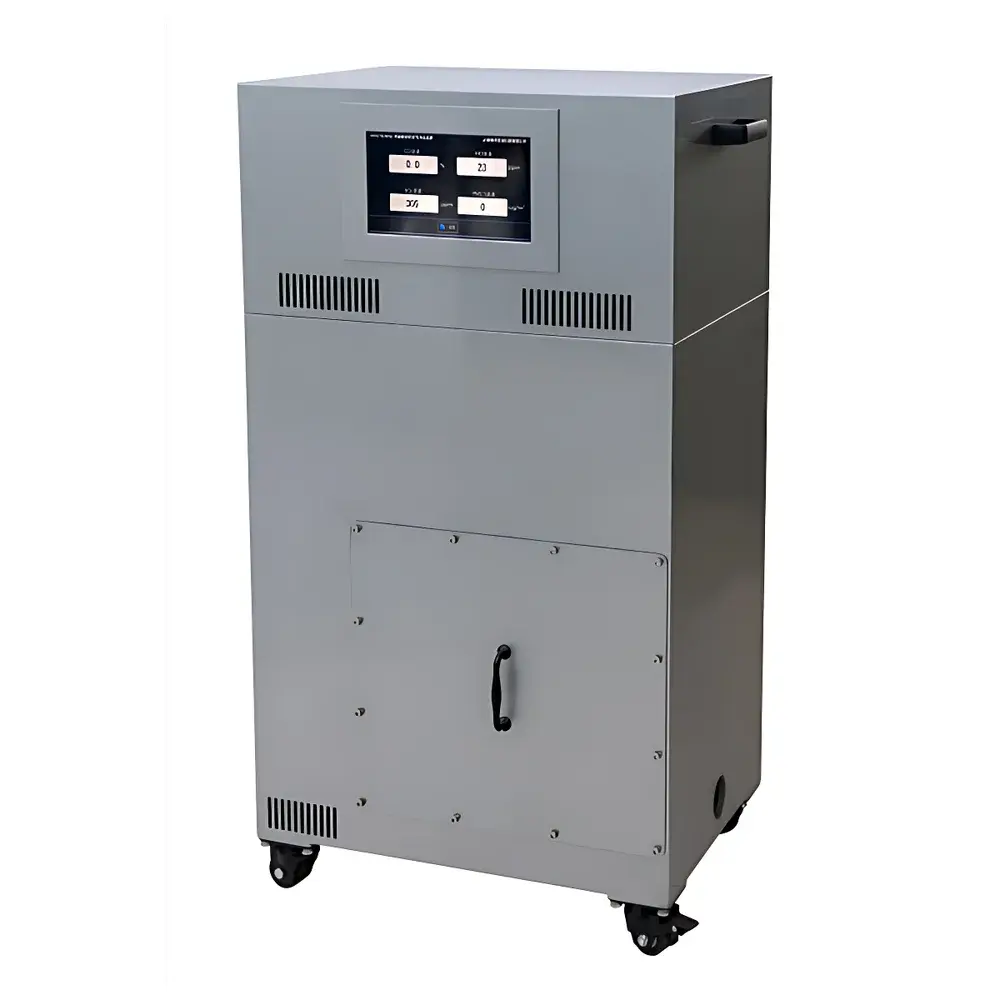
Shenkai SKY2103WQ Gasoline Engine Exhaust Aftertreatment System
| Brand | Shenkai |
|---|---|
| Origin | Shanghai, China |
| Model | SKY2103WQ |
| Emission Limits | SO₂ < 0.007 mg/m³, NO < 0.130 mg/m³, CO < 10 mg/m³, PM₂.₅ < 0.010 mg/m³ |
| Noise Level | ≤55 dB(A) |
| Optimal Inlet Exhaust Temperature | 280–320 °C |
| Treated Exhaust Temperature | 20–40 °C |
| Cooling Method | Water-cooled (external water supply or chiller required) |
| Coolant Inlet Temp | 5–20 °C |
| Air Filter Stages | Dual-stage professional-grade particulate filtration |
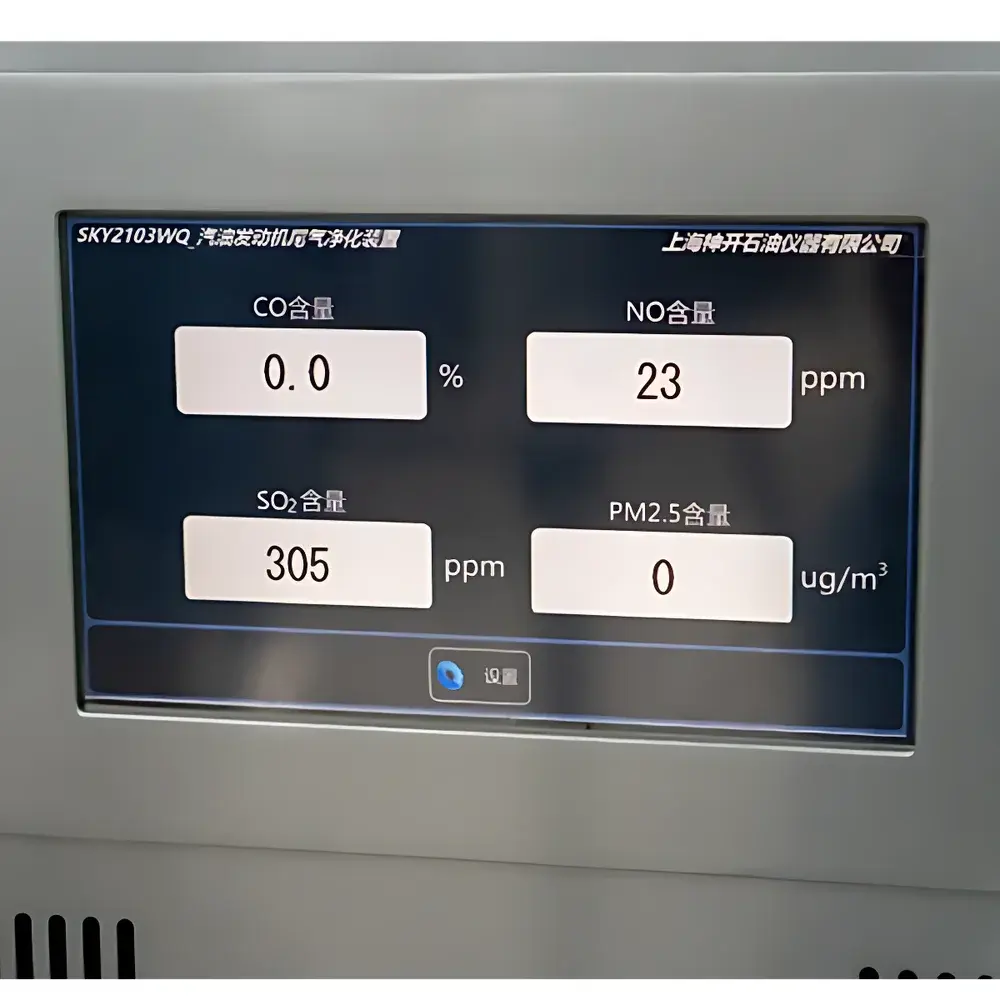
| Display | 10.1" color touchscreen interface |
| Power Consumption | ≤250 W |
| Dimensions (W×D×H) | 600 × 450 × 1115 mm |
| Net Weight | 60 kg |
| Operating Environment | 5–35 °C, 20–90% RH at 35 °C |
| Electrical Supply | AC 220 V ±10%, 50/60 Hz |
| Compliance | GB/T 24021, ISO 14021 |
Overview
The Shenkai SKY2103WQ Gasoline Engine Exhaust Aftertreatment System is an engineered solution for laboratory- and test-bench-based emissions control of gasoline-fueled internal combustion engines. Designed specifically for R&D, calibration, and regulatory compliance testing environments, the system integrates catalytic oxidation, dual-stage particulate filtration, and active exhaust cooling into a single compact, sealed architecture. It operates on the principle of three-way catalysis (TWC), where platinum-group metals (PGMs) in the proprietary monolithic catalyst simultaneously promote the oxidation of carbon monoxide (CO) and unburned hydrocarbons (HC), and the reduction of nitrogen oxides (NOx) under stoichiometric air–fuel conditions. Sulfur dioxide (SO2) removal is achieved via upstream sulfur-tolerant adsorption layers and thermal management to prevent catalyst poisoning. Particulate matter—particularly PM2.5—is captured by two replaceable, high-efficiency pleated filter cartridges with graded pore structure and electrostatic enhancement. Exhaust gas temperature is actively managed through a dedicated water-cooled heat exchanger, enabling safe downstream sampling and real-time sensor operation.
Key Features
- Integrated three-way catalytic converter optimized for gasoline engine exhaust composition, delivering high conversion efficiency for CO, NOx, and HC across dynamic load profiles
- Dual-stage air filtration system with standardized, field-replaceable filter cartridges—designed for >99.5% gravimetric capture of PM2.5 at rated flow rates
- Water-cooled exhaust heat exchanger with external coolant interface (5–20 °C inlet); no integrated compressor or refrigerant circuit
- Real-time, on-board emission monitoring via calibrated NDIR (CO), electrochemical (NO, SO2), and laser scattering (PM2.5) sensors—data displayed continuously on 10.1″ capacitive touchscreen
- Hermetically sealed flow path from inlet flange to outlet stack, minimizing fugitive emissions and ensuring full exposure of exhaust stream to catalytic and filtration media
- Modular service design: quick-release filter housing, accessible coolant maintenance port, and tool-free catalyst cartridge mounting
- Low-power operation (≤250 W) and acoustic enclosure yielding ≤55 dB(A) at 1 m—suitable for indoor laboratory integration
Sample Compatibility & Compliance
The SKY2103WQ is compatible with gasoline test engines ranging from single-cylinder research units to multi-cylinder production validation platforms (up to 200 kW output). Its inlet flange conforms to ISO 5136 and SAE J1930 mechanical interface standards. The system meets environmental labeling requirements per ISO 14021 (Type II environmental labels) and supports conformity assessment under GB/T 24021 (Chinese standard for self-declared environmental claims). While not certified as a vehicle-mounted aftertreatment device, its performance data are traceable to national metrological standards and suitable for generating pre-certification test reports aligned with GB 18352.6 (China VI), EPA Tier 3, and EU Stage V regulatory frameworks. All sensors comply with IEC 61508 SIL 2 functional safety guidelines for continuous emission monitoring subsystems.
Software & Data Management
The embedded control unit runs a deterministic real-time OS with dual-mode data handling: local display (touchscreen GUI with trend plots, alarm thresholds, and event logging) and optional Ethernet/RS-485 export to external DAQ systems. Logged parameters include second-by-second concentration values, catalyst bed temperature, coolant flow status, filter differential pressure, and system uptime. Audit trails record all operator actions—including filter replacement events and calibration resets—with timestamp, user ID, and IP address (when network-enabled). Data files conform to ASTM D6216-compliant CSV structure and may be imported into MATLAB, LabVIEW, or commercial emissions analysis suites. Optional firmware update support includes cryptographic signature verification to ensure integrity during remote maintenance.
Applications
- Engine development laboratories performing transient cycle testing (e.g., WLTC, FTP-75) with real-time post-processing of regulated pollutants
- Calibration facilities validating OBD-II readiness monitors and lambda sensor response under controlled aftertreatment conditions
- Academic research on low-temperature catalyst light-off behavior, sulfur aging mechanisms, and PM nucleation dynamics
- Third-party testing labs conducting type-approval support tests requiring documented abatement efficiency per GB/T 18289 or ISO 8178-4
- Manufacturing QA stations verifying batch-to-batch consistency of prototype exhaust systems prior to vehicle integration
FAQ
Does the SKY2103WQ require periodic catalyst regeneration?
No. The system is designed for continuous stoichiometric operation without onboard regeneration cycles; catalyst longevity is extended through precise thermal management and sulfur-resistant formulation.
Can the unit operate with deionized water or only municipal tap water?
Either is acceptable; however, use of deionized or softened water is recommended to minimize scaling in the cooling circuit over extended operation.
Is the touchscreen interface programmable for custom alarm thresholds?
Yes—users may configure upper/lower limits for each monitored parameter, with configurable hysteresis and notification methods (on-screen alert, relay dry contact output).
What maintenance intervals are recommended for the air filter cartridges?
Under typical lab testing conditions (≤8 hrs/day, moderate soot loading), replacement is advised every 200 operational hours or when differential pressure exceeds 1.2 kPa.
Does the system support analog voltage outputs for integration with legacy DAQ hardware?
Yes—four isolated 4–20 mA current loops are provided (one per pollutant channel), configurable via menu-driven setup without firmware modification.






