
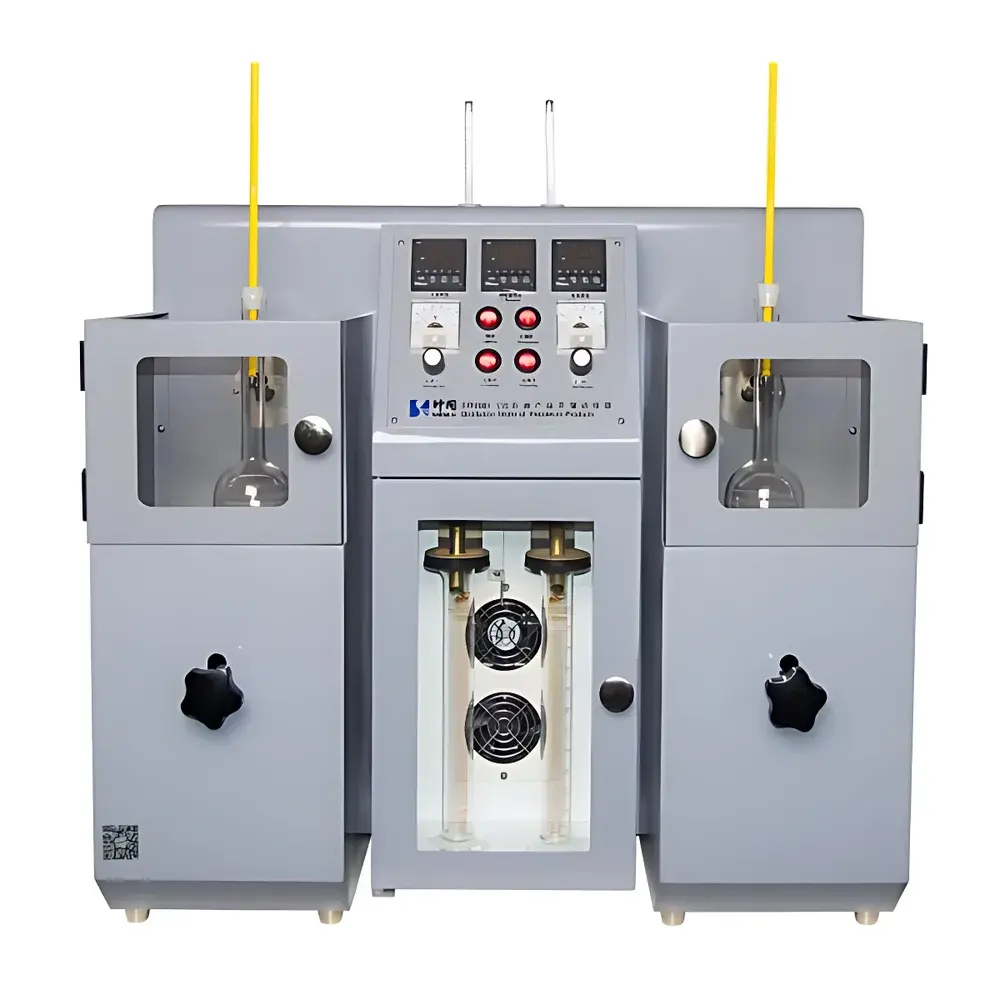
Shenkai SYP2001-VIC Petroleum Distillation Apparatus
| Brand | Shenkai |
|---|---|
| Origin | Shanghai, China |
| Model | SYP2001-VIC |
| Distillation Configuration | Front-mounted dual-bath dual-curved-tube |
| Temperature Range | Ambient to 400 °C |
| Left Bath Temp Control | 0–60 °C, ±0.5 °C accuracy |
| Right Bath Temp Control | 0–60 °C, ±0.5 °C accuracy |
| Condensate Cylinder Bath Temp | 0 °C to ambient, auto-controlled |
| Heating Power | 0–1200 W (continuously adjustable) |
| Supply Voltage | 220 V ±10%, 50 Hz ±1 Hz |
| Total Power Consumption | 2800 W |
| Dimensions (L×H×D) | 664 × 598 × 594 mm |
| Weight | 70 kg |
Overview
The Shenkai SYP2001-VIC Petroleum Distillation Apparatus is a precision-engineered front-mounted dual-bath distillation system designed for standardized determination of distillation characteristics of petroleum products under controlled atmospheric conditions. It operates on the principle of progressive vaporization and condensation in accordance with established thermodynamic equilibrium protocols defined in GB/T 6536, ASTM D86, ISO 3405, and IP 123. The instrument enables quantitative measurement of initial boiling point (IBP), final boiling point (FBP), recovery volume at specified temperatures, and percent recovered at designated cut points — critical parameters for fuel specification compliance, refinery process control, and quality assurance in downstream distribution. Its dual-bath architecture supports concurrent testing of two independent samples under identical or differentiated thermal profiles, enhancing laboratory throughput without compromising repeatability or regulatory traceability.
Key Features
- Front-mounted dual-bath, dual-curved-tube configuration enabling simultaneous distillation of two distinct samples with independent temperature regulation for each bath
- Imported high-efficiency refrigeration compressor delivering stable low-temperature operation (0–60 °C) in both left and right baths, with ±0.5 °C thermal stability
- Intelligent digital temperature controller with continuous adjustment capability across full range, supporting precise ramp-and-hold thermal programming
- Externally mounted electronic timer with LED display for unambiguous real-time tracking of distillation duration and phase transitions
- Mechanically agitated cold bath ensuring uniform thermal distribution and minimizing axial temperature gradients during condensate collection
- Manually adjustable heating voltage via analog pointer dial (0–1200 W range), providing granular control over vaporization rate and reflux behavior
- Integrated exhaust ventilation system for rapid cooling of heating assemblies between runs, reducing inter-test downtime
- Front-access hinged heating chamber door facilitating safe, ergonomic installation and removal of distillation flasks per ASTM D86 procedural requirements
Sample Compatibility & Compliance
The SYP2001-VIC is validated for use with light to intermediate distillates including gasoline fractions (e.g., natural gasoline, stabilized light hydrocarbons), aviation turbine fuels (Jet A-1, JP-5), diesel fuels, kerosene, naphthas, and petroleum solvent oils. It is not intended for residues-rich samples such as heavy fuel oils or vacuum residua due to limitations in residue handling and vapor-phase entrainment control. The apparatus conforms fully to SY/T 5648 technical specifications for petroleum distillation equipment and meets mechanical and operational requirements outlined in GB/T 6536 Annex A. All thermal sensors, voltage regulators, and timing modules are calibrated traceable to national metrological standards. Instrument design incorporates electrical safety features compliant with IEC 61010-1 for laboratory electrical equipment.
Software & Data Management
While the SYP2001-VIC operates as a hardware-integrated benchtop system without embedded PC-based software, its modular control architecture supports integration into centralized LIMS environments via analog output signals (0–10 V or 4–20 mA) for temperature, heating power, and elapsed time. Optional RS-485 serial interface kits enable bidirectional communication for remote parameter setting and data logging. All manual test records generated using this apparatus satisfy documentation requirements for GLP-compliant laboratories when maintained with signed, dated, and version-controlled test worksheets. Audit trails for calibration certificates, maintenance logs, and operator training records align with ISO/IEC 17025 clause 7.7 and FDA 21 CFR Part 11 principles where electronic records are implemented externally.
Applications
- Quality release testing of finished gasoline and diesel batches against regional specifications (e.g., EN 590, ASTM D975)
- Refinery fractionation column optimization through real-time comparison of feedstock and cut-point volatility profiles
- Research evaluation of additive effects on distillation curve shape and volatility distribution
- Contract laboratory services for third-party certification under API MPMS Chapter 10.2 or IP 123 accreditation scopes
- Educational demonstrations of fractional distillation thermodynamics in petroleum engineering curricula
- Regulatory submission support for fuel registration dossiers requiring ASTM D86-compliant volatility data
FAQ
What standards does the SYP2001-VIC comply with?
It is fully compliant with GB/T 6536, ASTM D86, ISO 3405, IP 123, and SY/T 5648.
Can it handle residual fuel oils?
No — the apparatus is not designed for samples with significant residue content (>5% by volume) due to potential coking and condenser fouling.
Is three-phase power required?
No — the unit operates on single-phase 220 V AC supply and does not require three-phase infrastructure.
How is temperature uniformity ensured in the cold bath?
A dedicated motor-driven impeller provides continuous mechanical agitation, maintaining radial and axial thermal homogeneity within ±0.3 °C across the bath volume.
What safety features are integrated?
Thermal cut-off switches, grounded chassis design, insulated heating elements, and interlocked front access door prevent unintended operation during flask handling.



