
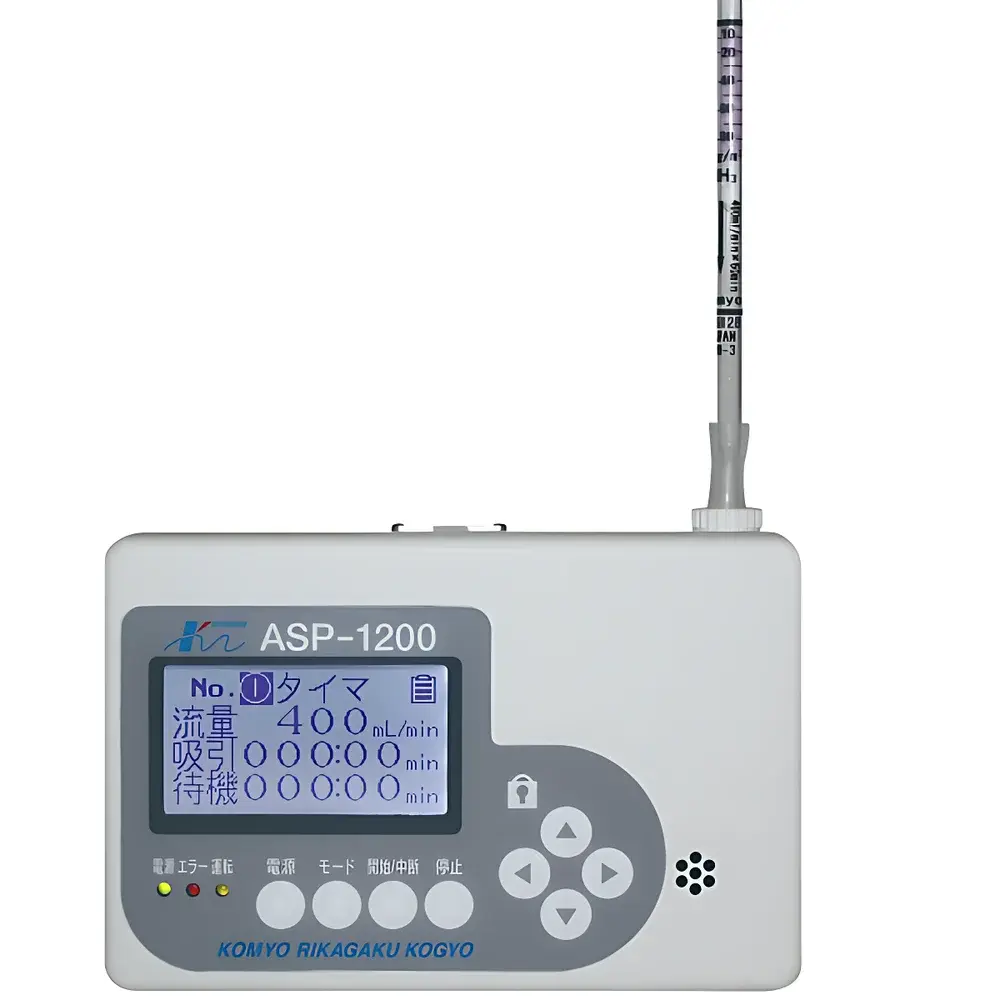
NorthKawakami Museum-Grade Ammonia Detection Tube
| Brand | Meiko Rikka |
|---|---|
| Origin | Japan |
| Manufacturer Type | Authorized Distributor |
| Origin Category | Imported |
| Model | 900NHH |
| Pricing | Available Upon Request |
Overview
The NorthKawakami 900NHH Ammonia Detection Tube is a precision-engineered, single-use colorimetric gas sampling device specifically developed for low-concentration ammonia (NH₃) monitoring in sensitive cultural heritage environments. Designed in accordance with Japanese industrial standards for museum air quality management, it operates on the principle of diffusion-controlled chemical reaction: ambient air is drawn through the tube at a calibrated flow rate using a handheld piston pump (sold separately), causing ammonia to react selectively with immobilized reagents inside the glass microbore tube. This generates a distinct, linearly proportional color stain whose length is quantified visually against a printed scale—enabling rapid, field-deployable concentration estimation without electricity, software, or calibration gases. Its primary application domain includes preventive conservation settings where real-time, non-invasive assessment of off-gassing from display cases, storage cabinets, archival materials, and adhesives is critical to mitigating ammonium salt formation on historical artifacts.
Key Features
- Museum-optimized sensitivity: Detects ammonia in the range of 0.05–5 ppm (parts per million) with ±15% measurement uncertainty at 23 °C and 50% RH—engineered to resolve sub-ppm fluctuations relevant to cellulose degradation thresholds.
- Japanese JIS-compliant manufacturing: Produced under strict quality control in Japan; each batch undergoes lot-specific verification per JIS K 0124 (Gas Detection Tubes) and conforms to ISO 8573-1 Class 4 purity requirements for internal reagent matrices.
- Chemical specificity: Selective for gaseous NH₃; minimal cross-sensitivity to common interferents including amines, formaldehyde, H₂S, and CO₂—validated via interlaboratory testing per ASTM D679–22 Annex A1.
- Stability & shelf life: Sealed in nitrogen-purged aluminum pouches with desiccant; guaranteed performance for 24 months from manufacture date when stored at ≤25 °C and <60% RH.
- Integrated documentation: Each tube carries a unique lot number, expiration date, and batch-certified calibration curve traceable to NMIJ (National Metrology Institute of Japan) reference standards.
Sample Compatibility & Compliance
The 900NHH tube is validated for use in indoor ambient air sampling only—not intended for stack emissions, soil headspace, or liquid-phase analysis. It complies with ICOM-CC (International Council of Museums – Committee for Conservation) Guidelines for Indoor Air Quality Monitoring and aligns with the British Standard BS EN 16798-1:2019 Annex C criteria for “low-risk” gaseous pollutant detection in heritage institutions. While not a regulatory compliance instrument per se, its measurement data supports GLP-aligned recordkeeping when used within documented sampling protocols—including pump draw volume (100 mL), sampling duration (1–2 min), and environmental condition logging (temperature/humidity). It does not meet FDA 21 CFR Part 11 requirements, as it produces analog visual readouts without electronic audit trails.
Software & Data Management
As an analog, manual-read detection system, the 900NHH requires no firmware, drivers, or proprietary software. Quantitative results are recorded manually in laboratory notebooks or digital logbooks compliant with ISO/IEC 17025:2017 Clause 7.5.2 (Control of Records). Users may integrate readings into LIMS or Excel-based trend analysis frameworks by entering tube ID, lot number, sampling location, time/date, pump strokes, observed stain length (mm), and derived concentration (ppm). Optional companion tools include Meiko Rikka’s standardized sampling protocol templates (available as PDF) and a free mobile app—“Meiko TubeCalc”—that assists in unit conversion (ppm ↔ mg/m³ at specified T/P) and uncertainty propagation per GUM (Guide to the Expression of Uncertainty in Measurement).
Applications
- Preventive conservation diagnostics: Mapping NH₃ hotspots near wood-based display mounts, urea-formaldehyde adhesives, or degraded proteinaceous materials (e.g., leather, parchment).
- Storage environment validation: Routine screening of archival boxes, cold storage vaults, and inert gas enclosures prior to artifact accessioning.
- Exhibition commissioning: Pre-installation air quality verification in newly constructed galleries or after HVAC modifications.
- Emergency response triage: Rapid on-site assessment following water damage incidents where microbial ammonification of organic debris may occur.
- Research-grade baseline studies: Supporting peer-reviewed investigations into material emission kinetics under controlled RH/temperature gradients (e.g., ISO 11341:2020 exposure chambers).
FAQ
Is the 900NHH tube compatible with all Meiko Rikka hand pumps?
Yes—it is dimensionally and flow-rate matched to Meiko Rikka’s standard 100 mL stroke pumps (models MP-100A, MP-100B) calibrated to ±2% accuracy per JIS B 7952.
Can it be reused after initial sampling?
No. The reaction is irreversible; tubes are single-use only. Reuse compromises accuracy and violates ISO 17025 traceability requirements.
Does temperature affect reading accuracy?
Yes. Results must be corrected using the temperature compensation chart provided in the instruction leaflet (valid for 10–35 °C); uncorrected readings outside this range exceed ±25% uncertainty.
How should expired tubes be disposed?
As non-hazardous solid waste per local regulations—reagents are immobilized silica gel-bound indicators with no free heavy metals or volatile organics.
Is there a certified reference material available for field verification?
Meiko Rikka offers traceable NH₃ permeation tubes (CRM-NH3-01) calibrated against NMIJ primary standards, intended for periodic user verification of pump/tube system performance.
Related Products







