
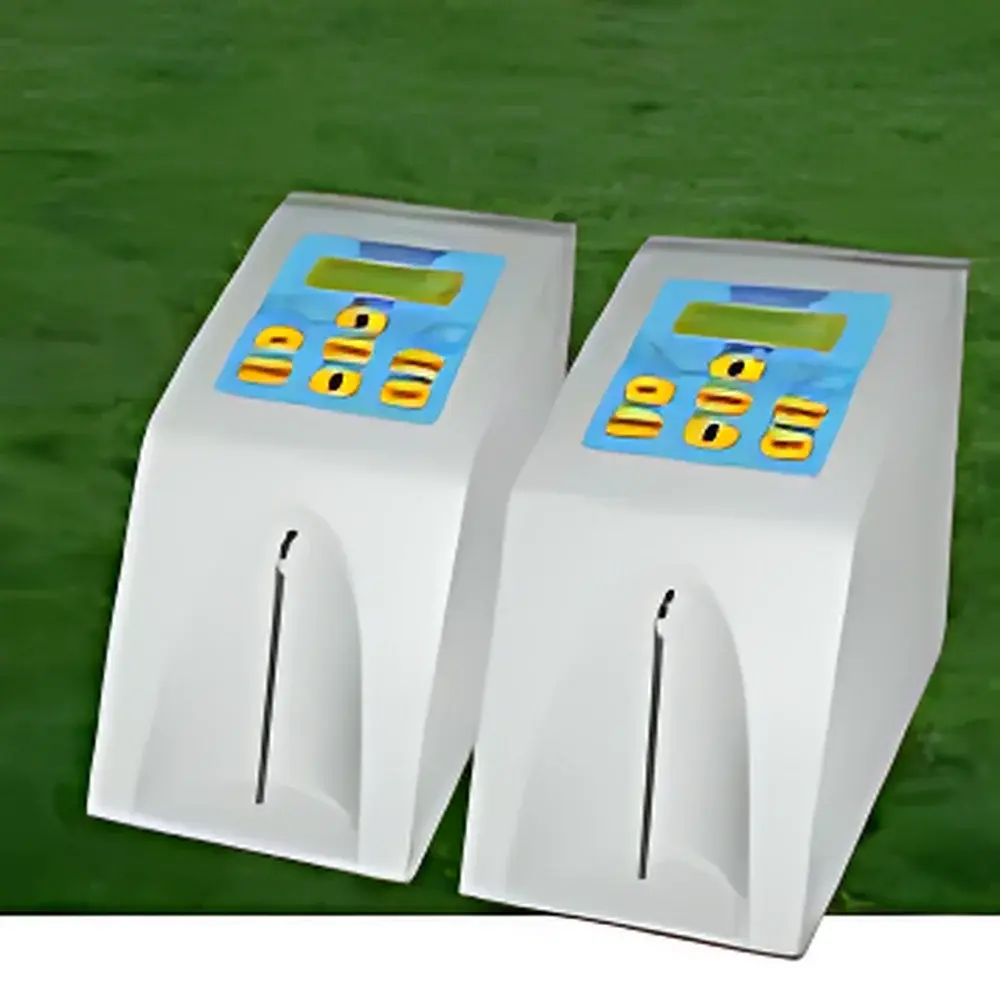
Yueweitang MASTER Compact Milk Composition Analyzer
| Brand | Yueweitang |
|---|---|
| Model | MASTER |
| Origin | Imported |
| Detection Parameters | Fat (0.00–20.00%), Protein (2.00–7.00%), Lactose (0.00–6.00%), Non-Fat Solids (3.00–15.00%), Ash (0.4–1.5%), Water Adulteration (1–70%), Freezing Point (–0.3 to –0.7 °C), Density (1.015–1.040 g/cm³), pH (0–14), Sample Temperature (7–35 °C) |
| Repeatability | Fat ±0.08%, Protein ±0.1%, Lactose ±0.1%, Non-Fat Solids ±0.1%, Ash ±0.05%, Water Adulteration ±1%, Freezing Point ±0.001 °C, Density ±0.0003 g/cm³, pH ±0.05 |
| Throughput | 45–60 samples/hour |
| Sample Volume | 25 mL |
| Power Supply | 110/220 V AC, 50–60 Hz |
| Dimensions (W×D×H) | 125 mm × 260 mm × 205 mm |
| Weight | 3.1 kg |
| Operating Environment | 7–35 °C, 30–80% RH |
| Interface | RS232 |
| Compliance | Designed for routine dairy QC in accordance with ISO 9622, IDF 141, and AOAC Official Methods |
Overview
The Yueweitang MASTER Compact Milk Composition Analyzer is a benchtop near-infrared (NIR) and multi-sensor fusion instrument engineered for rapid, non-destructive quantification of key compositional parameters in raw, pasteurized, and standardized bovine milk. Leveraging calibrated NIR spectroscopy combined with integrated thermistor-based temperature sensing, capacitive density measurement, and potentiometric pH detection, the analyzer delivers laboratory-grade compositional data without reagents or sample preparation. Its design prioritizes operational robustness in high-throughput dairy receiving stations, quality control labs, and mobile inspection units where space, power constraints, and operator training are limiting factors. The system operates on first-principles calibration models developed from reference-standard milk matrices traceable to NIST-certified materials and validated against ASTM D7219 (for freezing point depression) and ISO 5725-2 (accuracy and precision). It does not employ wet chemistry or hazardous solvents, aligning with green analytical chemistry principles and reducing disposal liabilities.
Key Features
- Multi-parameter simultaneous analysis: Fat, protein, lactose, non-fat solids, ash, freezing point depression (for water adulteration estimation), density, pH, and sample temperature — all measured in a single 25 mL aliquot.
- High-throughput capability: Processes 45–60 samples per hour with automated rinse cycles and self-diagnostic status reporting.
- Embedded auto-calibration: Uses internal reference standards and real-time drift correction algorithms to maintain long-term metrological stability without manual recalibration between shifts.
- IP65-rated front panel: Fully sealed membrane keypad and splash-resistant display ensure reliable operation in humid, high-dust dairy environments.
- Dual-power architecture: Compatible with both mains (110/220 V AC) and portable 12 V DC sources, enabling deployment in field laboratories or transportable QC vans.
- Low-maintenance optical path: Solid-state NIR source with no moving parts; no consumable filters or lamps required over typical 5-year service intervals.
Sample Compatibility & Compliance
The MASTER analyzer is validated for use with cow’s milk across standard thermal treatments (raw, HTST, UHT) and common fortification profiles (e.g., vitamin D, calcium). It accommodates viscosity variations up to 3.5 mPa·s and suspended solids ≤0.5% w/w without clogging or signal interference. All measurement protocols adhere to internationally recognized dairy testing frameworks: freezing point results comply with ISO 5725-2 for precision verification and ASTM D7219 for method validation; density and pH measurements meet ISO 6730 and ISO 2173 requirements respectively. The instrument supports audit-ready data integrity through optional GLP-compliant mode, including electronic signature capture, user-level access control, and immutable audit trails — fully compatible with FDA 21 CFR Part 11 when paired with validated third-party LIMS integration.
Software & Data Management
Firmware v3.2 includes embedded data logging with timestamped records stored locally (SD card slot) and exportable via RS232 to external PCs or printers. Raw spectral data (NIR absorbance at 1100–2500 nm) and derived parameter tables are saved in CSV and XML formats compliant with ASTM E1461. Optional PC software provides statistical process control (SPC) charting, batch trending, outlier detection (Grubbs’ test), and automatic report generation aligned with ISO/IEC 17025 documentation templates. All firmware updates are digitally signed and delivered via secure HTTPS channel to prevent unauthorized modification.
Applications
- Dairy intake verification at processing plants: Real-time rejection of adulterated or off-spec milk based on freezing point depression and density thresholds.
- Production line monitoring: In-line composition tracking during standardization and homogenization to maintain consistent product specifications.
- Regulatory compliance testing: Routine submission-ready reports for national dairy authorities requiring ISO 9622-compliant fat/protein declarations.
- Research & development: Rapid screening of novel feed formulations’ impact on milk composition across herd trials.
- Cooperative milk collection centers: Portable, battery-compatible operation for decentralized testing in rural infrastructure-limited regions.
FAQ
Does the MASTER require daily calibration with certified reference milk?
No — it performs automatic reference-based calibration every 10th sample using an internal ceramic standard; full verification against CRM milk is recommended weekly per ISO/IEC 17025 Clause 7.7.
Can it analyze goat or buffalo milk?
Yes, with user-loaded secondary calibration models; factory-default calibrations are optimized for bovine milk per ISO 9622 Annex B.
Is the freezing point measurement traceable to international standards?
Yes — the thermistor array is NIST-traceable, and freezing point depression algorithm follows ISO 5725-2 repeatability criteria with documented uncertainty budgets.
What data security protocols are implemented for audit readiness?
All user actions, result modifications, and firmware updates are logged with SHA-256 hashing; audit trail export includes digital signatures verifiable via PKI infrastructure.
How is cleaning and maintenance performed?
The fluidic path uses food-grade stainless steel and PTFE; automated rinse cycles execute after each sample using deionized water; no disassembly or solvent cleaning required.





