
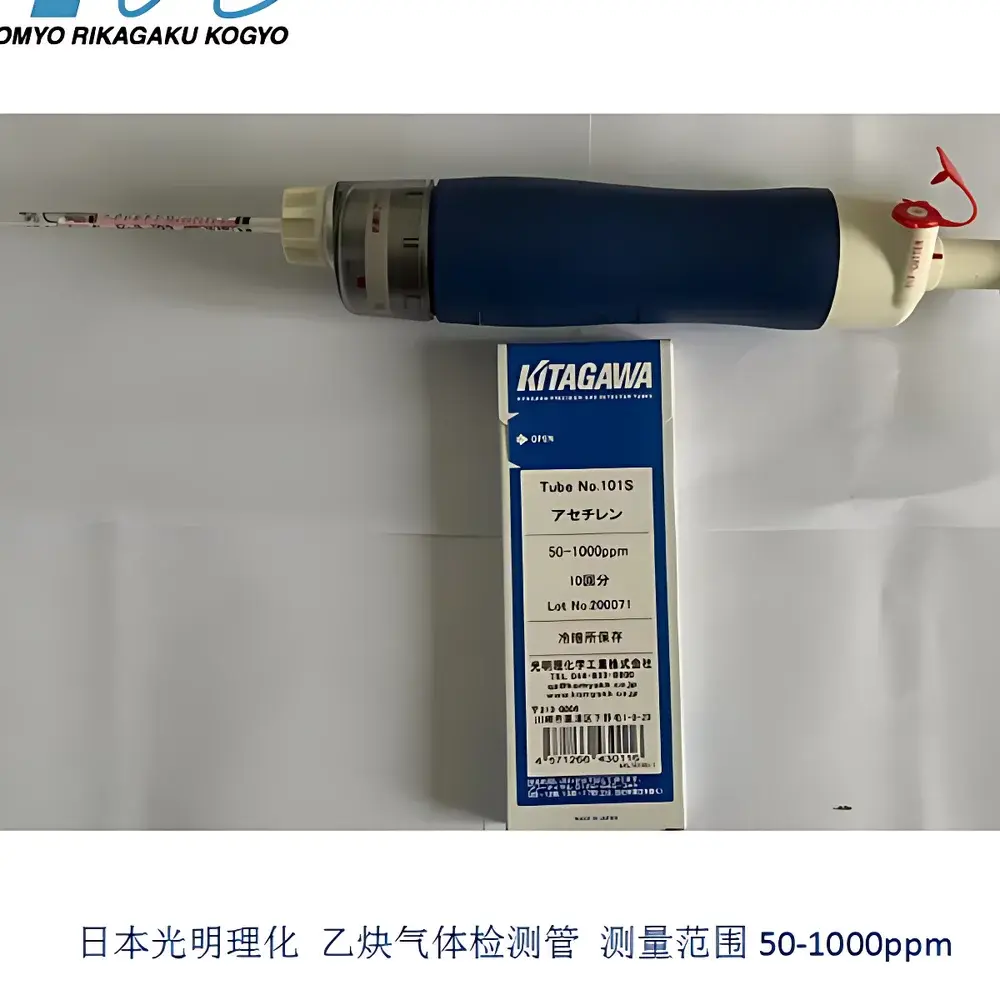
Kokan-style Acetylene Gas Detection Tube (Model 101S) by Riken Keiki
| Brand | Riken Keiki |
|---|---|
| Origin | Japan |
| Model | 101S |
| Detection Range | 50–1000 ppm Acetylene |
| Principle | Colorimetric Reaction with Pre-impregnated Reagent |
| Calibration | Linear Scale with Visual Endpoint Reading |
| Pump Compatibility | AP-20 Hand Pump (sold separately) |
| Tube Length | 100 mm |
| Inner Diameter | 4.0 mm |
| Shelf Life | 24 months from manufacture date (stored at 5–30°C, dry, dark) |
| Compliance | JIS K 0802, ISO 8573-3 (for sampling methodology), CE-marked per Directive 2014/68/EU (PED) for pressure-rated components in pump system |
Overview
The Kokan-style Acetylene Gas Detection Tube Model 101S is a precision-engineered, single-use colorimetric indicator tube manufactured by Riken Keiki Co., Ltd.—Japan’s longest-standing and globally leading producer of gas detection tubes since 1947. Designed in accordance with the original Kokan (North River) principle developed by Dr. Kokan in post-war Japan, this tube employs a fixed-bed, chemically impregnated silica gel column sealed within calibrated borosilicate glass. When acetylene (C₂H₂) is drawn through the tube via the standardized AP-20 hand pump (100 mL stroke volume, ±5% volumetric accuracy), the gas reacts stoichiometrically with palladium(II) chloride and ammonium molybdate reagents, generating a distinct, irreversible brown-to-black color front. The length of color development corresponds linearly to acetylene concentration—read directly against the printed scale on the tube body. This method delivers rapid, field-deployable quantification without electricity, calibration gases, or software, making it ideal for confined space entry verification, welding safety checks, acetylene cylinder leak screening, and emergency response triage.
Key Features
- Validated detection range of 50–1000 ppm acetylene with ±15% full-scale accuracy under ISO 8573-3–compliant sampling conditions (temperature 15–35°C, relative humidity <85%, no condensation)
- Pre-calibrated linear scale with 50 ppm graduation intervals; endpoint reading requires no interpolation
- Manufactured under ISO 9001-certified cleanroom conditions; each batch undergoes lot-specific stability testing and certificate of analysis (CoA) issuance
- Borosilicate glass construction ensures chemical inertness, thermal shock resistance, and dimensional stability during manual actuation
- Compatible exclusively with Riken Keiki AP-20 dual-stroke hand pump (pump not included); pump adherence to JIS K 0802 ensures reproducible 100 mL draw volume per stroke
- No external power, batteries, or firmware required—fully operational in Zone 0/1 hazardous areas where intrinsic safety certification is mandated
Sample Compatibility & Compliance
The 101S tube is validated for ambient air sampling only. It is not intended for use in reducing atmospheres (e.g., high CO or H₂), high-humidity environments (>85% RH), or matrices containing chlorine, hydrogen sulfide, or unsaturated hydrocarbons beyond trace levels—these may cause interference or false positives. Each tube is individually foil-wrapped with desiccant and labeled with manufacturing date, expiry date, lot number, and JIS-compliant performance data. Riken Keiki maintains full traceability per ISO/IEC 17025 requirements for reference material preparation. The detection method aligns with JIS K 0802 Annex B for qualitative/semi-quantitative tube-based analysis and supports GLP documentation workflows when paired with AP-20 pump log sheets.
Software & Data Management
As a passive, analog measurement device, the 101S tube does not interface with digital systems or require software. However, Riken Keiki provides downloadable PDF-based Field Use Log Templates (Rev. 2023) compliant with OSHA 1910.120 and NFPA 70E recordkeeping standards. These templates support manual entry of operator ID, sampling location, date/time, pump strokes, observed color front position, calculated concentration, and environmental conditions—enabling audit-ready paper trails suitable for internal QA review or regulatory inspection (e.g., EPA Region 6 Air Toxics Program reporting). No electronic data capture or CFR Part 11 compliance is applicable, as no electronic records are generated.
Applications
- Verification of acetylene absence prior to hot work in industrial maintenance zones (per NFPA 51B)
- Routine leak detection around oxy-acetylene cutting stations and manifold assemblies
- First-response screening in fire investigation scenarios where acetylene decomposition products may indicate cylinder failure
- Monitoring residual acetylene in purge gas streams during shutdown/startup of ethylene crackers
- Educational laboratory demonstrations of stoichiometric gas–solid reaction kinetics and diffusion-limited color development
- Complementary tool in Tier-1 exposure assessment per ACGIH TLV® guidelines for C₂H₂ (TWA 2.5 ppm, STEL 10 ppm)
FAQ
What is the shelf life of the 101S tube, and how should it be stored?
Unopened tubes retain stated performance for 24 months from the date of manufacture when stored at 5–30°C in dry, dark conditions. Avoid freezing or exposure to direct sunlight.
Can the 101S tube be reused after a single measurement?
No. The reaction is irreversible and the reagent bed is consumed stoichiometrically. Reuse compromises accuracy and violates JIS K 0802 Section 5.2.
Is the AP-20 pump required, or can other hand pumps be substituted?
Only the Riken Keiki AP-20 pump is validated for use with 101S. Substitution invalidates JIS/ISO conformance due to uncontrolled draw volume, flow rate, and backpressure effects.
Does this tube meet OSHA or MSHA requirements for workplace monitoring?
It satisfies OSHA 1910.120(q)(3)(ii) for initial hazard identification and is listed in MSHA’s Approved Equipment Catalog for Class I, Division 1 locations—but cannot replace full-shift personal sampling per 29 CFR 1926.55.







