
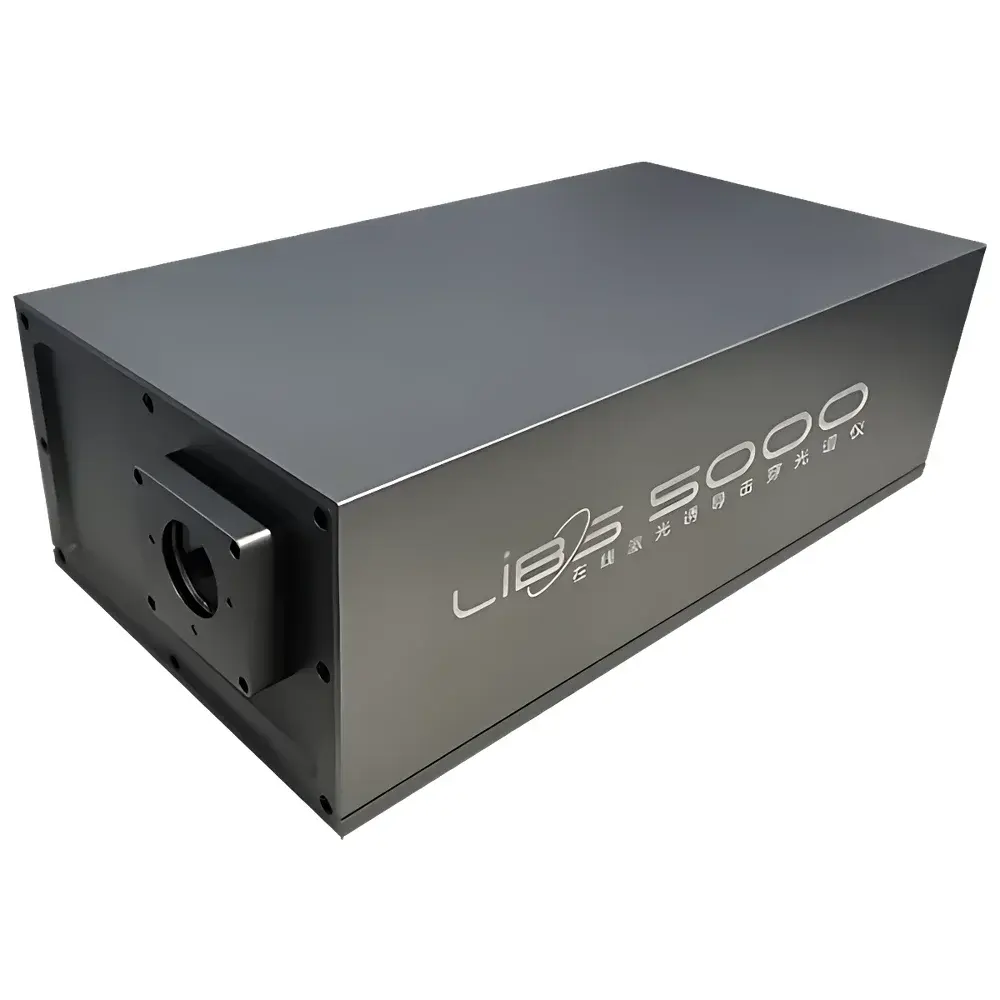
LANScientific LIBS 5000 Online Laser-Induced Breakdown Spectroscopy Analyzer
| Brand | LANScientific |
|---|---|
| Origin | Jiangsu, China |
| Manufacturer Type | Original Equipment Manufacturer (OEM) |
| Product Category | Domestic |
| Model | LIBS 5000 |
| Instrument Type | Online |
| Pricing | Upon Request |
Overview
The LANScientific LIBS 5000 Online Laser-Induced Breakdown Spectroscopy Analyzer is an industrial-grade elemental analysis system engineered for real-time, in-situ monitoring of liquid-phase samples—including brines, molten salts, process streams, and corrosive electrolytes—without physical contact or sample preparation. It operates on the fundamental principle of Laser-Induced Breakdown Spectroscopy (LIBS): a high-energy pulsed laser is focused onto the sample surface to generate a transient microplasma; the emitted atomic and ionic emission spectra are collected via broadband optical fiber coupling and resolved by a high-resolution echelle spectrometer (190–900 nm spectral range). Spectral intensities are quantitatively correlated to elemental concentrations through calibrated univariate or multivariate regression models, enabling ppm-level detection limits for key metallic and non-metallic elements (e.g., Na, K, Mg, Ca, Li, Sr, B, Cl, S). Designed specifically for continuous operation in harsh process environments, the LIBS 5000 integrates a chemically inert, sapphire-windowed probe head with active cooling and pressure-balanced optics, ensuring long-term stability under high-salinity, elevated-temperature, and turbulent flow conditions.
Key Features
- True online capability: Continuous, non-contact elemental analysis of flowing or static liquids at process line pressure and temperature
- Robust probe architecture: Corrosion-resistant Inconel housing with sapphire optical window; IP66-rated enclosure; optional ATEX/IECEx Zone 2 certification for hazardous areas
- Sub-second analytical cycle: Single-shot acquisition time < 1 s; configurable averaging (1–100 shots) for improved signal-to-noise ratio
- Multi-element simultaneous detection: Full spectral capture enables quantitative analysis of ≥15 elements per measurement without hardware reconfiguration
- Integrated thermal management: Active air/water-cooled spectrometer and probe head to maintain spectral calibration stability over extended runtimes
- Embedded edge computing: Onboard ARM-based controller performs real-time spectral preprocessing (background subtraction, peak integration, matrix correction) prior to data transmission
Sample Compatibility & Compliance
The LIBS 5000 is validated for direct analysis of aqueous brines (up to 300 g/L TDS), molten chloride/nitrate salts (≤ 800 °C), and industrial process liquors containing suspended solids ≤ 5 µm. It complies with IEC 61000-6-2 (electromagnetic immunity) and IEC 61000-6-4 (emission standards). For regulated industries, the system supports audit-ready data integrity workflows aligned with FDA 21 CFR Part 11 requirements—including electronic signatures, user role-based access control, and immutable audit trails for all calibration, measurement, and configuration events. All firmware and software updates follow ISO/IEC 17025 traceable change control procedures.
Software & Data Management
The analyzer ships with LANScientific CloudLink™—a secure, TLS 1.3-encrypted cloud platform supporting MQTT/OPC UA protocol bridging for seamless integration into DCS, MES, and SCADA systems. Local HMI provides touchscreen-based instrument control, real-time spectral visualization, and alarm-triggered auto-calibration. Raw spectra (.spe), processed concentration tables (.csv), and metadata logs are stored redundantly across onboard eMMC and remote cloud storage with configurable retention policies. Advanced analytics modules include PCA-based drift compensation, PLS regression model deployment, and automated outlier detection using Mahalanobis distance metrics. All reports conform to ASTM E2927-22 (Standard Guide for LIBS Analysis) formatting conventions.
Applications
- Brine processing: Real-time Li, Mg, Na, K, Ca, and B monitoring in lithium extraction circuits to optimize evaporation pond staging and resin exchange cycles
- Metallurgical smelting: Molten salt bath composition tracking (e.g., AlCl₃-NaCl-KCl mixtures) during aluminum recycling and rare-earth metal refining
- Coal-fired power: Online ash composition analysis (Si, Al, Fe, Ca) in flue gas desulfurization slurries to prevent scaling and corrosion in scrubber systems
- Environmental compliance: Continuous heavy metal (Pb, Cd, As, Cr) surveillance in wastewater discharge streams from electroplating and mining operations
- Chemical manufacturing: Catalyst bath monitoring (e.g., Co, Ni, Mo in hydrodesulfurization units) to extend catalyst life and reduce downtime
FAQ
Does the LIBS 5000 require sample digestion or dilution before analysis?
No. The system performs direct, non-contact analysis of raw liquid samples—including undiluted brines and molten salts—eliminating wet chemistry steps and associated contamination risks.
How is calibration maintained under variable temperature and flow conditions?
Calibration stability is ensured through internal reference plasma lines (e.g., NIST-traceable Ar I 420.067 nm), real-time plasma temperature monitoring (Boltzmann plot method), and adaptive matrix-matched standardization protocols.
Can the system interface with existing plant automation infrastructure?
Yes. Native OPC UA server implementation enables bidirectional communication with Siemens PCS7, Honeywell Experion, Emerson DeltaV, and Yokogawa CENTUM VP DCS platforms without middleware.
What safety certifications does the probe head carry for use in explosive atmospheres?
The standard probe meets IP66 and NEMA 4X; optional configurations include ATEX II 2G Ex db IIB T4 Gb and IECEx Ex db IIB T4 Gb certification for Zone 2 gas environments.
Is spectral data export compatible with third-party chemometric software?
Yes. Raw intensity matrices (.mat or .h5 format), wavelength-calibrated spectra (.csv), and metadata (JSON) are fully exportable for offline modeling in MATLAB, Python (scikit-learn), or Unscrambler X.





