
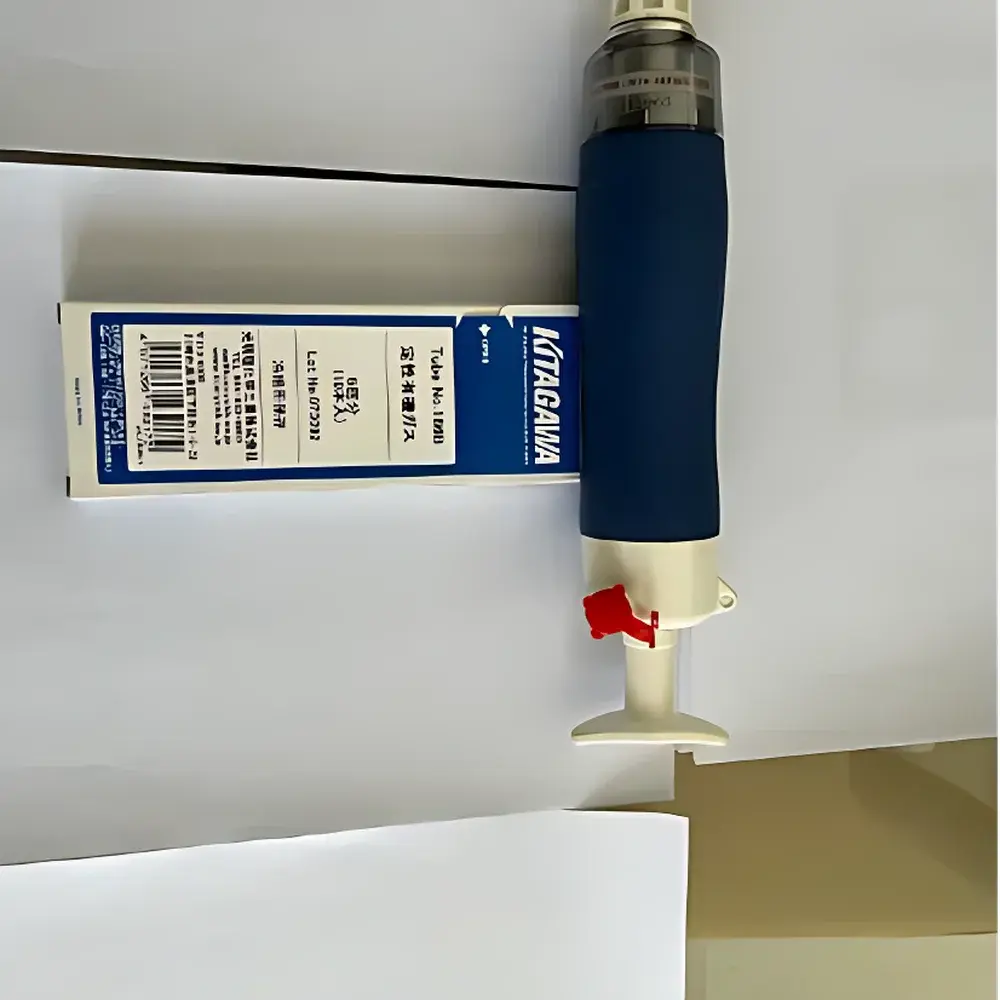
Kokusan 186B Organic Qualitative Gas Detection Tube
| Brand | Kokusan |
|---|---|
| Origin | Japan |
| Model | 186B |
| Type | Single-Use Colorimetric Indicator Tube |
| Detection Principle | Solid-Phase Chemical Reaction with Visual Color Development |
| Target Analytes | >40 Volatile Organic Compounds (VOCs) |
| Sampling Method | Manual Aspiration via Integrated Pump |
| Detection Time | 1–10 min per tube |
| Shelf Life | 24 months (unopened, stored at 2–30 °C) |
| Tube Dimensions | Ø6 mm × 100 mm |
| Calibration Traceability | NIST-traceable reference gas standards used during manufacturing |
| Compliance | Meets JIS K 0321:2019 and EN 1231:1997 requirements for qualitative gas detection tubes |
Overview
The Kokusan 186B Organic Qualitative Gas Detection Tube is a field-deployable, single-use colorimetric indicator system engineered for rapid, on-site identification of volatile organic compounds (VOCs) in emergency response, industrial hygiene, and environmental incident scenarios. Based on solid-phase chemical reaction principles, the tube contains a proprietary reagent-impregnated silica gel column that undergoes stoichiometric, analyte-specific color development upon exposure to target gases. When sampled air is drawn through the tube using the calibrated manual pump (sold separately), reactive functional groups—such as aldehydes, ketones, alcohols, esters, aromatic hydrocarbons, chlorinated solvents, and amines—induce localized chromogenic changes along the reagent bed. The length and intensity of the resulting color stain are directly correlated with both presence and approximate concentration range, enabling unambiguous qualitative classification without laboratory instrumentation.
Key Features
- Simultaneous screening for over 40 distinct VOCs—including formaldehyde, acetone, benzene, toluene, xylene, chloroform, methanol, ethyl acetate, and styrene—using a single tube format.
- Integrated calibration markings printed directly on the glass envelope enable immediate visual interpretation; no external reader or software required.
- Pre-calibrated aspiration volume (100 mL standard draw) ensures reproducible sample introduction across operators and environments.
- Robust borosilicate glass construction resists mechanical shock and thermal drift during transport and field use.
- Batch-certified against NIST-traceable reference gas mixtures; each production lot includes Certificate of Analysis documenting sensitivity limits and interference profiles.
- Designed for compatibility with Kokusan’s full line of handheld piston pumps (e.g., GP-100 series), meeting ISO 8519:2021 ergonomic and flow-rate consistency specifications.
Sample Compatibility & Compliance
The 186B tube operates effectively across ambient temperature ranges of −10 °C to +40 °C and relative humidity up to 90% RH (non-condensing). It is validated for use in mixed-gas matrices typical of fire residues, chemical spill zones, confined-space entries, and wastewater treatment facilities. Interference testing confirms minimal cross-reactivity with common inorganic gases (CO, CO₂, NO₂, SO₂, H₂S) at concentrations below occupational exposure limits. Regulatory alignment includes compliance with Japanese Industrial Standard JIS K 0321:2019 (“Colorimetric Gas Detection Tubes — General Rules”) and European Standard EN 1231:1997 (“Workplace Atmospheres — Detection Tubes — Requirements and Test Methods”). While not intended for regulatory compliance reporting under OSHA 1910.120 or EPA Method TO-17, it serves as a Tier-1 screening tool aligned with NIOSH Manual of Analytical Methods (NMAM) Chapter 2.1 guidelines for preliminary hazard assessment.
Software & Data Management
As a passive, analog detection system, the 186B tube does not interface with digital platforms or require firmware. However, its results are fully compatible with structured digital documentation workflows: color-stain interpretations can be recorded in electronic field notebooks (e.g., Fulcrum, SafetyCulture iAuditor), integrated into incident management systems (e.g., EHS Insight, Intelex), and archived alongside GPS-tagged photos and pump calibration logs. For audit readiness, batch-specific Certificates of Analysis are provided in PDF format with embedded digital signatures compliant with ISO/IEC 17025:2017 documentation requirements. No FDA 21 CFR Part 11 electronic signature functionality applies, as the device generates no electronic records.
Applications
- First-responder triage during chemical release incidents, including transportation accidents involving solvent tankers or pesticide containers.
- Routine leak detection in pharmaceutical cleanrooms, semiconductor fabrication fabs, and paint-spray booths where VOC accumulation poses inhalation or explosion risks.
- Pre-entry verification for confined space entry (CSE) programs per OSHA 1910.146, confirming absence of specific organics prior to ventilation or PPE selection.
- Post-fire scene analysis to differentiate between pyrolysis byproducts (e.g., acrolein, benzene) and residual accelerants (e.g., gasoline-range organics).
- Educational use in occupational safety training modules to demonstrate structure–reactivity relationships in organic detection chemistry.
FAQ
Can the 186B tube quantify gas concentrations?
No—it provides qualitative identification only. Quantitative analysis requires complementary methods such as GC-FID, PID, or FTIR spectroscopy.
Is the tube reusable after sampling?
No. Each tube is designed for single-use only; re-use compromises reagent integrity and introduces false-negative risk.
What is the recommended storage condition?
Store unopened tubes in original packaging at 2–30 °C, away from direct sunlight and strong oxidizers. Do not refrigerate.
Does humidity affect performance?
Performance remains stable up to 90% RH; however, condensation inside the tube or pump must be avoided to prevent reagent washout.
How often should the manual pump be recalibrated?
Per ISO 8519:2021, piston pumps used with 186B tubes require annual calibration verification using a dry gas meter traceable to national standards.







