
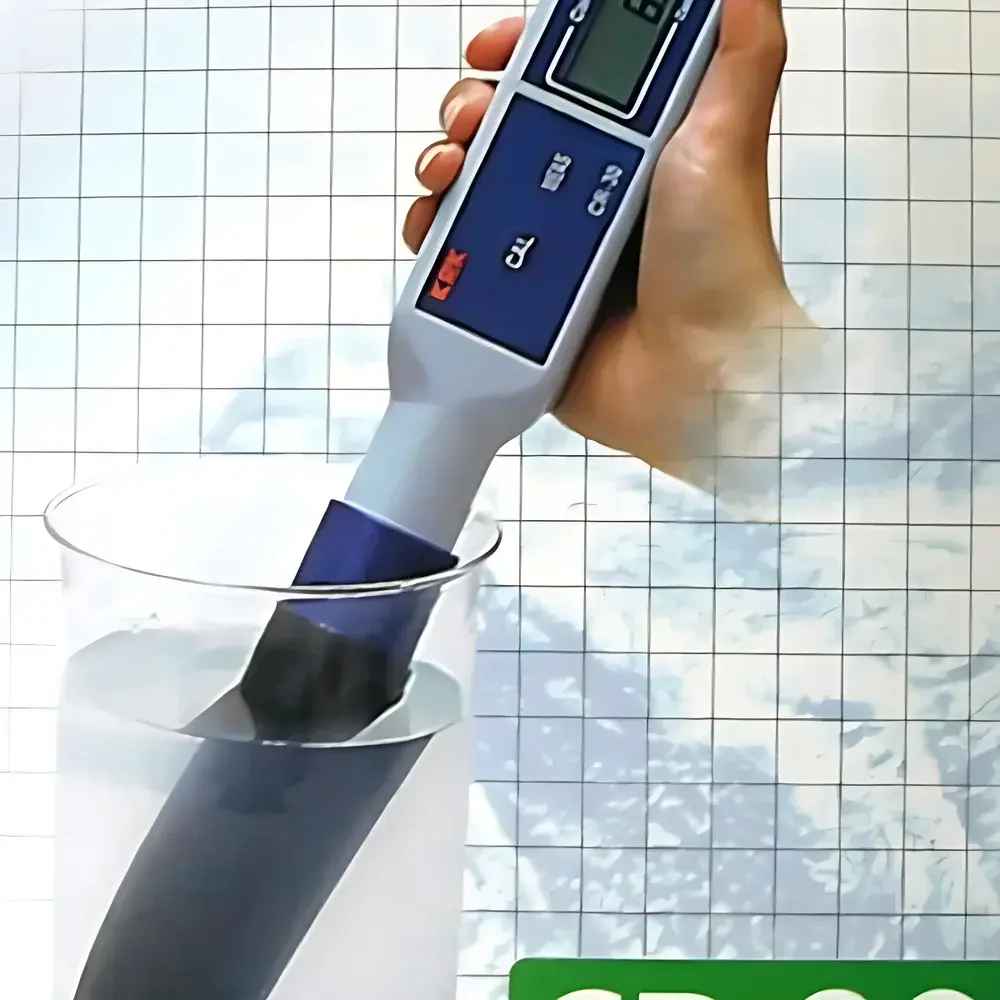
CR-30 Platinum-Cobalt Colorimeter by Rikagaku
| Brand | Rikagaku |
|---|---|
| Origin | Japan |
| Model | CR-30 |
| Measurement Principle | Platinum-Cobalt Spectrophotometric Method |
| Range | 0.0–50.0 Pt-Co Units |
| Repeatability | ±0.5 Pt-Co Units (at constant temperature) |
| Operating Temperature | 5–35°C |
| Storage Temperature | −10–35°C |
| Protection Rating | IP63 |
| Power Supply | 4 × LR1 (1.5 V) alkaline batteries (DC 6 V) |
| Dimensions | 54 × 38 × 350 mm |
| Weight | ~300 g |
| Sensor Immersion Depth | Fixed reference level |
| Zero Calibration | Deionized or distilled water |
| Span Calibration | Optional Pt-Co standard solution (e.g., 10 Pt-Co units, 250 mL) |
| Display Alerts | BAT (low battery), ERR (error), S (sensor fault), CAL (calibration mode) |
| Over-range Indication | Upper limit value blinking |
| Sample Compatibility | Clear, low-turbidity aqueous samples (e.g., drinking water, swimming pool water) |
| Exclusions | Organic solvents, strong alkalis, hydrofluoric acid |
Overview
The CR-30 Platinum-Cobalt Colorimeter is a handheld, field-deployable instrument engineered for rapid, reagent-free assessment of color in potable and recreational water sources. It implements the internationally recognized platinum-cobalt (Pt-Co) spectrophotometric method—defined in ASTM D1209, ISO 7887, and APHA Standard Method 2120B—to quantify yellowness intensity as Pt-Co units (also known as Hazen units). Unlike titrimetric or visual comparator methods, the CR-30 employs a fixed-wavelength photodiode sensor optimized for absorbance at 455 nm, where Pt-Co solutions exhibit maximal spectral discrimination against background interference. Its optical path is calibrated to match the 10-mm effective light path specified in standard methodology, ensuring traceable comparability across laboratories and regulatory inspections. Designed explicitly for clarity-focused applications—including municipal drinking water distribution systems, public swimming pools, and cooling tower monitoring—the CR-30 delivers stable, operator-independent results without chemical reagents, consumables, or warm-up time.
Key Features
- Reagent-free operation: Eliminates handling hazards, disposal costs, and lot-to-lot variability associated with liquid standards or chemical kits.
- Two-point calibration architecture: Zero calibration using deionized or distilled water; span calibration optional via certified Pt-Co reference standards (e.g., 10 Pt-Co units, supplied separately).
- Ruggedized IP63-rated housing: Dust-tight and resistant to vertically falling water droplets—suitable for humid environments, outdoor kiosks, and mobile inspection workflows.
- Low-power DC6V operation: Powered by four replaceable LR1 alkaline cells, enabling >2,000 measurements per set under typical usage conditions.
- Intuitive tactile interface: Dedicated CAL and MEAS buttons eliminate menu navigation; status LEDs and alphanumeric LCD provide unambiguous feedback (BAT, ERR, S, CAL).
- Fixed immersion geometry: Sensor probe features engraved depth marker ensuring consistent optical path length and minimizing user-induced variability.
Sample Compatibility & Compliance
The CR-30 is validated for use with low-turbidity, non-viscous aqueous matrices meeting APHA-defined clarity criteria (11), hydrofluoric acid, and organic solvents (e.g., acetone, ethanol) are incompatible and may degrade the PVC measurement cell or sensor window. Instrument validation documentation supports GLP-aligned recordkeeping; calibration events (zero and span) are timestamped and stored in non-volatile memory for audit readiness.
Software & Data Management
The CR-30 operates as a standalone, embedded-system device with no onboard data logging or PC connectivity. All measurement metadata—including date/time stamp, calibration status, and alert flags—are retained in volatile display memory only during active session. For regulated environments requiring electronic records, users integrate the CR-30 into broader QA/QC workflows using manual transcription into LIMS or ELN platforms. The device supports 21 CFR Part 11 compliance when paired with procedural controls: written SOPs governing calibration frequency (recommended daily pre-use zero check), environmental monitoring logs (temperature/humidity tracking), and battery replacement documentation. Traceability is maintained through serial-numbered calibration certificates for optional Pt-Co standards (NIST-traceable, batch-certified).
Applications
- Drinking water quality verification at treatment plant effluent points and distribution network taps.
- Swimming pool and spa facility routine monitoring per WHO Guidelines for Safe Recreational Water Environments.
- Pre-filtration assessment in reverse osmosis and activated carbon polishing stages.
- Audit support for ISO 22000 and HACCP-based food processing water safety plans.
- Educational laboratory instruction on colorimetric principles and water aesthetics regulation.
FAQ
What does “Pt-Co unit” mean, and how is it related to Hazen units?
The Pt-Co unit is synonymous with the Hazen unit—a standardized scale defined by the absorbance of a potassium chloroplatinate/cobaltous chloride solution. One Pt-Co unit equals the color produced by 1 mg/L of platinum (as chloroplatinate) and 0.5 mg/L of cobalt (as cobaltous chloride) in distilled water.
Can the CR-30 measure colored wastewater or industrial effluents?
No. The CR-30 is not suitable for high-turbidity, highly colored, or chemically aggressive matrices. Its 0–50 Pt-Co range and optical design assume optical clarity per ASTM D1209; samples exceeding 5 NTU require filtration prior to analysis.
Is periodic recalibration required, and how often?
Zero calibration is recommended before each measurement session. Span calibration using a certified Pt-Co standard is advised weekly for routine use or after sensor cleaning or battery replacement.
Does the instrument meet FDA or ISO certification requirements?
The CR-30 itself carries no formal ISO/IEC 17025 accreditation; however, its measurement principle conforms to ISO 7887-2:2012 and ASTM D1209–22, enabling use within accredited laboratories when operated per documented SOPs and supported by metrologically valid standards.
How should the sensor be cleaned between measurements?
Rinse thoroughly with deionized water and gently wipe the optical window with lint-free tissue. Avoid abrasive cleaners, alcohol, or ultrasonic baths, which may scratch the acrylic lens or compromise seal integrity.
Related Products







