
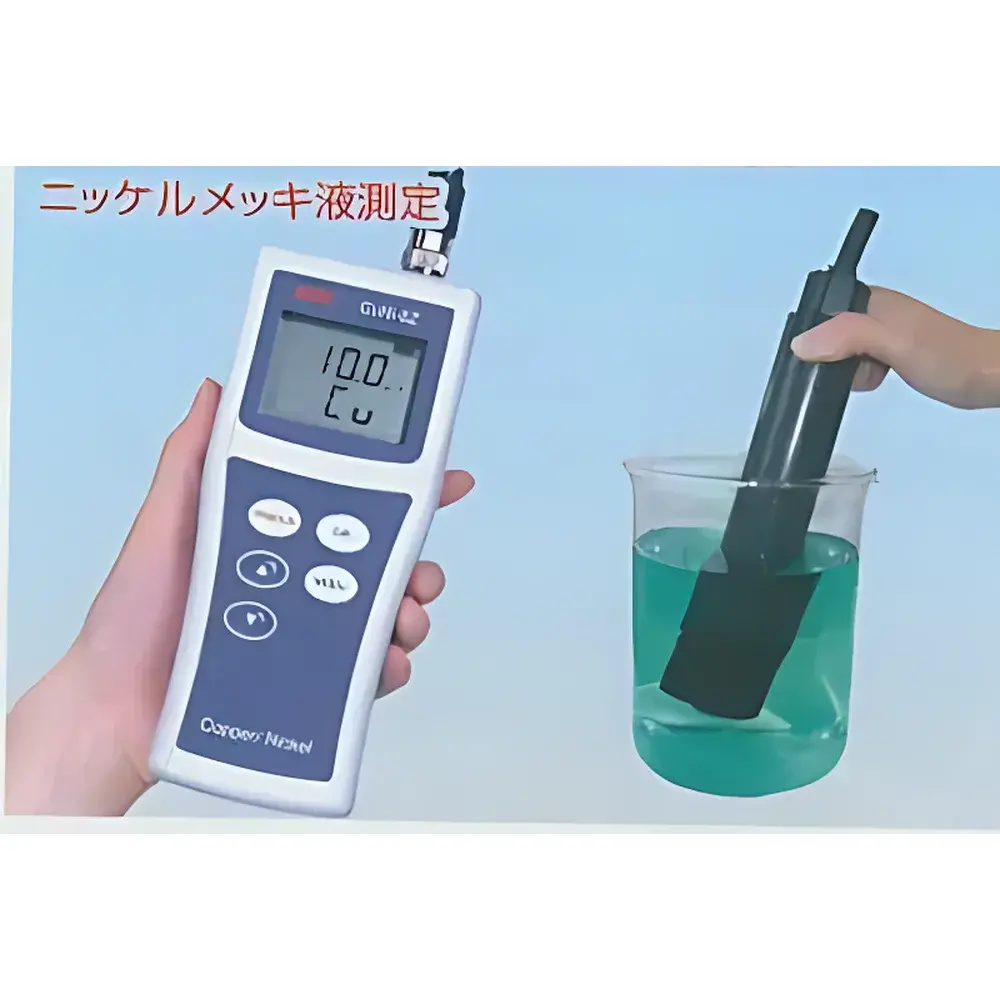
CU-5Z Portable Copper Concentration Meter by Kasuri Rikka
| Brand | Kasuri Rikka |
|---|---|
| Origin | Japan |
| Model | CU-5Z |
| Instrument Type | Portable |
| Ion Detection Capability | Multi-ion (Cu²⁺-optimized) |
| Measurement Principle | UV-Vis Spectrophotometry (LED-based, dual-wavelength with reference light) |
| Measuring Range | Cu²⁺: 0.0–76.3 g/L |
| CuSO₄ | 0.0–300 g/L |
| Molarity | 0.000–1.200 mol/L |
| Detection Limit | 0.1 g/L (as Cu) |
| Accuracy | ±2% of theoretical value (under controlled calibration conditions) |
| Response Time | 1 s |
| Operating Temperature | 5–45 °C |
| Relative Humidity | ≤85% RH |
| Power Supply | 3× AAA alkaline batteries (LR03), auto-off after 30 min |
| Dimensions | 38 mm (H) × 75 mm (W) × 180 mm (D) |
| Weight | ~300 g |
| Sensor Material | Chemically resistant alloy with inert optical interface |
| Temperature Compensation | Automatic (NTC-based) |
| Display | 3½-digit LCD |
Overview
The CU-5Z Portable Copper Concentration Meter is an industrial-grade photometric analyzer engineered for rapid, on-site quantification of dissolved copper ions (Cu²⁺) and copper sulfate (CuSO₄) in electroplating bath solutions. Designed specifically for PCB manufacturing environments, it operates on the principle of UV-Vis spectrophotometry using a stabilized LED light source paired with a reference photodetector to eliminate drift from ambient light or source intensity variation. Unlike conventional ion-selective electrodes or titration-based methods, the CU-5Z employs a fixed-wavelength absorption assay calibrated against NIST-traceable copper standards, enabling direct correlation between optical density and copper concentration across three interconvertible units: g/L (as elemental Cu), g/L (as CuSO₄), and mol/L. Its optical architecture incorporates automatic brightness correction and real-time temperature compensation—critical for maintaining measurement fidelity in dynamic plating line conditions where bath temperatures commonly fluctuate between 20–45 °C.
Key Features
- Triple-unit display: Simultaneous readout of Cu²⁺ (0.0–76.3 g/L), CuSO₄ (0.0–300 g/L), and molarity (0.000–1.200 mol/L) with 0.1 g/L detection limit for elemental copper
- Dual-channel photometric system: Primary measurement LED + dedicated reference LED ensures long-term stability and minimizes zero drift during continuous field operation
- Chemically robust sensor head: Constructed from corrosion-resistant alloy with optically sealed quartz window; fully compatible with sulfuric acid matrices (up to 200 g/L H₂SO₄) and hydrogen peroxide-containing baths
- Automatic temperature compensation (ATC): Integrated NTC thermistor corrects absorbance readings across the full 5–45 °C operational range, reducing thermal error to <±0.3% per °C deviation
- Low-power portable design: Powered by three standard AAA alkaline cells with intelligent auto-shutdown (30-minute timeout), delivering >200 hours of typical field use per battery set
- Compact ergonomics: 300 g mass and palm-sized form factor (38 × 75 × 180 mm) optimized for glove-compatible handling in cleanroom and wet-process areas
Sample Compatibility & Compliance
The CU-5Z is validated for direct immersion measurement in acidic copper electroplating electrolytes—including acid sulfate (H₂SO₄/CuSO₄), acid chloride, and mixed-acid formulations common in PCB through-hole and pattern plating. It exhibits no interference from common bath additives (e.g., chloride ions up to 50 ppm, SPS, PEG, Janus Green B) or residual peroxide (≤500 ppm). While not certified to ISO/IEC 17025 as a standalone metrological instrument, its calibration protocol aligns with ASTM D1688 (Standard Test Methods for Copper in Water) and supports GLP-compliant documentation when used with traceable Cu standard solutions (e.g., Kasuri Rikka CRM-Cu-01, certified to ±0.5% uncertainty). The device meets IEC 61010-1:2010 safety requirements for portable electrical equipment in industrial laboratories.
Software & Data Management
The CU-5Z operates as a standalone field instrument with no embedded data logging or Bluetooth connectivity. All calibration and measurement records must be manually transcribed or captured via external digital logbooks. However, its consistent output format (three concurrent concentration units, timestamp-independent but operator-annotatable) facilitates structured entry into LIMS platforms compliant with FDA 21 CFR Part 11 when paired with validated electronic notebooks. Calibration is performed using two-point verification with Kasuri Rikka-certified Cu standard solutions (0.0 and 50.0 g/L Cu), and calibration validity is user-determined per internal SOP—typically recommended before each shift or after solution changeover in high-volume production lines.
Applications
- Real-time monitoring of copper concentration in PCB electroplating baths to maintain optimal deposition rate and throwing power
- Verification of bath replenishment accuracy following automated dosing cycles
- Rapid troubleshooting of abnormal deposit morphology (e.g., nodulation, burning) linked to Cu²⁺ deviation beyond ±5 g/L tolerance bands
- Pre- and post-filtration validation to assess particulate-related copper loss in recirculated electrolytes
- Supporting QS-9000 and IATF 16949 process control requirements for plating line chemical management
- Field verification of laboratory ICP-OES results during cross-validation studies
FAQ
Does the CU-5Z require periodic factory recalibration?
No—recalibration is performed in-field using Kasuri Rikka traceable standards; annual verification against primary standards is recommended but not mandatory for routine production use.
Can the sensor be immersed in hot (>45 °C) plating baths?
No—the operating temperature limit is strictly 45 °C; prolonged exposure above this threshold may degrade LED output stability and accelerate battery discharge.
Is the device suitable for measuring copper in cyanide-based strike baths?
No—it is not validated for cyanide matrices due to complexation-induced spectral interference; use only in acidic sulfate or chloride electrolytes.
What is the expected lifetime of the optical sensor under daily use?
With proper cleaning (deionized water rinse post-use) and avoidance of abrasive contaminants, the sensor window maintains functional integrity for ≥3 years or 10,000+ measurements.
Does the CU-5Z comply with RoHS or REACH regulations?
Yes—the housing, electronics, and sensor materials are fully compliant with EU Directive 2011/65/EU (RoHS2) and Regulation (EC) No 1907/2006 (REACH), with full declaration of SVHC substances available upon request.
Related Products







