
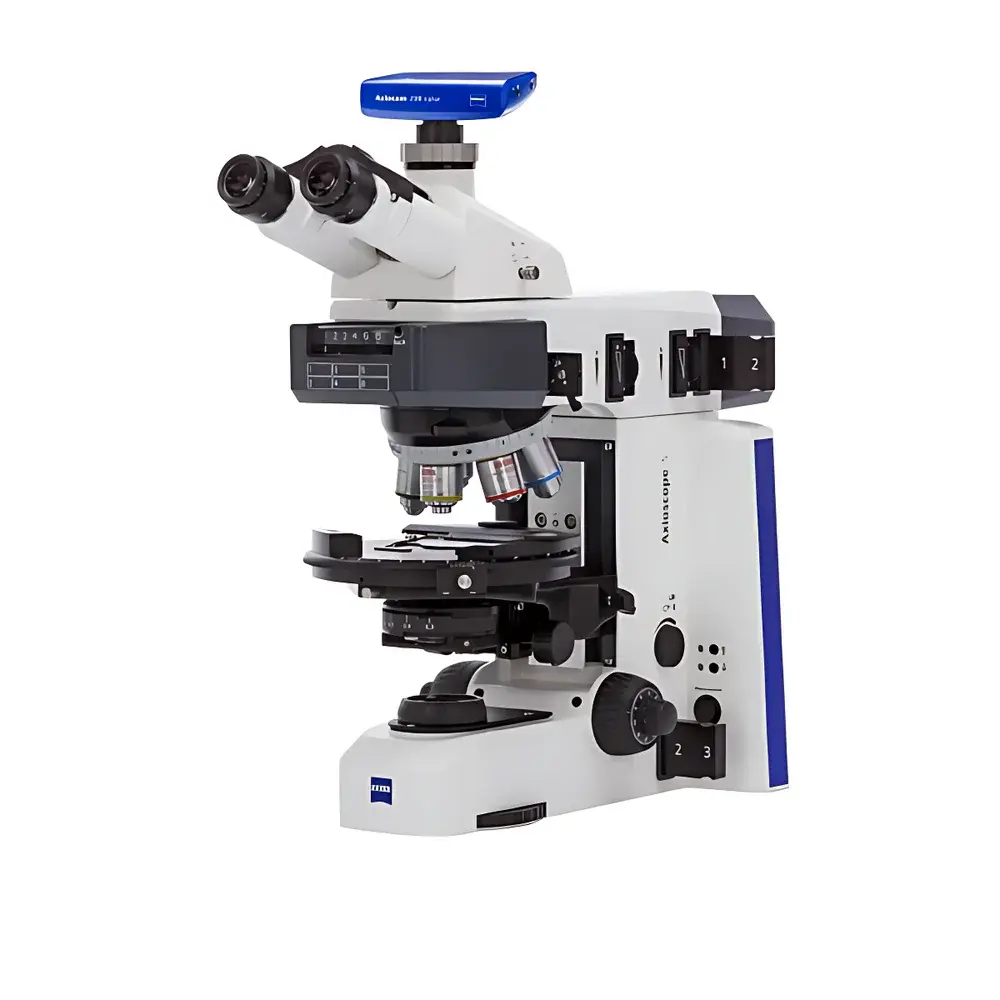
Zeiss Axioscope 5Pol Research-Grade Intelligent Digital Polarizing Microscope
| Brand | Zeiss |
|---|---|
| Origin | Germany |
| Model | Axioscope 5Pol |
| Optical System | IC2S Infinity-Corrected |
| Field Number | 23 |
| Illumination | 10 W White LED (Transmitted) / 12 V, 100 W Halogen (Reflected) |
| Observation Modes | Transmitted Light — Brightfield, Polarized Light, Conoscopy, Phase Contrast |
| Reflected Light Turret | Encoded 2-/4-/6-position |
| Objective Turret | Encoded 6-position, Centering-Adjustable |
| Stage | 170 mm or 190 mm Diameter, 360° Rotatable with 0.1° Precision and 45° Indexing |
| Maximum Sample Height | 110 mm |
| Polarizer | Fixed or Rotatable, Heat-Resistant Module for HBO 103 Lamp |
| Analyzer | 360° Rotatable with 0.1° Graduation |
| Lambda/Full-Wave Retardation Plate | Fixed or Rotatable |
| Circular Polarization System | Available for Transmitted Light |
| Software | ZEN Core and LabScribe |
| Features | Integrated Capture Button, Auto-Intensity Management, ECO Sleep Mode (15 min Inactivity), Real-Time Extended Depth of Focus, Panoramic Image Stitching, Automatic Scale Bar Recognition |
| Compliance | Designed for ISO 9001-aligned manufacturing |
Overview
The Zeiss Axioscope 5Pol is a research-grade digital polarizing microscope engineered for high-fidelity crystallographic and anisotropic material analysis across geoscience, materials science, polymer engineering, and forensic metallurgy. Built upon Zeiss’ IC2S (Improved Contrast and Color Stability) infinity-corrected optical architecture, it delivers diffraction-limited resolution, zero-stress optics, and long-term radiometric stability—critical for quantitative birefringence measurement, extinction angle determination, and interference color evaluation. Its dual-path illumination design supports simultaneous transmitted-light polarization (including conoscopy and circular polarization) and reflected-light polarization or fluorescence, enabling comprehensive characterization of both transparent thin sections and opaque industrial specimens. The system’s modular mechanical design—featuring encoded turrets, motorized stage positioning, and intelligent light management—ensures traceable, repeatable, and operator-independent operation in regulated environments.
Key Features
- IC2S optical path with apochromatic correction and strain-free objectives optimized for polarized light performance across UV–VIS spectrum
- Integrated 360° precision analyzer (0.1° graduation) with interchangeable fixed/rotatable λ-plate (530 nm) for quantitative retardation measurement
- Dedicated circular polarization module for transmitted light—enabling uniform interference contrast across all crystal orientations, essential for rock thin-section imaging and polymer spherulite analysis
- Heat-resistant polarizer assembly compatible with high-intensity HBO 103 mercury arc lamps, ensuring stable polarization state during extended thermal-stage experiments
- Encoded 6-position objective turret with automatic magnification recognition and software-synchronized scale bar loading
- Large-diameter (190 mm) rotating mechanical stage with 0.1° angular resolution, 45° indexing detents, and 110 mm vertical clearance—accommodating hot/cold stages, cathodoluminescence detectors, and tensile rigs
- Intelligent illumination management: auto-adjustment of LED/halogen intensity upon objective or contrast mode change; ECO sleep mode after 15 minutes of inactivity
- Dedicated hardware capture button on microscope body for synchronized image acquisition without PC interaction
Sample Compatibility & Compliance
The Axioscope 5Pol accommodates diverse sample formats—from standard 26 × 48 mm geological thin sections and 150 mm semiconductor wafers to irregular metallurgical mounts and fiber-reinforced composites. Its open optical train and modular port configuration support integration with third-party accessories including Linkam heating/cooling stages (−196 °C to +1500 °C), photometric detectors, and Raman coupling interfaces. From a regulatory standpoint, the platform meets ISO 10934-1 (microscopy terminology) and ISO 9276-6 (particle shape description via microscopy) requirements. When deployed with ZEN Core software configured for audit trail logging, electronic signatures, and role-based access control, the system satisfies data integrity prerequisites under FDA 21 CFR Part 11 and EU Annex 11 for GxP-compliant laboratories.
Software & Data Management
ZEN Core serves as the primary acquisition and analysis environment, supporting real-time extended depth-of-focus (EDF) rendering, automated panoramic stitching of large-area scans (e.g., full petrographic thin sections), and AI-assisted grain boundary detection. LabScribe provides complementary workflow automation for routine QC tasks—including automatic birefringence quantification, extinction angle mapping, and interference color classification per Michel-Lévy chart standards. All measurements are embedded with EXIF metadata (objective ID, magnification, polarizer/analyzer angles, retardation settings), ensuring full traceability. Export options include TIFF (with embedded calibration metadata), CSV (for statistical analysis in JMP or Python), and PDF reports compliant with internal SOP templates.
Applications
- Geological Petrography: Quantitative mineral identification via optic sign, 2V angle, pleochroism, and Becke line analysis in igneous/metamorphic thin sections
- Materials Failure Analysis: Stress distribution mapping in tempered glass, laminated polymers, and composite laminates using photoelasticity and isoclinic/isochromatic fringe interpretation
- Pharmaceutical Solid-State Characterization: Polymorph differentiation and crystallinity assessment in active pharmaceutical ingredients (APIs) under heated stage conditions
- Forensic Fiber Analysis: Birefringence profiling and orientation index calculation for synthetic textile fibers (e.g., nylon, polyester)
- Semiconductor Metrology: Defect inspection in sapphire substrates and epitaxial layers using conoscopic interference patterns
- Ceramic & Cement Microstructure: Quantification of anisotropic phases (e.g., β-SiAlON, mullite) and residual stress in sintered bodies
FAQ
Is the Axioscope 5Pol compatible with third-party thermal stages?
Yes—the microscope features standardized dovetail mounting rails and unobstructed optical access, supporting integration with Linkam, Instec, and ERICO hot/cold stages up to 1500 °C.
Can ZEN Core export calibrated measurements for statistical process control (SPC)?
Yes—measurement data (e.g., extinction angle, retardation value, grain size) can be exported directly to CSV with SI units and uncertainty estimates, enabling import into Minitab, JMP, or custom Python/Pandas pipelines.
Does the system support ASTM D4123 or ISO 10934-compliant reporting?
While the hardware itself does not “certify” compliance, its optical calibration traceability (via Zeiss factory certification), measurement repeatability (<±0.3° angular error), and software audit trail functionality enable full adherence to these standards when implemented within validated lab procedures.
What is the maximum usable numerical aperture (NA) for polarized light observation?
With the Plan-Apochromat 100×/1.40 Oil objective and strain-free condenser, the system achieves NA = 1.40 in transmitted polarized light—optimized for high-resolution interference figure analysis and precise 2V determination.
How is polarization extinction verified during routine maintenance?
ZEN Core includes a built-in polarization calibration routine that measures background intensity at crossed polars across the field of view, generating a spatial uniformity heatmap and reporting RMS extinction ratio (typically >1000:1 with proper alignment).




