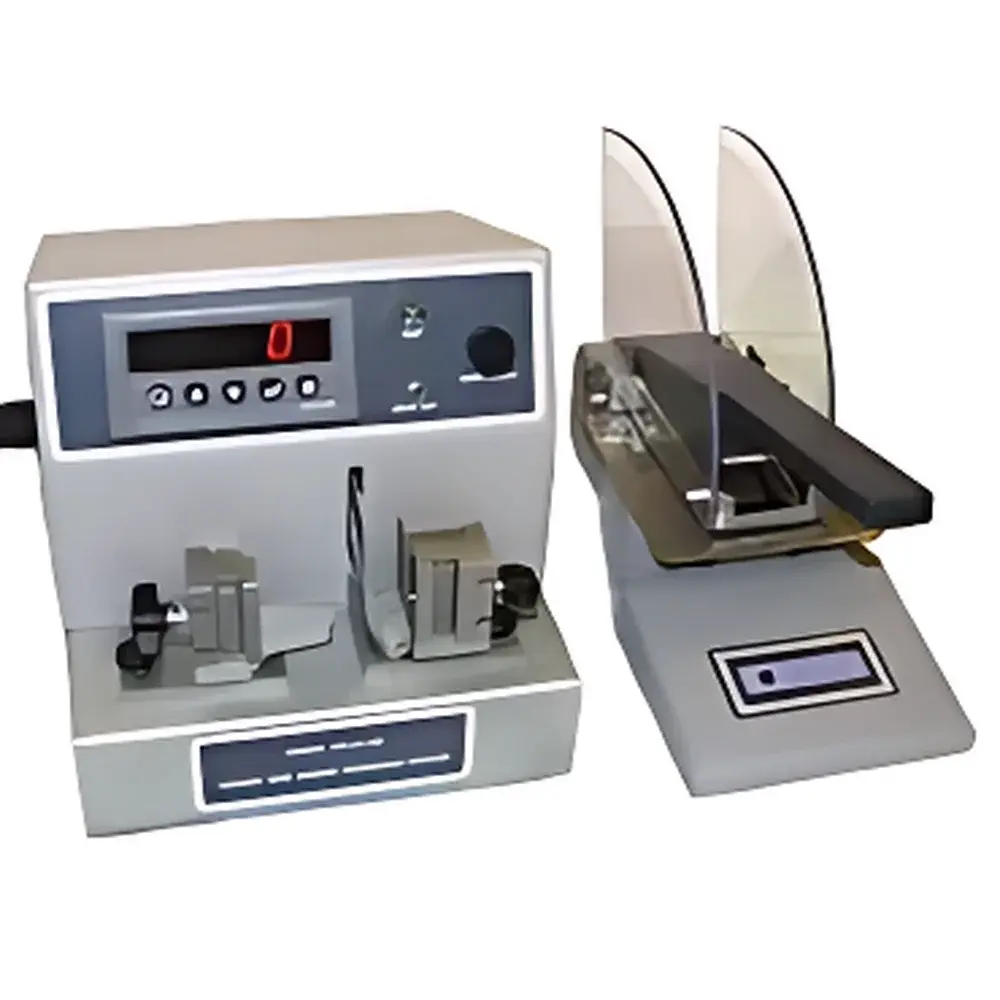
TMI 79-11-00 Crease Stiffness Tester
| Brand | TMI |
|---|---|
| Origin | USA |
| Model | 79-11-00 |
| Measurement Range | 0–399 gf |
| Display | 3-digit LCD |
| Creasing Angle | 90° |
| Stiffness Bend Angle | 15° |
| Readout Time | 15 s |
| Resolution & Accuracy | ±1.0 gf |
| Power Supply | 240 V, 50 Hz |
| Fuse | 500 mA |
| Dimensions (Instrument) | 235 mm (H) × 180 mm (L) × 320 mm (W) |
| Dimensions (Packed) | 670 mm (H) × 550 mm (L) × 520 mm (W) |
| Weight (Instrument) | 11 kg |
| Weight (Packed) | 14 kg |
| Includes | Precision cutting knife and calibration weights |
Overview
The TMI 79-11-00 Crease Stiffness Tester is an engineered mechanical instrument designed specifically for quantitative evaluation of crease resistance and bending stiffness in corrugated board, solid bleached sulfate (SBS), folding boxboard (FBB), and coated paperboard used in high-speed packaging operations. It operates on the principle of controlled angular deflection under static load, applying standardized bending moments to simulate real-world creasing and folding behavior during carton erecting and forming. Unlike generic tensile or flexural testers, this device isolates two critical mechanical properties—board stiffness (measured at 15° bend) and crease line resistance (measured at 90° fold)—and computes their ratio, a dimensionless parameter directly correlated with downstream packaging machine performance. The instrument complies with fundamental physical test methodologies referenced in TAPPI T 813 (Stiffness of Paperboard) and ASTM D6415 (Standard Test Method for Measuring the Resistance to Folding of Paperboard), serving as a functional bridge between laboratory measurement and production-line process validation.
Key Features
- Dual-mode mechanical testing: Simultaneously quantifies bending stiffness (15° angle, 15 s dwell) and crease resistance (90° fold, 15 s dwell) on the same specimen strip.
- Precision-machined anvil and loading arm system ensures repeatable force application with minimal hysteresis and zero drift over extended use cycles.
- Integrated 3-digit LCD display with automatic zero stabilization provides direct readout in gram-force (gf), eliminating manual interpolation or analog scale estimation.
- Factory-calibrated using NIST-traceable reference weights; includes certified calibration mass set and precision guillotine-style cutting knife for consistent specimen preparation (15 mm width × 100 mm length).
- Robust cast-aluminum frame and stainless steel loading components ensure long-term dimensional stability under ambient lab conditions (23 ± 2°C, 50 ± 5% RH recommended per ISO 187).
- No software dependency: Fully electromechanical operation enables immediate deployment in GLP-compliant environments where computerized systems require 21 CFR Part 11 validation.
Sample Compatibility & Compliance
The TMI 79-11-00 accommodates standard paperboard specimens measuring 15 mm wide × 100 mm long, cut parallel to machine direction (MD) and cross direction (CD) for orthogonal property assessment. It supports substrates ranging from 200–800 g/m² basis weight and thicknesses up to 1.2 mm, including laminated, coated, and metallized boards common in pharmaceutical blister packaging and premium consumer goods cartons. Test protocols align with TAPPI T 820 (Crease Resistance of Paperboard), ISO 5628 (Determination of Bending Resistance), and internal QC specifications defined in ISO 9001:2015 Clause 8.5.2 (Identification and Traceability of Monitoring Equipment). All measurements are performed under controlled temperature and humidity per ISO 187, ensuring inter-laboratory reproducibility within ±3% RSD for repeated measurements on homogeneous lots.
Software & Data Management
This instrument operates without embedded firmware or digital data logging. All output is analog-to-digital converted and displayed locally in real time. For integration into enterprise quality management systems (QMS), users may manually record values into validated electronic notebooks (e.g., LabWare LIMS, Veeva Vault QMS) or export via external USB-connected digital calipers (optional accessory). While no native software is supplied, the unit’s deterministic mechanical response supports audit-ready documentation: each test requires operator-initiated reset, physical specimen placement verification, and timed release activation—providing inherent procedural traceability. Calibration records, including date, technician ID, and reference weight serial numbers, must be retained per FDA 21 CFR Part 211.160(b) and ISO/IEC 17025:2017 Clause 6.4.10.
Applications
- Optimization of creasing rule geometry (depth, width, profile) on rotary die-cutters to minimize fiber rupture while achieving target fold initiation force.
- Validation of board supplier specifications against internal “crease-stiffness ratio” thresholds: MD ratio 1.5–3.0 and CD ratio 3.0–7.0 for stable carton erection on vertical form-fill-seal (VFFS) lines.
- Root-cause analysis of carton misfolding, side-panel warping, or glue-joint failure during high-speed packaging trials.
- Pre-qualification of new board grades prior to full-scale production ramp-up, reducing costly line downtime and scrap rates.
- Supporting Design for Manufacturability (DFM) initiatives by correlating lab-scale stiffness metrics with actual machine-set parameters such as pre-creasing pressure and fold roller torque.
FAQ
What standards does the TMI 79-11-00 comply with?
It supports test methods aligned with TAPPI T 813, TAPPI T 820, ASTM D6415, and ISO 5628 for stiffness and crease resistance evaluation.
Is environmental conditioning required before testing?
Yes—specimens must be conditioned per ISO 187 (23 ± 2°C, 50 ± 5% RH) for minimum 24 hours to ensure moisture equilibrium and measurement consistency.
Can the instrument measure both MD and CD directions on the same sample sheet?
Yes—by rotating the specimen 90° and re-cutting along orthogonal axes, users obtain paired directional datasets essential for ratio-based process modeling.
Does the unit include calibration certification?
Yes—a factory-issued calibration certificate with NIST-traceable weight verification is provided, valid for 12 months under normal use conditions.
What maintenance is required for long-term accuracy?
Annual mechanical inspection of pivot bearings, spring tension verification, and replacement of worn cutting blades are recommended per TMI Service Bulletin SB-79-11-00 Rev. 3.