
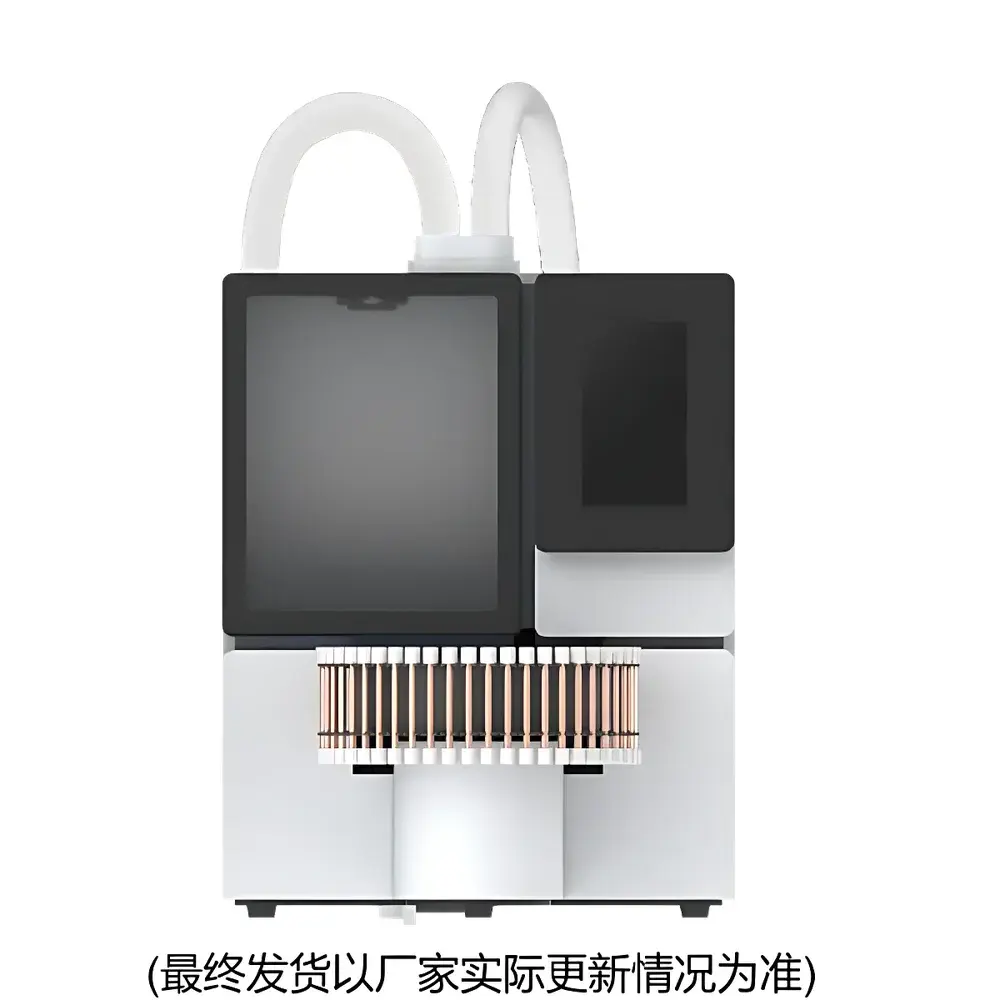
ColinTech AutoTD D50 Dual-Channel Automated Thermal Desorber
| Brand | ColinTech (Chengdu Colin Technology Co., Ltd.) |
|---|---|
| Origin | Sichuan, China |
| Manufacturer Type | OEM Manufacturer |
| Instrument Type | Two-Stage Thermal Desorber |
| Automation Level | Fully Automated |
| Primary Desorption Temperature Range | 50–400 °C |
| Secondary Desorption (Cold Trap) Temperature Range | −30–400 °C |
| Valve & Transfer Line Temperature Range | 50–300 °C |
| Cold Trap Temperature Range | −30–400 °C |
| Temperature Control Accuracy | < 0.1 °C |
| Desorption Recovery Rate | 99.5% |
| Sample Position Capacity | 50 positions |
Overview
The ColinTech AutoTD D50 is a fully automated, dual-channel two-stage thermal desorber engineered for high-throughput, trace-level analysis of volatile and semi-volatile organic compounds (VOCs and SVOCs) in environmental air, stack emissions, and indoor air matrices. It operates on the principle of sequential thermal desorption: analytes are first thermally released from sorbent tubes under controlled inert gas flow (primary desorption), cryogenically focused onto a low-temperature cold trap (−30 °C minimum), and then rapidly transferred—via instantaneous resistive heating of the trap—to a gas chromatograph (GC) for separation and detection. This two-stage architecture eliminates matrix interference, enhances sensitivity by up to two orders of magnitude over single-stage systems, and ensures quantitative recovery across wide concentration ranges (ng to µg per tube). The dual-channel design enables parallel processing of two sample tubes—either into two independent GC inlets or into two separate GC systems—effectively doubling laboratory throughput without compromising analytical integrity.
Key Features
- Dual independent thermal desorption channels with synchronized timing control, supporting simultaneous analysis of two samples or staggered method sequences.
- 50-position robotic autosampler with integrated cap removal and re-capping mechanism—eliminates manual tube handling and dedicated inlet caps.
- Patented 360° cylindrical heating system (CN Patent ZL201310023569.5) for primary desorption: uniform radial contact ensures complete, residue-free analyte release from the full length of the sorbent tube.
- Electronically cooled cold trap capable of reaching −30 °C (optional configuration supports −60 °C), enabling efficient focusing of highly volatile compounds (e.g., C2–C6 hydrocarbons) with rapid thermal ramp rates (>1000 °C/s).
- Instantaneous secondary desorption via heated carrier gas pulse (CN Utility Model ZL201020649905.9), delivering sharp, symmetrical peaks and minimizing carryover (<0.01% typical).
- Two-stage programmable split flow: primary split (1:1 to 1:5000) and secondary split (1:1 to 1:5000), enabling linear dynamic range extension from sub-ng to µg levels within a single run.
- Integrated leak-check protocol prior to each desorption cycle, with real-time pressure decay monitoring and audible/visual alarm on failure.
- Automated moisture purge function: pre-desorption dry gas flush removes ambient humidity from the transfer path, reducing water-induced column degradation and baseline instability.
- Onboard touchscreen interface with password-protected user access levels, method storage (up to 10 methods + sequences), and immutable audit-trail logging compliant with GLP/GMP documentation requirements.
Sample Compatibility & Compliance
The AutoTD D50 accommodates standard 6 mm OD × 89 mm (3.5″) stainless steel or glass sorbent tubes (e.g., Tenax TA, Carbopack B/C, Carboxen 1000, or multi-bed configurations). Its hardware and firmware architecture support full compliance with international method standards including EPA TO-17, ISO 16017-1, ASTM D6196, and EN 13649-2. All temperature zones—including valve oven, transfer lines, and cold trap—are independently PID-controlled with <0.1 °C stability, meeting calibration traceability requirements per ISO/IEC 17025. System validation reports include temperature uniformity mapping, desorption recovery verification (n=10, RSD <1.2%), and carryover assessment per USP guidelines.
Software & Data Management
Control is executed via embedded Linux-based firmware with a 7-inch capacitive touchscreen HMI. Method development includes granular control over primary/secondary desorption times, trap cooling/focusing durations, split ratios, carrier gas flows (optional EPC/EFC module), and GC trigger synchronization. All run parameters—including timestamps, operator ID, tube position, and real-time pressure/temperature logs—are written to an encrypted SQLite database with write-once, read-many (WORM) policy. Export formats include CSV and XML for LIMS integration. Audit trail records are tamper-evident and meet FDA 21 CFR Part 11 requirements for electronic signatures and data integrity when paired with network authentication protocols.
Applications
- Regulatory monitoring of ambient air VOCs (benzene, toluene, xylenes, formaldehyde) per EPA Method TO-17.
- Stack emission testing of industrial processes for chlorinated solvents, PAHs, and phthalates under EN 13649-2 and ISO 16017-1.
- Indoor air quality (IAQ) surveys targeting terpenes, aldehydes, and plasticizers in building materials and furnishings.
- Workplace exposure assessment per OSHA and NIOSH sampling protocols using charcoal or silica gel tubes.
- Method development labs requiring robust, reproducible thermal desorption for compound identification and quantification in complex matrices.
FAQ
What GC interfaces does the AutoTD D50 support?
It features universal pneumatic and electrical interfaces compatible with all major GC manufacturers (Agilent, Thermo Fisher, Shimadzu, PerkinElmer) via standard 1/16″ stainless steel transfer lines and TTL/RS-232 trigger signals.
Can the cold trap reach −60 °C as mentioned in the specifications?
The base configuration achieves −30 °C; the −60 °C capability requires optional cryogenic cooling module (Order Code: CT-60-OP), which uses cascade Peltier elements with active heat dissipation.
Is method transfer from single-channel desorbers straightforward?
Yes—method parameters (temperatures, times, splits) map directly; dual-channel operation adds parallelization logic but preserves identical desorption physics and calibration curves.
How is data integrity ensured during long unattended runs?
Each run generates a SHA-256 checksummed log file; system memory retains last 1000 runs locally, and remote syslog forwarding is configurable for centralized IT monitoring.
Does the instrument support remote diagnostics and software updates?
Yes—SSH-enabled secure shell access (disabled by default) allows authorized service engineers to perform firmware updates and diagnostic telemetry via encrypted VPN tunnel.




