
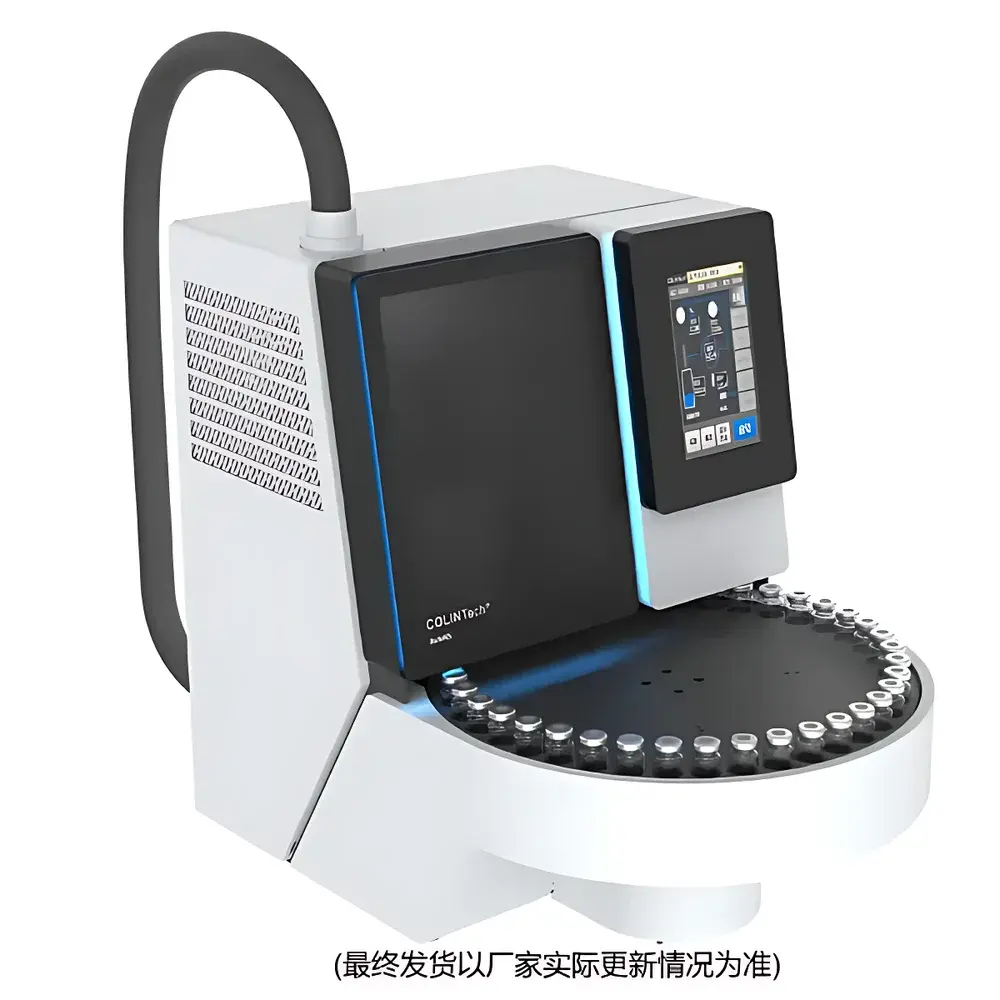
Colintech AutoHS® 40A Fully Automated Static Headspace Sampler
| Brand | Colintech |
|---|---|
| Origin | Sichuan, China |
| Manufacturer Type | Direct Manufacturer |
| Instrument Type | Static Headspace Sampler |
| Automation Level | Fully Automatic |
| Sample Vial Capacity | 40 positions |
| Vial Size | 20 mL |
| Vial Heating Range | Ambient to 180 °C |
| Valve & Needle Temperature Control Range | 35–210 °C |
| Injection Mode | Time-based quantitative sampling (no fixed loop volume) |
| Operating Modes | Gas Purge Mode, Constant Mode, Time-Gradient Mode, Multiple Headspace Extraction (MHE) Mode |
| EPC Integration | Yes, compatible with all major GC/GC-MS platforms |
| Optional Feature | Mechanical Vial Agitation (Shaking) |
Overview
The Colintech AutoHS® 40A is a fully automated static headspace sampler engineered for precision, reproducibility, and method flexibility in volatile organic compound (VOC) analysis. It operates on the fundamental principle of static headspace equilibrium—where analytes partition between a liquid or solid sample matrix and its overlying gas phase at controlled temperature and time. Unlike dynamic purge-and-trap systems, the AutoHS® 40A extracts VOCs directly from the equilibrated headspace vapor without carrier gas sweeping, minimizing dilution and maximizing detection sensitivity for trace-level volatiles. Its dual-flow needle architecture and static-dynamic compensation extraction mechanism enable high-fidelity transfer of headspace gas under elevated pressure directly into the GC inlet—eliminating transfer line dead volume and secondary sample handling. This design delivers superior peak shape, reduced carryover, and enhanced signal-to-noise ratios—particularly critical for high-boiling-point or strongly adsorbing compounds such as chlorinated solvents, aldehydes, and residual monomers.
Key Features
- Dual-flow sample extraction needle with static-dynamic compensation: Ensures quantitative transfer of headspace vapor while actively mitigating memory effects from high-concentration or high-boiling analytes.
- Four operational modes: Gas purge (inert atmosphere operation), constant equilibration, time-gradient extraction, and multiple headspace extraction (MHE)—supporting both standardized protocols (e.g., EPA Method 502.2, USP , ISO 11843-2) and custom research workflows.
- 40-position 20 mL vial carousel with 15 independently heated zones and overlapping heating capability—enabling continuous batch processing without thermal downtime.
- Full electronic pressure control (EPC) integration: Enables precise, real-time regulation of vial pressurization, transfer line pressure, and GC inlet backpressure—ensuring retention time stability and cross-platform compatibility with Agilent, Thermo Fisher, Shimadzu, and PerkinElmer GC/GC-MS systems.
- Intuitive graphical user interface with touch-enabled navigation, method storage for up to 10 protocols, and customizable sequence scheduling—including pause/resume functionality and event-triggered diagnostics.
- Optional mechanical agitation module: Provides programmable orbital shaking during equilibration to accelerate mass transfer for heterogeneous or viscous matrices (e.g., blood, soil slurries, polymer extracts).
Sample Compatibility & Compliance
The AutoHS® 40A accommodates standard 20 mL crimp-top headspace vials with silicone/PTFE septa and supports a broad range of sample types—including aqueous solutions (drinking water, wastewater), biological fluids (serum, urine, saliva), pharmaceutical formulations (injectables, ointments), edible oils, packaged foods, environmental solids (soil, sediment), and polymeric materials. Its gas purge mode meets requirements for oxygen-sensitive analyses (e.g., oxidation-prone aldehydes or thiols). The system adheres to core regulatory expectations for analytical instrumentation: audit-trail-ready method editing (aligned with FDA 21 CFR Part 11 principles), GLP-compliant parameter locking, and full traceability of run conditions (temperature, time, pressure, valve actuation). It is routinely deployed in laboratories complying with ISO/IEC 17025, USP , EP 2.4.24, and ASTM D7622.
Software & Data Management
Control and data acquisition are managed via the dedicated AutoHS Control Suite—a Windows-based application supporting local operation and remote monitoring over LAN. Each method stores complete thermal profiles, timing parameters, pressure setpoints, and vial position mapping. Raw instrument logs—including valve actuation timestamps, heater thermocouple readings, and EPC feedback loops—are retained for ≥90 days and exportable in CSV or XML format. Sequence files support conditional branching (e.g., skip vial on error), auto-recovery after power interruption, and integration with LIMS via OPC UA or ASCII file drop. All software updates are version-controlled and documented per ICH Q5A change management guidelines.
Applications
The AutoHS® 40A is validated for routine and research applications across regulated and academic environments: residual solvent analysis in APIs per ICH Q3C; VOC profiling in municipal drinking water per EPA 524.4; ethanol quantification in forensic blood samples (CAP-accredited workflows); flavor compound screening in edible oils and dairy products; off-gas characterization from packaging films; and screening of degradation markers (e.g., formaldehyde, acetaldehyde) in medical device polymers. Its MHE mode enables accurate determination of analyte activity coefficients and matrix binding constants—supporting thermodynamic modeling in method development.
FAQ
Is the AutoHS® 40A compatible with third-party GC data systems?
Yes—it communicates via industry-standard RS-232 and Ethernet interfaces, and supports trigger synchronization with any GC that accepts TTL or contact-closure start signals.
Does it support unattended overnight operation?
Yes—the system includes hardware interlocks, thermal runaway protection, and automatic vial ejection after analysis; sequences can span >12 hours with no operator intervention.
Can carryover be verified and corrected automatically?
Yes—built-in blank vial testing routines quantify carryover per compound class; optional post-run bake-out cycles (up to 210 °C) are programmable per sequence step.
What maintenance is required for long-term reliability?
Scheduled quarterly inspection of septa, needle seals, and pressure transducers; annual calibration of temperature sensors and EPC modules using NIST-traceable references.
Is method validation documentation available?
Colintech provides IQ/OQ protocol templates, performance qualification data (precision, linearity, LOD/LOQ), and installation checklists aligned with ISO/IEC 17025 Annex A.2 requirements.





