
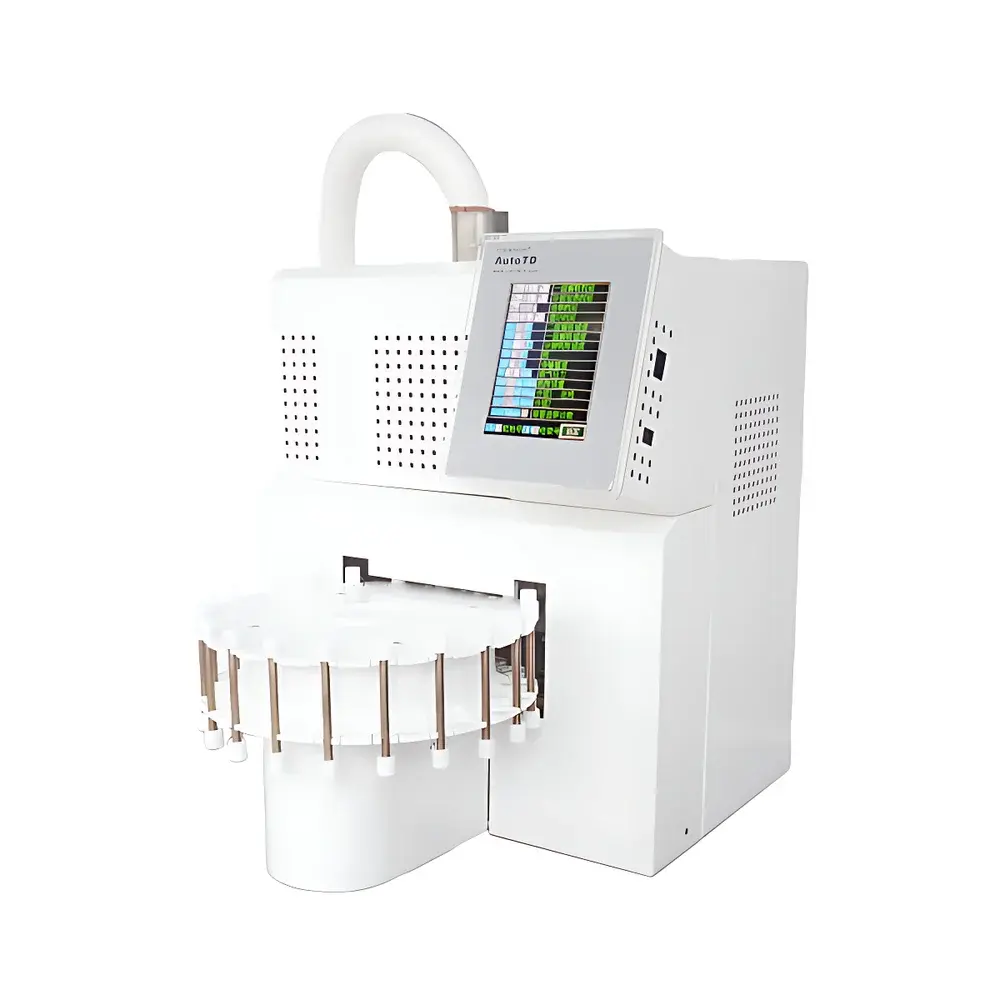
ColinTech AutoTD 20A Automated Two-Stage Thermal Desorber
| Brand | ColinTech (Chengdu Colin Analytical Instrument Co., Ltd.) |
|---|---|
| Origin | Sichuan, China |
| Manufacturer Type | Original Equipment Manufacturer (OEM) |
| Instrument Category | Domestic |
| Model | AutoTD 20A |
| Instrument Type | Two-stage thermal desorber |
| Automation Level | Fully automated |
| Primary Desorption Temperature Range | 50–400 °C |
| Secondary Desorption (Cold Trap) Temperature Range | −40 to 400 °C |
| Valve & Transfer Line Temperature Range | 50–300 °C |
| Temperature Control Accuracy | < ±0.1 °C |
| Desorption Recovery Rate | > 99.5% |
| Sample Capacity | 20 positions |
| Dual-Stage Split Flow Capability | Enables quantitative analysis across concentration ranges from ng to µg per analyte |
| Method Storage | Up to 10 user-defined methods |
| GC/GC-MS Compatibility | Universal interface for all major gas chromatography and mass spectrometry platforms |
Overview
The ColinTech AutoTD 20A is a fully automated, two-stage thermal desorption system engineered for high-fidelity volatile organic compound (VOC) and semi-volatile organic compound (SVOC) analysis in environmental, occupational hygiene, and materials testing laboratories. It operates on the principle of sequential thermal desorption—first releasing analytes from sorbent tubes under controlled heating (primary desorption), then refocusing and rapidly re-desorbing them onto a cryogenically cooled trap (secondary desorption) prior to introduction into the gas chromatograph. This dual-stage architecture eliminates cold-spot losses, minimizes band broadening, and delivers sharp, symmetrical chromatographic peaks with enhanced signal-to-noise ratios. The system’s proprietary 360° cylindrical heating of sample tubes ensures uniform thermal energy distribution—critical for reproducible desorption kinetics and avoidance of channeling or incomplete elution. Its integrated cold trap supports ultra-low temperature focusing (down to −40 °C) and rapid thermal ramping (up to 400 °C), enabling robust capture and efficient transfer of both light VOCs (e.g., benzene, formaldehyde) and heavier SVOCs (e.g., naphthalene, phthalates).
Key Features
- Fully automated 20-position sample carousel with robotic cap removal and resealing—eliminating manual handling errors and ensuring consistent tube sealing integrity.
- Primary desorption via patented 360° circumferential heating—provides homogeneous thermal exposure across the entire sorbent bed surface, improving desorption efficiency and reducing carryover.
- Secondary desorption using cryo-focused thermal flash release: cold trap cools to −40 °C, then heats at programmable rates up to 400 °C with inert carrier gas flow, yielding narrow injection bands and superior peak shape.
- Precision temperature control across all zones (sample tube, valve, transfer line, cold trap) with stability better than ±0.1 °C—essential for method transferability and regulatory compliance.
- Integrated leak verification protocol and automated moisture purge cycle—performed before each run to ensure baseline stability and prevent water-induced column degradation or detector saturation.
- Dual-stage split flow configuration allows dynamic range extension from sub-ng to µg levels without hardware modification or manual dilution.
- Onboard method storage for up to 10 customizable sequences—including temperature ramps, flow profiles, timing parameters, and conditional logic for conditional re-injection or fault recovery.
Sample Compatibility & Compliance
The AutoTD 20A accepts standard 6 mm OD stainless steel or glass sorbent tubes (e.g., Tenax TA, Carbopack B/C, Carboxen 1000) compliant with ISO 16017-1, EPA TO-17, and ASTM D6196. Its design supports both single-tube and multi-tube batch processing, with full traceability of tube ID, desorption parameters, and run timestamps. The system meets functional requirements for GLP and GMP environments: audit trail logging (user actions, method changes, calibration events), electronic signature support (via optional LIMS integration), and alignment with FDA 21 CFR Part 11 data integrity principles when deployed with validated software configurations. All thermal zones are calibrated using NIST-traceable reference thermocouples, and performance qualification includes recovery testing per ISO 16017-2 Annex B.
Software & Data Management
Controlled via Windows-based ColinTech TD Manager software, the AutoTD 20A provides intuitive sequence building, real-time monitoring of temperature/pressure profiles, and automated report generation (PDF/CSV). Raw method files include metadata fields for analyst ID, sample ID, instrument serial number, and calibration status—ensuring full data lineage. Exported chromatographic data conforms to AIA (.cdf) format for seamless import into third-party GC data systems (e.g., Agilent OpenLab, Thermo Chromeleon, Waters Empower). Audit logs record every parameter change, run initiation, and error event with time/date stamp and operator credentials. Remote diagnostics and firmware updates are supported over secure Ethernet connection.
Applications
- Indoor air quality monitoring (IAQ): quantification of formaldehyde, benzene, toluene, xylenes (BTX), and terpenes from passive and active sampling tubes.
- Workplace exposure assessment per OSHA and NIOSH methods (e.g., NIOSH 1501, 1600 series).
- Materials emission testing (e.g., carpets, adhesives, automotive interiors) following ISO 16000-9 and ASTM D5116.
- Pharmaceutical packaging leachables screening using USP and ICH Q5C-aligned protocols.
- Soil and sediment headspace analysis for petroleum hydrocarbons and chlorinated solvents.
FAQ
Is the AutoTD 20A compatible with my existing GC or GC/MS system?
Yes—the system features universal pneumatic and electrical interfaces (standard 1/8″ Swagelok fittings, TTL trigger signals, RS-232/Ethernet communication) and has been validated with Agilent, Thermo Fisher, Shimadzu, and PerkinElmer platforms.
What sorbent tube types are supported?
All standard 6 mm OD tubes including single-bed (Tenax TA), multi-bed (Carbotrap/Carbopack), and quartz-lined variants used in EPA TO-17 and ISO 16017-1 compliant sampling.
Does the system support unattended overnight operation?
Yes—20-position capacity, automatic cap handling, and built-in leak/moisture checks enable fully autonomous batch runs of up to 20 samples without intervention.
How is temperature calibration verified?
Each thermal zone is calibrated using NIST-traceable Class A thermocouples; certificate of calibration is provided with initial installation and recommended annually.
Can method parameters be locked to prevent unauthorized changes?
Yes—software administrator privileges allow role-based access control, method locking, and password-protected editing modes aligned with 21 CFR Part 11 requirements.



