
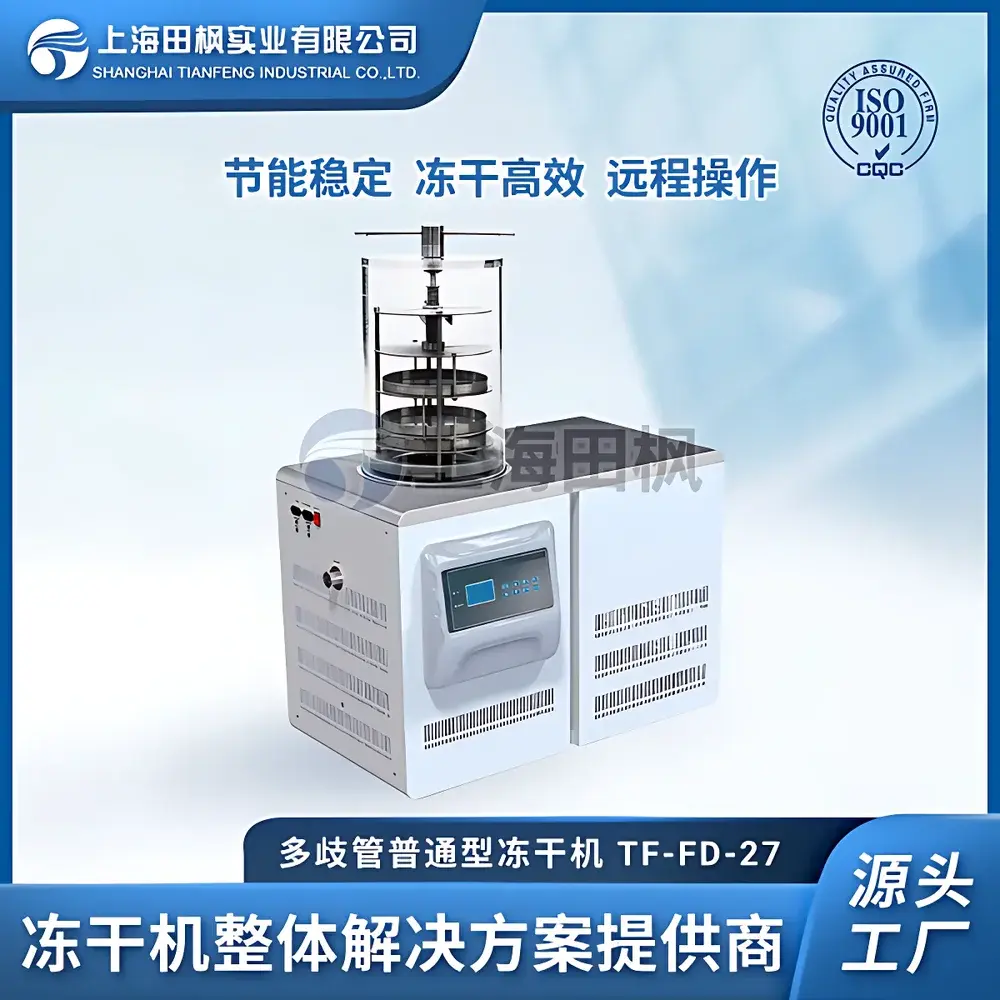
Tianfeng TF-FD-27S Pressure-Seal Benchtop Freeze Dryer
| Brand | Tianfeng |
|---|---|
| Origin | Shanghai, China |
| Manufacturer Type | Direct Manufacturer |
| Region of Origin | Domestic (China) |
| Model | TF-FD-27S Pressure-Seal CNC Heating |
| Instrument Type | Pressure-Seal Configuration |
| Application Scope | Laboratory-scale R&D and small-batch production |
| Shelf Area | 0.11 m² |
| Ultimate Vacuum | <15 Pa (at no-load) |
| Condenser Temperature | < −80 °C |
| Ice Capacity | 6 kg/24 h |
| Power Supply | 220 V, 50 Hz |
| Rated Power | 2200 W |
| Dimensions (H × W × D, excl. drying chamber) | 1200 × 550 × 870 mm |
| Sample Tray | Φ220 mm × 3 layers |
| Control System | Touchscreen LCD with real-time shelf temperature & vacuum profile logging, PID-controlled shelf heating |
| Construction | 304 stainless steel condenser and chamber interior |
| Optional Accessories | In-chamber pressure control valve (inert gas purge), co-lyophilization point tester, automated stoppering module, GLP-compliant data logger (21 CFR Part 11 compliant) |
Overview
The Tianfeng TF-FD-27S Pressure-Seal Benchtop Freeze Dryer is a laboratory-grade, in-situ pre-freezing lyophilization system engineered for reproducible, scalable freeze-drying of thermolabile biologicals, pharmaceuticals, and research samples. It operates on the fundamental principle of sublimation—removing water from frozen materials under deep vacuum while maintaining product integrity below the eutectic and collapse temperatures. Unlike conventional drying methods conducted above 0 °C—which induce denaturation, oxidation, or structural collapse—the TF-FD-27S performs primary drying at cryogenic temperatures (< −40 °C shelf setpoint) and secondary drying at controlled, low-temperature heating (< 60 °C), preserving native conformation, activity, and reconstitution fidelity. Its integrated pressure-seal mechanism enables sterile vial stoppering directly within the drying chamber post-lyophilization, eliminating post-process handling and contamination risk—a critical requirement for GMP-aligned lab-scale formulation development and clinical trial material preparation.
Key Features
- Double-stage cascade refrigeration system achieving stable condenser temperatures ≤ −80 °C—optimized for efficient capture of both aqueous and low-volatility organic solvents (e.g., acetone, ethanol, tert-butanol)
- In-situ pre-freezing capability: Samples freeze directly on heated shelves without transfer, minimizing thermal shock and ensuring uniform ice nucleation
- CNC-controlled electric shelf heating with ±1 °C uniformity across three stainless-steel shelves (Φ220 mm each), enabling programmable ramp-hold freeze-drying cycles per ICH Q5C and USP <1211>
- Real-time graphical display of shelf temperature, chamber pressure, and condenser temperature via 7-inch industrial touchscreen; data exportable as CSV for audit-ready traceability
- Full 304 stainless steel condenser and internal chamber architecture—corrosion-resistant, clean-in-place (CIP)-compatible, and compliant with ISO 14644-1 Class 5 cleanroom installation protocols
- Optically transparent acrylic drying chamber with integrated LED lighting—enables continuous visual monitoring of cake formation, collapse, and desiccation progress without vacuum break
- Integrated inert gas inlet valve (N₂ or argon compatible) for controlled backfilling and oxygen-sensitive sample protection during loading/unloading
Sample Compatibility & Compliance
The TF-FD-27S supports diverse sample formats including glass vials (10–30 mL), serum bottles, and custom trays, accommodating formulations ranging from monoclonal antibody solutions to microbial cultures and botanical extracts. Its validated shelf area of 0.11 m² supports batch sizes up to 1.2 L total volume (typical fill depth: 10 mm). The system meets key regulatory prerequisites for early-phase bioprocess development: it supports IQ/OQ documentation packages, provides timestamped event logs (including vacuum pump activation, shelf heating start/stop, pressure rise tests), and accommodates 21 CFR Part 11–compliant electronic signatures when paired with optional validated data loggers. All wetted surfaces conform to ASTM A240/A240M standards for 304 stainless steel; vacuum components comply with ISO 2859-1 sampling plans for leak integrity verification.
Software & Data Management
The embedded controller runs proprietary firmware supporting up to 20 user-defined freeze-drying protocols, each with independent ramp rates, hold durations, and pressure setpoints. Real-time curves are overlaid for comparative analysis (e.g., shelf temp vs. chamber pressure vs. condenser temp). Raw sensor data—including thermocouple readings (Type T, calibrated to NIST-traceable standards), Pirani and capacitance manometer outputs, and compressor current draw—is logged at 1-second intervals and stored internally (8 GB flash memory) with automatic rollover. Export options include USB mass storage and Ethernet TCP/IP transmission to LIMS or ELN systems. Optional software add-ons provide automated cycle deviation alerts, statistical process control (SPC) charting, and PDF report generation with digital signature fields aligned to ALCOA+ principles.
Applications
This system serves critical functions across multiple regulated domains: (1) Pre-formulation studies of protein therapeutics, where residual moisture content (target: ≤1.5% w/w) and cake morphology must be correlated with stability under accelerated storage conditions (ICH Q1A); (2) Lyophilization cycle development for Phase I/II clinical trial supplies, leveraging its precise shelf temperature control to map critical product temperatures (Tg’, Rc) via comparative DSC integration; (3) Preservation of reference standards and diagnostic reagents requiring long-term ambient stability without refrigeration; (4) Processing of heat-labile natural compounds (e.g., polyphenols, enzymes, probiotics) where enzymatic activity retention (>95% vs. fresh) is quantified via HPLC or enzymatic assay post-reconstitution; (5) Academic research in cryobiology, tissue engineering scaffold fabrication, and nanomaterial aerogel synthesis—where pore structure uniformity (measured by mercury intrusion porosimetry) depends on controlled ice crystal growth kinetics.
FAQ
What is the maximum vial loading capacity for the TF-FD-27S?
With standard Φ22 mm vials filled to 10 mL, the unit accommodates approximately 120 vials across three shelves. Loading density may vary depending on vial height and required thermal mass.
Does the system support validation documentation for GxP environments?
Yes—factory-provided IQ/OQ protocols, calibration certificates for all sensors (traceable to NIST), and blank URS templates are included. Optional PQ support services are available upon request.
Can the condenser handle solvents other than water?
The −80 °C condenser efficiently traps common lyophilization co-solvents including methanol, ethanol, and acetonitrile. For highly volatile solvents (e.g., dichloromethane), consult engineering for cold trap configuration adjustments.
Is remote monitoring supported?
Ethernet connectivity enables secure remote access via VPN for real-time status viewing and alarm notification (SMTP/SNMP), though cycle initiation remains local for safety compliance.
What maintenance intervals are recommended?
Vacuum pump oil change every 500 operational hours; condenser coil inspection quarterly; O-ring replacement annually or after 200 cycles—per manufacturer’s Maintenance Logbook (included).



